If President Donald Trump’s $5,000 “Trump Dividend” Becomes Reality, the Unintended Consequences Would Be Catastrophic
Although the stock market has endured some of its wildest volatility in history under President Donald Trump, it’s also delivered jaw-dropping returns. The timeless Dow Jones Industrial Average (^DJI +0.83%), benchmark S&P 500 (^GSPC +0.59%), and tech-inspired Nasdaq Composite (^IXIC +0.64%) gained 57%, 70%, and 142% during Trump’s first, non-consecutive term, and they’ve delivered something of an encore performance since January 2025.
But the fate of Wall Street’s artificial intelligence (AI)-driven bull market may rest on the upcoming midterm elections. While not every bill crafted on Capitol Hill affects the stock market or U.S. economy, our elected officials in Congress are ultimately responsible for the fiscal policy that impacts consumers and businesses.

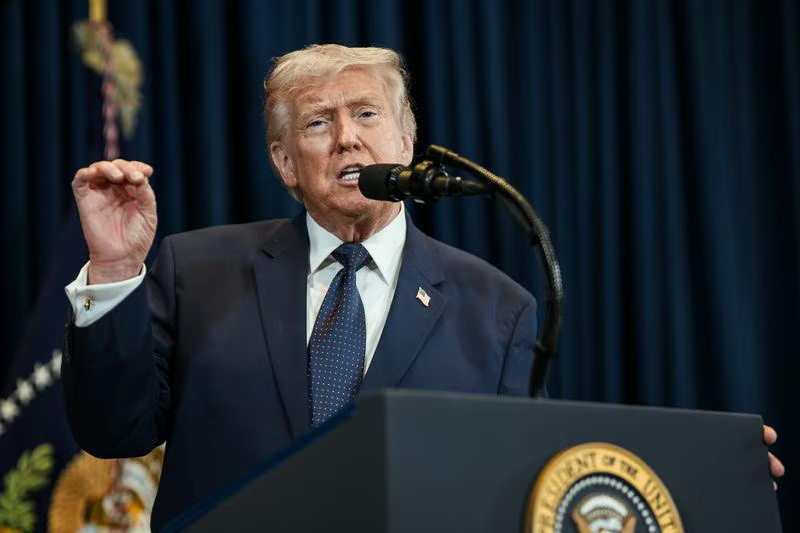
Image source: Official White House Photo by Daniel Torok.
President Trump doubles down on his $5,000 “Trump Dividend” pledge
Ahead of the Nov. 3 midterms, President Trump has doubled down on his pledge to give every adult U.S. citizen $5,000 if Republicans sweep both houses of Congress. Currently, Republicans hold a slim majority in the Senate (53 of 100 seats) and the House of Representatives (218 of 435 seats).
If the GOP can retain both houses, it’ll be considerably easier for President Trump and his party to pass major legislation.
During the president’s first term, a unified government enabled the passage of the Tax Cuts and Jobs Act (TCJA), which permanently lowered the peak marginal corporate income tax rate from 35% to 21%. The TCJA has spurred record S&P 500 share buybacks and has been instrumental in the stock market’s outperformance.
If Republicans win the House of Representatives and the Senate in the 2026 Midterm Elections, I’m going to give all adult citizens in the United States of America, $5,000! Thank you for your attention to this matter, and I look forward to signing those checks! pic.twitter.com/YOkESiUBrc
— Donald J. Trump (@realDonaldTrump) October 3, 2026
Once again, President Trump has enjoyed a unified government during the first two years of his second term. In July 2025, he signed the “Big, Beautiful Bill” into law, permanently reducing personal income tax bracket rates and introducing a bevy of temporary tax breaks.
But if (very, very big “if”) this “Trump Dividend” becomes reality, there’s a very high probability that the unintended consequences would be catastrophic for the economy and stock market.
The president’s Trump Dividend would light a fire under the prevailing inflation rate
Before digging any further, let’s make clear that there’s a laundry list of things we don’t yet know about the president’s proposed $5,000 payout. In no particular order, we’re not sure:
- If it’s legal
- If Congress would pass the measure
- Where the money would come from (tariff revenue doesn’t come close to covering the more than $1.2 trillion dollar estimated payout)
But if the Trump Dividend does occur, it’ll almost certainly light a fire under an already persistently elevated inflation rate.
BREAKING: August CPI inflation comes in at 3.4%, in-line with expectations of 3.4%
Core CPI inflation falls to 2.4%, also in-line with expectations of 2.4%.
Month-over-month CPI inflation rose +0.4%, the biggest increase since May 2026.
Treasury yields are rising on the news.
— The Kobeissi Letter (@KobeissiLetter) September 11, 2026
On the one hand, it’s easy to understand the lure of putting cash into the hands of consumers. More than likely, this cash will be spent, spurring economic growth, or put to work in the stock market, fueling gains for the Dow Jones Industrial Average, S&P 500, and Nasdaq Composite.
After the start of the COVID-19 pandemic and multi-week lockdowns in several states, the federal government issued several rounds of fiscal stimulus checks to qualified individuals. This cash led to a quick rebound for the U.S. economy and sent Wall Street’s major stock indexes screaming higher.
On the other hand, historical precedent shows that these rounds of fiscal stimulus contributed to a surge in inflation. By June 2022, the rapid increase in U.S. money supply had pushed the annualized inflation rate to a four-decade high of 9.1%. Putting cash into consumers’ hands via stimulus leads to higher prices.
Mind you, a potential surge in inflation caused by the Trump Dividend would come at a time when Trumpflation (inflation specifically driven by Trump’s policies) is already driving up consumer prices. While the president’s tariffs are modestly boosting prices, it’s the impact of the Trump-led Iran war and the ongoing closure of the Strait of Hormuz that lifted annualized inflation to a three-year high of 4.2% in May.
If Trump’s $5,000 payout becomes reality, inflation would almost certainly soar.

Image source: Getty Images.
Long-duration Treasury bond yields would rocket higher, too
However, the expectation of skyrocketing inflation wouldn’t be the only unintended consequence of the proposed Trump Dividend. We’d likely also witness long-duration Treasury bond yields skyrocket.
This year, rising long-duration yields are nothing new. The 10-year Treasury bond, which has long served as the benchmark for mortgage rates, climbed above 5.3%, while the 30-year yield briefly topped 5.6%. Both mark 24-year highs.
Elevated inflation is one reason we’ve watched bond yields surge. Bond traders are demanding higher yields to ensure their returns aren’t gobbled up by persistently elevated inflation.
But it’s not just rising consumer prices driving up long-duration bond yields. The bond market is also clearly concerned about America’s rapidly rising total debt. In mid-August, total debt surpassed $40 trillion and has shown no signs of slowing.
BREAKING: President Trump says higher US inflation will “pay off” US debt “very rapidly” in response to total US debt rising above $40 trillion.
“I know I’m the best in the world… you can pay off the debt through other means. But the one thing that you can do is pay it off… pic.twitter.com/zkIA4qwQz0
— The Kobeissi Letter (@KobeissiLetter) October 2, 2026
Since 2020, federal deficits have tallied between $1.38 trillion and $3.13 trillion annually. Ongoing annual deficits of this magnitude aren’t sustainable over the long term. Even though the U.S. hasn’t defaulted on any of its interest payments or maturities, the bond market is not-so-subtly signaling through rapidly rising yields that this problem can no longer be swept under the rug.
If the $5,000 Trump Dividend is paid out, it would add more than $1.2 trillion to U.S. total debt. While the president has claimed that tariff revenue would cover this payout, the federal government collected only $264 billion in net tariff revenue in calendar year 2025.
President Trump pushing the U.S. deeper into debt wouldn’t sit well with bond traders, leading to substantially higher long-duration yields. This would mean higher mortgage rates, crushing the housing market, and unfavorable borrowing costs for businesses. The latter could be catastrophic for a historically expensive stock market that’s been powered by the partially debt-financed AI infrastructure build-out.
Hypothetically, if the Trump Dividend were to become reality, it would do far more harm than good for the U.S. economy and stock market.