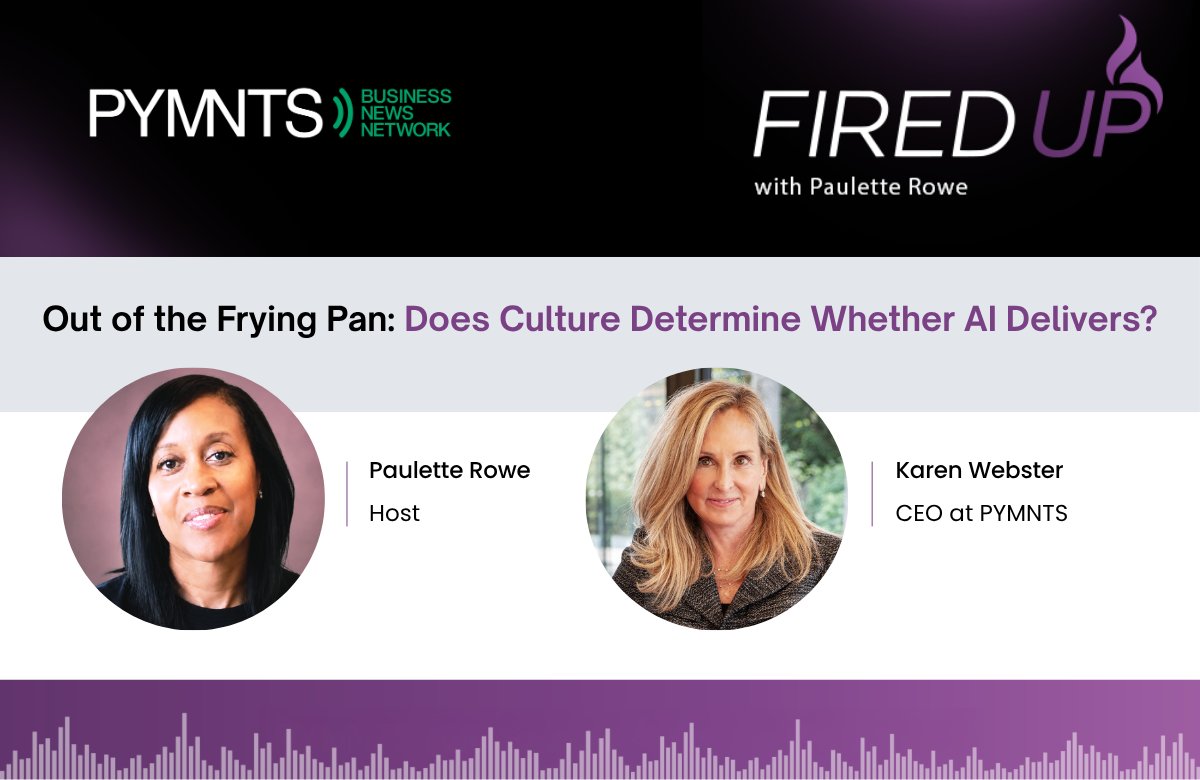
PYMNTS Launches BNN With Paulette Rowe’s ‘Fired Up’ Podcast
Artificial intelligence can compress work that once took days into minutes, but companies still must decide what their people should do with the time they get back.
That management challenge framed the inaugural episode of “Fired Up” with payments veteran Paulette Rowe. “Fired Up” is a new PYMNTS Business News Network podcast series examining culture, leadership and performance as AI changes how work gets done. The first episode featured PYMNTS CEO Karen Webster.
Rowe said she has encountered executives who treated investment in people and culture as “a nice-to-have, or even worse, an overhead.” Her definition of culture went beyond benefits, all-hands meetings and office perks. She described it in operational terms, like where power sat, how relationships worked and what companies deliberately did to align the organization.
AI complicates that work because employees don’t need to wait for their employers to introduce the technology.
Webster offered her own research process as an example. Before generative AI, finding information for an article could require a researcher to locate the material and assemble a sourced PowerPoint, she said. The assignment could take enough time to consume a weekend. AI shortened the search for a starting point. Webster could then have people check the facts and sources rather than spend their time assembling the initial body of research.
“You have to think of the output as clay,” Webster said, with additional verification in the mix.
Moving Faster Without Losing Control
Management can’t concentrate exclusively on reinventing the company around AI, Webster said. Executives still have businesses to operate and commitments to meet.
“You obviously have to keep your eye on what you’re committed to as part of the core business,” Webster said. “At the same time, you’re looking at how you reinvent it.”
Webster used Formula 1 to describe the required combination of speed and control. Companies must become comfortable operating faster because competitors aren’t simply improving the same processes, she said.
Waiting for greater certainty therefore carries a competitive cost.
“Time is a currency,” Webster said.

We’d love to be your preferred source for news.
Please add us to your preferred sources list so our news, data and interviews show up in your feed. Thanks!
Experimentation and pilots supply information that companies can’t obtain by waiting for the technology to mature somewhere else.
Webster’s “hair salon test” offered a less formal measure of how far AI has already traveled.
She recalled sitting in a salon around Christmas 2015 and hearing customers discuss Alexa and the speakers they wanted for their countertops. Years later, conversations in the same setting turned to where people searched for information about products they wanted to buy.
“And it’s chat,” Webster said, with a nod to what has changed.
In the corporate realm, AI adoption therefore isn’t occurring solely through centrally planned technology projects. Because of their everyday use of AI outside of the office, employees have already developed their own experience with the tools.
Rowe later raised an argument that readily available AI could make knowledge effectively abundant and drive its value toward zero.
Webster contended that anyone could ask a model to produce a brief on open banking. Expertise becomes apparent in whether the user supplies context, probes the model and ultimately tests an observation while recognizing information worth pursuing.
Webster identified a challenge Rowe said she planned to pursue with future guests. Can companies create enough trust for employees to experiment with powerful tools without treating experimentation as permission to abandon controls?
Future episodes will put the premise to operators dealing with AI and organizational change inside their own businesses, with Rowe examining how different leaders approach trust, experimentation, performance and the changing nature of work.
Watch the full interview to learn more about:
- Why Webster said she expects AI to alter business models around payments, data and intelligence.
- How consumers’ use of AI for product discovery could affect merchants even before agentic purchasing becomes commonplace.
- Why Webster said AI output should be treated as “clay” rather than finished work.
For all PYMNTS AI coverage, subscribe to the daily AI Newsletter.