ExxonMobil Just Made Its 20th Discovery in a Block That’s Produced 2.7 Billion Barrels. Here’s What It Means for XOM Stock.
ExxonMobil (XOM +2.22%) and Angola’s National Oil, Gas and Biofuels Agency (ANPG) announced a new oil discovery off Angola’s coast in a field that has already produced a massive 2.7 billion barrels of oil since the first oil discovery there in 1998.
Exxon’s shares closed 2.2% higher following the news. For shareholders, the attractiveness lies in the additional optionality this discovery brings to a mature, deepwater cash-flow platform.
The question investors need to consider is this: can ExxonMobil turn the remaining resources here into a high-return set of barrels that can sufficiently offset declines in existing fields?

Image source: Getty Images.
Block 15: The crown jewel
ExxonMobil holds a 36% interest and is the operator of the oilfield known as Block 15, which covers around 1,044 square kilometers (258,000 acres) off the Angolan coast. The previous 19 discoveries in this acreage have already produced 2.7 billion of the approximately 3 billion barrels of recoverable resources. The latest and 20th discovery at the Vicango Este-01 exploration well should increase the total recoverable oil.
As the operator of this block, Exxon has control over capital allocation, project timing, and operating decisions. In addition to Block 15, ExxonMobil holds 19% and 15% interests in nearby Blocks 17 and 32, respectively, which are operated by the French energy giant TotalEnergies SE (TTE +1.71%).
All three blocks hold a cumulative 9 billion barrels of recoverable oil resources, with ExxonMobil having interests in approximately 2.2 billion barrels. However, interests alone don’t determine revenue or cash flow generation.
The biggest advantage of the discovery is that all three blocks are proven resources and relatively well developed, meaning Exxon can avoid significant upfront development costs, shorten development timelines, and hence improve returns on incremental projects.

Today’s Change
(2.22%) $3.57
Current Price
$164.23
Key Data Points
Market Cap
Day’s Range
$162.55 – $165.18
52wk Range
$110.39 – $176.41
Volume
13.1M
Avg Vol
15.5M
Gross Margin
20.88%
Dividend Yield
2.51%
Production matters more than acreage
In today’s $100-per-barrel oil environment, the latest discovery is significant since Angola is primarily an oil story. At $100 a barrel, the economics of oil extraction are significantly different from $50-60 a barrel. According to Angola’s state-owned oil company, Sonangol, production costs for the country’s marginal offshore oil fields are in the range of $20 to $25 a barrel.
For investors who are bullish on long-term oil demand, this is obviously attractive.
While Angola’s production base is small relative to ExxonMobil’s global production portfolio, investors need to closely monitor how management executes projects. New projects that have yet to incur initial development costs may eventually produce oil at low cost, but the real advantage comes from mature projects that are already producing oil cheaply.
So the caveat is that a “recoverable resource potential” isn’t the same as actual production or free cash flow generation.
The key question is whether Exxon can bring new oil production online quickly enough to offset the decline in its older projects, either by expanding existing fields or by developing new ones. For example, Block 15, of which ExxonMobil is the operator, has already exhauseted 90% of the total recoverable resource.
The bet is on higher returns
Investors, therefore, need to consider whether the latest discovery can replace the oil Block 15 is losing quickly enough to sustain production for years to come. For context, the company has extended its license to produce in Block 15 through 2037.
Investing in ExxonMobil stock is essentially a bet on the company’s ability to generate attractive returns across the commodity cycle while maintaining significant profit margins when global crude oil prices rise.
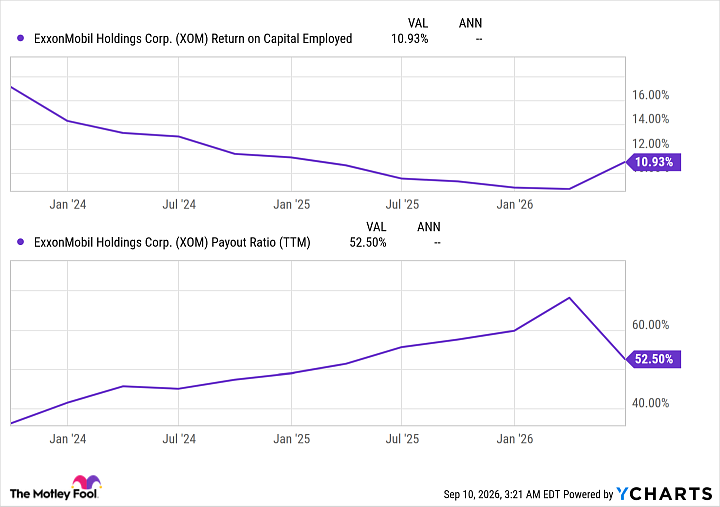
XOM Return on Capital Employed data by YCharts.
The last three years saw declining returns on capital employed (ROCE), though the higher oil prices have ensured double-digit returns this year. Consequently, dividends were gradually taking a larger share of earnings, but that too has fallen, implying greater flexibility for management to deploy capital in lucrative projects.
Ultimately, the new discovery needs to be evaluated against management’s long-term strategy, which targets a 17% ROCE, as outlined during a corporate update last December.
The latest project should easily achieve the stated return.