
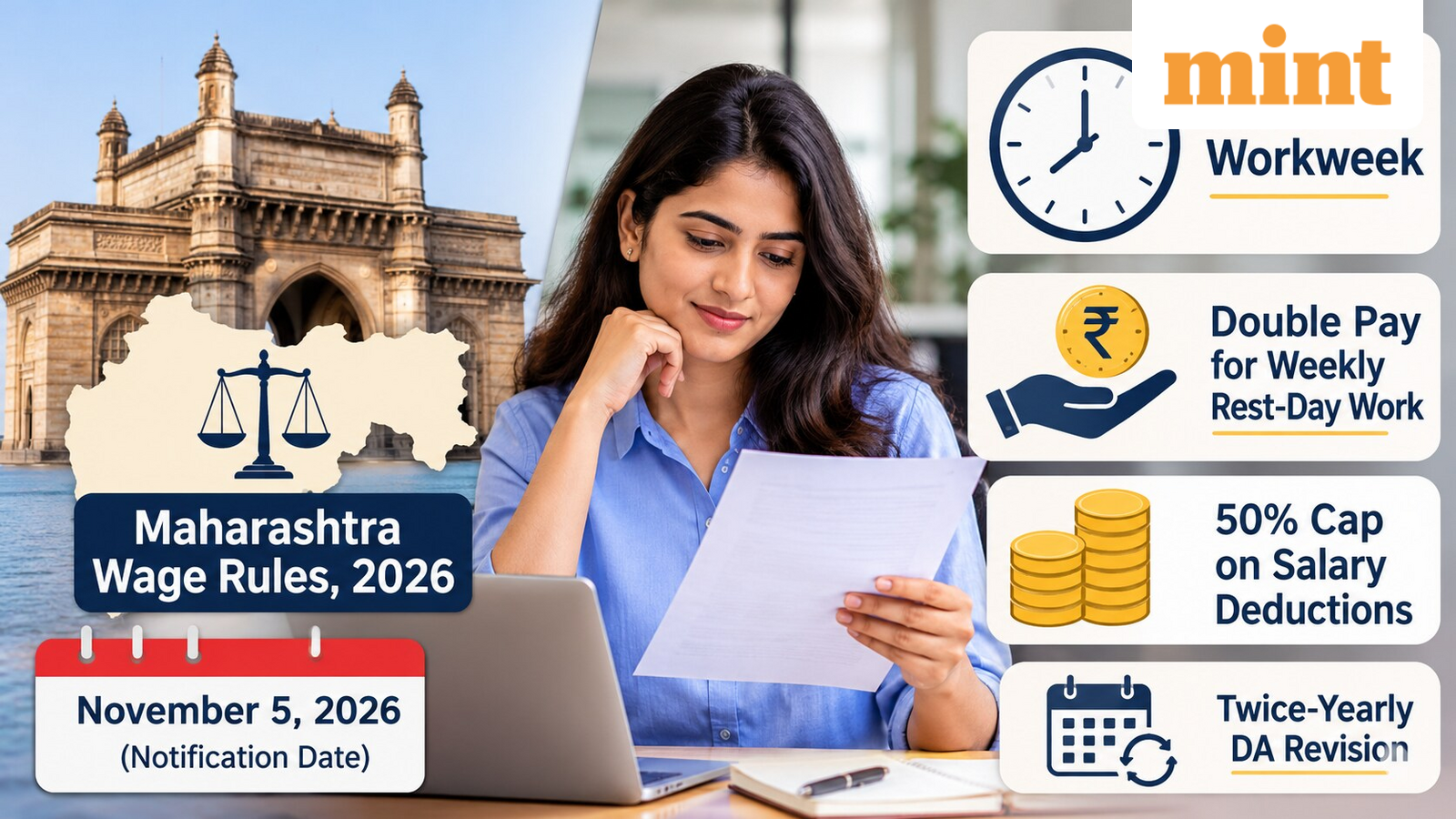
Employees working in Maharashtra will have a defined framework for working hours, weekly rest, overtime payments, and wage deductions under the Maharashtra Wage Rules, 2026.
The state’s Labour Department notified the rules on 5 November 2026. The rules came into force on the same day, upon publication in the Official Gazette.
For salaried employees, the provisions are relevant to working schedules and take-home pay. They prescribe a maximum 48-hour working week for employees whose wage period is not calculated daily, provide for additional payment when employees work on weekly rest days under specified conditions, and cap permissible wage deductions.
The rules extend across Maharashtra and replace the state’s Minimum Wages Rules, 1963, and Payment of Wages Rules, 1963.
Who do the new Maharashtra wage rules cover?
The notification states that the rules extend to the entire state of Maharashtra. It refers to employees across different wage-period arrangements.
However, there is an important distinction for government employees. Rule 3 expressly states that the state government will not fix minimum wage rates for Maharashtra government employees under this Code.
This exclusion relates to minimum-wage fixation; the notification does not establish a blanket exemption for every other provision for all government employees.
What is the new weekly working-hour limit?
Under Rule 5, an employee whose wage period is calculated daily will have a normal working day of eight hours. For employees paid on a basis other than daily wages, the total weekly working hours cannot exceed 48.
The rule states, “the total number of weekly working hours shall not exceed forty-eight hours.”
Employees must also receive at least one rest day every week. Sunday will ordinarily be the rest day for a six-day working week, although employers can designate another day.
If an employee works on the weekly rest day, the employer must provide a substitute full-day rest, subject to the prescribed conditions. An employee cannot be made to work for more than 10 consecutive days without a full-day rest.
When will employees get double pay?
The double-payment provision is not an automatic entitlement for every instance of overtime.
Under Rule 6, an employee working on a weekly rest day must receive overtime-rate wages and a substitute rest day. In specified cases involving a six-day working week and the prescribed monthly-to-daily wage calculation, the payment for working on the rest day must not be less than twice the normal wage rate.
The notification states that such an employee “shall be paid, only for the rest day on which he worked, an amount equal to the wages payable to him at the overtime rate, which shall not be less than twice the normal rate of wages.”
Is there any cap on salary deductions?
Yes. Under Rule 11, the total deductions an employer makes from an employee’s wages cannot exceed 50% of the wages payable during a wage period. If the deductions exceed this limit, the remaining amount cannot be deducted immediately.
It must be carried forward and recovered in subsequent wage periods, subject to the same 50% limit in each period.
How often will dearness allowance be revised?
Variable dearness allowance for employees receiving minimum wages will be revised twice a year, before 1 April and 1 October, based on the average Consumer Price Index for Industrial Workers published by the Labour Bureau.
Disclaimer: This is for informational purposes only. The applicability of wage rules and benefits may vary.