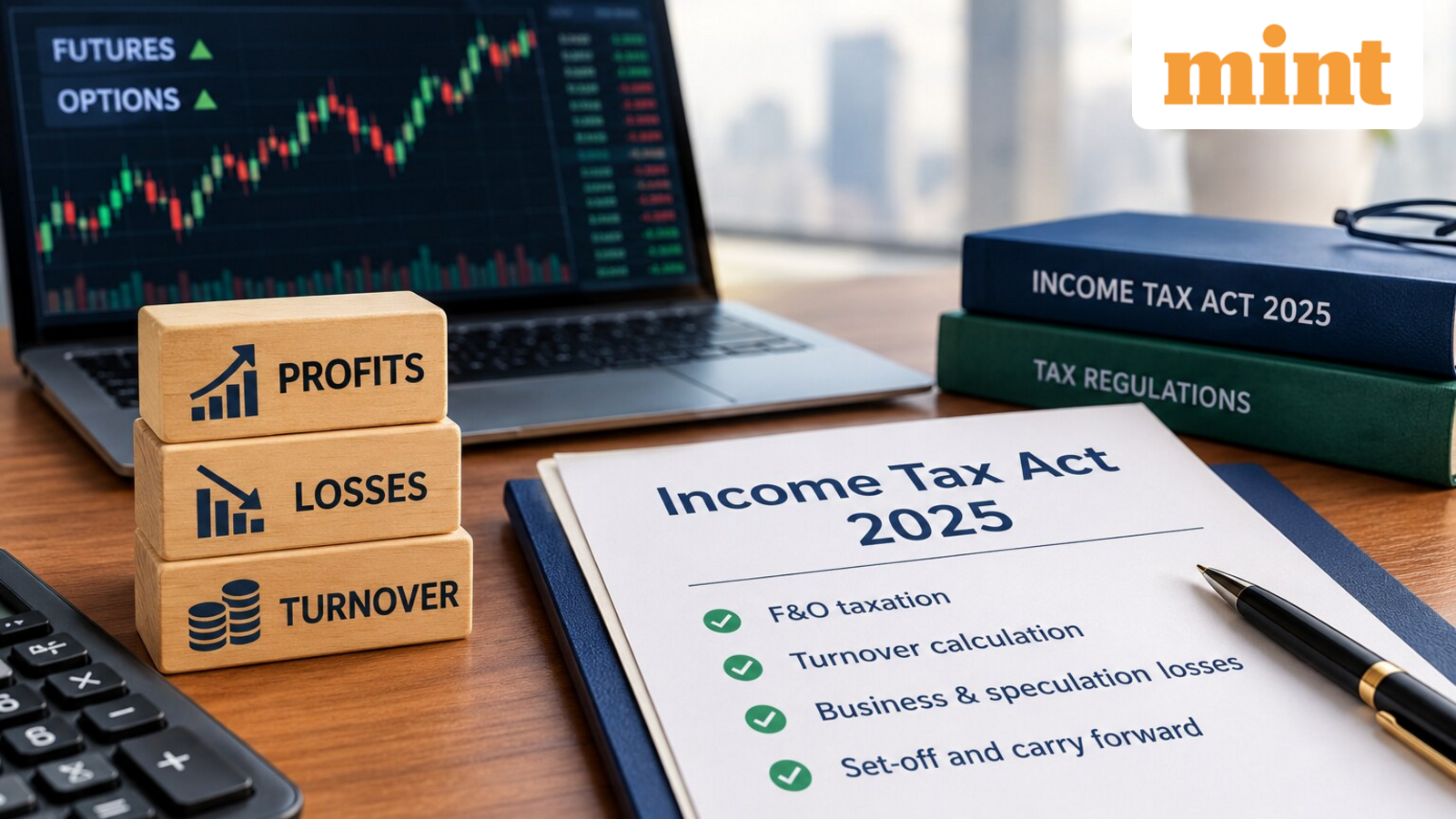
Income Tax Act 2025: Tax expert explains F&O rules and how to correctly set off and carry forward losses
The Income-tax Act, 2025, came into force on 1 April 2026, bringing new section numbers for several familiar tax provisions. With this development, the decades-old Income Tax Act, 1961, has been successfully phased out.
For futures and options (F&O) traders, however, the broad tax treatment continues to remain largely unchanged. All eligible exchange-traded derivative transactions continue to be treated as non-speculative business transactions, rather than capital gains or speculative transactions.
Says Nishant Shanker, Tax Controversy & Dispute Resolution, Navraj Global Advisors, “F&O transactions are not treated as speculative transactions and are generally taxable under Profits and Gains of Business or Profession.”
As per sections 66(31) and 66(33) of the new Act, a specified derivative transaction is excluded from the definition of a ‘speculative transaction’, subject to the prescribed conditions. Hence, eligible F&O profits are generally taxed as business income at applicable rates.
The eventual taxable figure is the ‘net business profit’ after separating expenses incurred wholly and exclusively for trading. This includes expenses such as brokerage, exchange charges, internet expenses, and professional fees. This is not taxed under special rates applicable to capital gains.
F&O losses: Set-off and carry-forward rules
Having clarity on the distinction between business and speculation losses is essential. Section 112 of the Income Tax Act, 2025, provides that a non-speculative business loss that cannot be fully set off can generally be carried forward for up to eight years and then subsequently adjusted against business or professional income.
On this, Shanker explains, “A non-speculative business loss can generally be set off against eligible business/professional income and carried forward for up to eight years. Speculation losses are restricted to speculation profits and carry forward for four tax years.”
For the current financial year, eligible business losses can generally be set off against income under other heads, subject to restrictions as provided under Section 109. Such income cannot be set off against ‘salary income’.
A loss that is carried forward under Section 112 can eventually be set off against business or professional income. Speculation-driven losses, by contrast, are governed by Section 113 and can be set off only against speculation-driven profits, with a 4-year carry-forward period.
To explain the implications further, Shanker added an important qualification: “For F&O, the key issue is whether the transaction qualifies as a specified derivative transaction. If it does, it is outside the normal speculation-loss restriction. The Act’s provisions on speculation losses specifically restrict such losses to profits from the speculation business.”
A trader is also mandated to file the loss return within the prescribed due date in order to preserve the carry-forward benefit. Section 121 elucidates this requirement under the new Act. Having clarity on these tax aspects is a must for taxpayers to ensure meaningful compliance with tax authorities.
How F&O turnover is calculated
It is important to note that turnover is different from taxable profit. It is vital for tax audit and compliance purposes. The calculation follows the defined tax-audit methodology.
“For tax and audit purposes, F&O turnover is determined using the prescribed methodology, principally considering the aggregate of favourable and unfavourable differences, with relevant treatment of option premiums,” Shanker said.
On a broad level, the calculation takes into account the absolute value of favourable and unfavourable differences from derivative transactions. The premiums received on the sale of options are also given due consideration, although they should not be counted twice if it has already been included while calculating the trading profit or loss.
Now, any open derivatives positions at the end of the financial year require separate treatment, with the relevant turnover generally recognised when the contracts are eventually settled or squared off. Further, when a derivatives transaction results in delivery, the applicable differences between the trade and settlement prices, along with the relevant sale value of the stock-in-trade where applicable, also need due consideration.
For all F&O traders, the key, hence, is that they should not only focus on calculating the final profit or loss. They should understand the applicable legal provisions in their respective cases. In case of doubts, for complete clarity, it is wise to seek guidance from a certified tax planner and financial advisor.
It is vital to correctly determine whether the transaction is a specified derivative, calculate turnover under the prescribed methodology, post the same, claim eligible expenses, and report losses within the prescribed deadline; all of these are fundamental to ensuring meaningful tax compliance.
Disclaimer: This article is for informational purposes only and should not be considered tax or legal advice. Taxpayers should verify the applicable provisions and consult a qualified tax professional before filing.