What gets Edward Jones to open its wallet for wealthtech?
- Key insight: Edward Jones has particular ideas about how wealthtech brings value to the firm that go well beyond portfolio and time management.
- Supporting data: Every year, Edward Jones’ Ventures team hears pitches from roughly 2,000 startups wanting to provide its clients with a financial service. Only five to 10 make the cut.
Every year, Edward Jones Ventures head Greg Robinson and his team meet with around 2,000 company founders eagerly pitching a wealthtech service or application ostensibly of use to advisors and their clients.
Processing Content
It’s his and his team’s job to discern which offerings go beyond what Edward Jones’ more than 20,000 advisors already provide.
The strategy points to a growing need in wealth management: Firms are increasingly looking to technology not just to make advisors more efficient, but to increase their roles in clients’ lives, strengthen relationships and ultimately attract more assets.
In the end, only five to 10 of the firms pitching in any given year move on to become a “portfolio company” that receives either a minority investment from Edward Jones or a contractual relationship.

To get there, entrepreneurs have to demonstrate how their latest bright ideas can bolster the firm’s business — often by giving them insights into clients’ finances in a way that
“You know, the business results and all of that can come after, but if they’re not aligned with, ‘Hey, we are going help a client, or this is improving a client’s financial life, or this is improving a practice team’s lives and then improves a client’s life,’ then we are really uninterested,” Robinson said.
READ MORE:
Edward Jones advisors get pitched at annual Innovation Summit
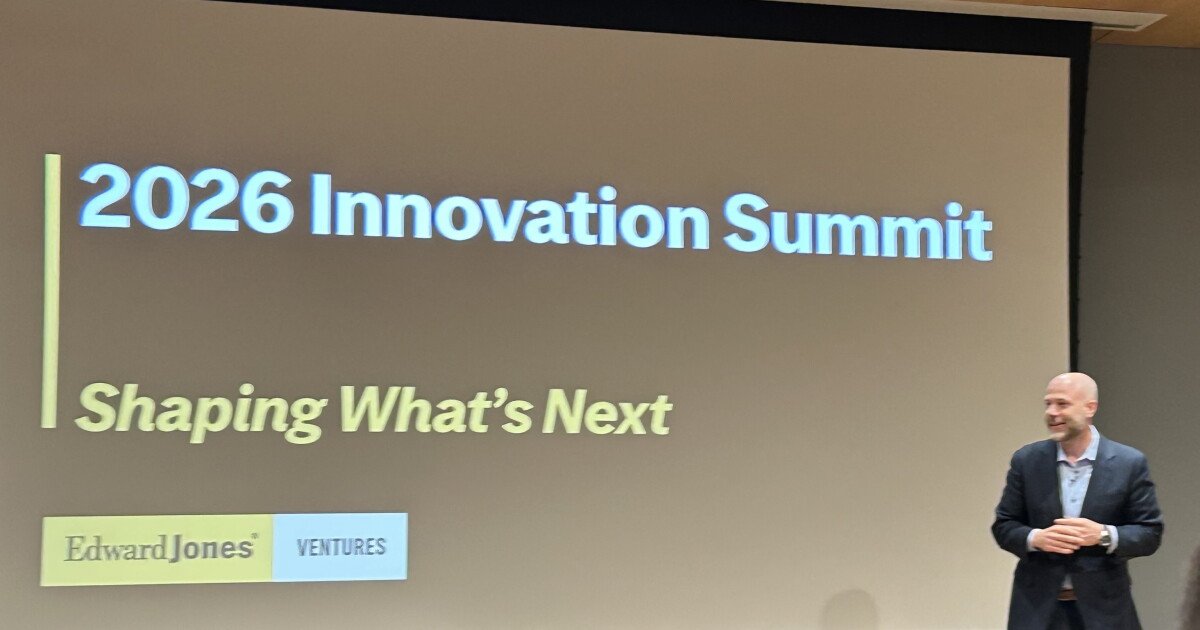
One of the biggest opportunities founders get to pitch Edward Jones on their bright ideas has become an annual event for the firm with roughly $2.6 trillion in client assets in the U.S and Canada. This year, scores of Edward Jones advisors and employees attended the firm’s second annual Innovation Summit in its hometown of St. Louis to hear from entrepreneurs offering advisors software and other technology for everything from
Robinson said Edward Jones Ventures has enlisted the services of roughly 20 outside portfolio companies since its founding three years ago as a division dedicated to finding how the latest advances offered by tech startups can be put to use in wealth management. The new partners run the gamut from Worthy, a firm that specializes in tax analysis, to Alix, a service that helps clients settle their estates.
“There’s an old saying that irrespective of how good your firm is and however we feel about Edward Jones, just math will tell you there are more smart people who work elsewhere,” Edward Jones Chief Strategy Officer Hasan Malik said in opening remarks Monday.
READ MORE:
How protecting data can bring in new clients and assets
That same introductory session provided an example of how outside startups can help Edward Jones find answers to two seemingly unrelated questions: How can advisors keep clients’ assets safe with fraud and scams on the rise? And how can they retain management of wealth clients pass down to heirs?
As a result of a partnership announced in June, Edward Jones clients can now sign up free for
Meilii Gensler, managing director for Edward Jones’ U.S. business segment, said Edward Jones advisors whose clients sign up for Carefull see twice the rate of inflows of net new assets than those whose don’t. She said such business results are not “a primary drive of why we are doing this.”
But entrepreneurs pitching Edward Jones should keep in mind the firm’s business interests, “because at the end of the day, we need this to make financial sense,” she said.
Gensler said Edward Jones works with roughly $6 billion in assets deemed susceptible to fraud, much of it held by elderly clients. One of Carefull’s features allows clients to designate certain relatives and friends “trusted contacts” whom advisors can reach out to when they see signs of untoward activity.
Advisors who come to the rescue of clients at risk of being scammed are often in a position to gain the confidence of these contacts. Sometimes they’ll even be enlisted as their financial advisors.
Todd Rovak, the CEO and co-founder of Carefull, said his firm had a particularly strong opportunity to demonstrate its usefulness following the recent deaths of two Edward Jones clients. Relatives who had been listed as trusted contacts were able to reach out to the firm to retrieve information like passwords needed for paying bills, contracts for gardeners and other service providers, and records showing how much the deceased would give, say, to charity.
Rovak noted studies indicating widows are likely to drop their husbands’ financial advisors — although recent research suggests such firings
Edward Jones cant help prevent those losses by providing what he likes to call a “hero moment.”
“Jones may be better than average, but that’s still the moment when we want to retain those assets, and we do that by being there for just doing the right thing and creating value,” Rovak said.
READ MORE:
How a startup idea gets adopted by Edward Jones, modified by advisors
Robinson said most of the startup firms enlisted by the Ventures team receive minority investments from Edward Jones. Some, like Carefull, are brought on as contractual partners with the possibility of selling an ownership stake to Edward Jones at a later date.
Robinson said he and his team have yet to see a startup firm brought in by the Ventures team fail to live up to its promise. But he acknowledged it’s still early days.
“Maybe in a few years, we’ll see the typical thing for young startups,” Robinson said. “Not all of them make it, right?”
After Edward Jones Ventures chooses which startups’ pitches are worthy of more attention and puts them through initial testing, it often relies on what it calls “champions” to be the first to try out the new tech with actual clients. One of the first to consistently raise his hand for this role is Josh Wynne, a financial advisor in Dunkirk, Maryland, who’s been at Edward Jones for 12 years.

Dan Shaw
Wynne said most of the tech applications from startups that come to him have already demonstrated that they can augment Edward Jones’ service offerings in some way. His job is often then to put them within reach of actual clients and then, after observing the results, suggest improvements.
“In some ways, it’s co-creation,” Wynne said. “They say, ‘This is what we’ve done.’ And then I say, ‘If they edited it this way, our field would love it.'”
READ MORE:
What advisors at Edward Jones need next
Wynne said many of his clients come from in and around Washington, D.C., and have jobs in government or as lobbyists or business owners. That tends to make services like the tax analysis offered by Edward Jones’ partner firm Worthy particularly useful.
Wynne said he uses Worthy to help answer questions related to capital gains taxes, estate taxes and Roth IRA conversions. He often finds himself feeding complicated tax documents into Worthy to receive a list of actions clients could take to decrease the amounts they owe to the IRS.
Wynne said he came to trust the results in part by giving Worthy his own financial statements at first and then vetting the recommendations for both accuracy and completeness.
“Who has a 160-page tax document that they love reading?” Wynne said. “No one. This reads it and tells us this is what you could do better.”
Wynne said advisors will find various portfolio companies enlisted through Edward Jones Ventures more or less useful depending on the types of clients they serve. He, for instance, sees little need for Grantd, a firm that helps companies compensate employees using their own equity. Edward Jones advisors in California, home to a large number of all U.S. startups, are likely a different story, Wynne said.
If he had to name one crying need that an outside entrepreneur could provide to Edward Jones, he said, it would be for some sort of overlaying system that could tie all of the current Venture offerings together. Wynne said advisors still must have clients log in to some of the current services on their own, rather than being able to direct them through a central portal.
“What’s missing is how do we make clients feel like they’re not going to eight different silos,” Wynne said.
Robinson said there is also a need for services that will help clients with complicated healthcare decisions, plan for their children’s education and go beyond making successful investments by generally defining what they might consider “financial fulfillment.” For any entrepreneur who may consider approaching Edward Jones with a pitch, Robinson said he’s less interested in hearing about their businesses and how they make money and more about what drove them to become an entrepreneur in the first place.
Then he has a simple question.
“Is the client central?” Robinson said. “That’s what we do in wealth management, right? We help families of all sizes, all shapes. And I think the firms that are going to win in wealth are going to be the ones that prioritize and and and figure out how to best serve those families.”