
Is Amazon Stock a Buy as Cloud Revenue Continues to Surge?
Amazon (AMZN +3.25%) turned in another strong quarter when it reported its third-quarter results after the bell on Oct. 29. However, the stock’s struggle to gain momentum continued, as it has largely run in place this year. Despite continued strong revenue and earnings growth, Amazon stock is up only modestly in 2026 and has risen only around 45% over the past five years in a strong bull market.
While Amazon has been a market laggard in recent years, I think now could be a great time to buy the stock. Let’s take a closer look at its Q3 results and prospects to see why.

Image source: The Motley Fool.
The path to $1 trillion in AWS revenue
Amazon’s cloud computing unit, AWS, once again led the way for the company in Q3. AWS revenue soared more than 39% to $46 billion, topping the $45.3 billion consensus, as compiled by StreetAccount. It was its fastest growth in nearly five years, an acceleration from last quarter’s 37% growth.
AMZN Amazon
$248.17+$7.82 (+3.25%)
NASDAQ · As of 3:19 PM ET 11/02/26
The company highlighted the strength of the Bedrock inference service, noting that Fortune 500 companies are spending nearly seven times as much on Bedrock as last year. Meanwhile, token volumes have increased nearly 17-fold. It noted that it recently added OpenAI models to Bedrock, and that usage has grown rapidly.
Amazon said its chip business more than doubled in the quarter. Revenue commitments for both Graviton (its custom ARM Holdings-based CPU) and Trainium (its AI accelerator), meanwhile, have increased more than 20-fold year over year. Given high demand, Amazon will also start selling Trainium chips outside of AWS starting in late 2027.
Operating income in the segment, meanwhile, jumped 56% to $17.8 billion. Investments in custom chips and networking helped it achieve a strong 38.7% operating margin in the quarter
Amazon’s e-commerce operation, meanwhile, continues to perform well. Its North American sales rose by 6% year over year to $112.9 billion, while international sales rose 5%, or 8% in constant currencies, to $43.1 billion. The solid growth came despite a shift in Prime Day from Q3 last year into Q2 this year. It said excluding this shift, e-commerce growth would have been 4% higher.
On the negative side, the company saw a major slowdown in advertising revenue growth. Ad revenue grew 12% in the quarter to $19.6 billion. That was a big deceleration from the 26% growth it saw in Q2. However, management said the shift in Prime Day had an 8.5% sequential impact.
In my view, the most impressive thing during the quarter was the operating leverage Amazon saw in its North American e-commerce operations. Operating income surged more than 80% to $8.7 billion. Its international segment saw operating income jump 33% to $1.6 billion.
Overall, Amazon’s revenue climbed 12% year over year to $201.9 billion, which just missed the $202.25 billion analyst consensus, as compiled by Bloomberg. Earnings per share (EPS) fell to $1.89, missing the $1.97 consensus, due to a big gain last year on its Anthropic investment.
Capital expenditure and free cash flow have been big topics with hyperscalers. On that front, Amazon saw its trailing 12-month free cash flow come in at a negative $42.4 billion, as it spent a whopping $75.9 billion in capex in Q3. Amazon is still planning $220 billion in capex this year and plans to significantly increase that amount in 2027. Given its investments, it believes AWS revenue will grow 40% in each of 2027 and 2028 and that AWS could become a $1 trillion business in five to 10 years.
Looking ahead, Amazon projected that its third-quarter revenue would climb to between $240 billion and $247 billion (representing growth of between 12.5% and 16%).
Time to buy the stock?
While investors have been skittish about artificial intelligence (AI) infrastructure spending, there should be little doubt that the big cloud computing companies like Amazon are getting strong returns on their investments, which is showing up not just in revenue growth but also in other segments’ operating margins. While margins could fluctuate, especially as investments and depreciation surge before revenue hits, given its ROIC (return on invested capital), aggressively scaling this business looks like the right move.
At the same time, the operating leverage the company is seeing in its e-commerce business from its investments in robotics and AI is just such an underappreciated part of the Amazon story. This is driving huge profits and is another reason why Amazon is a great stock to buy on its recent weakness.
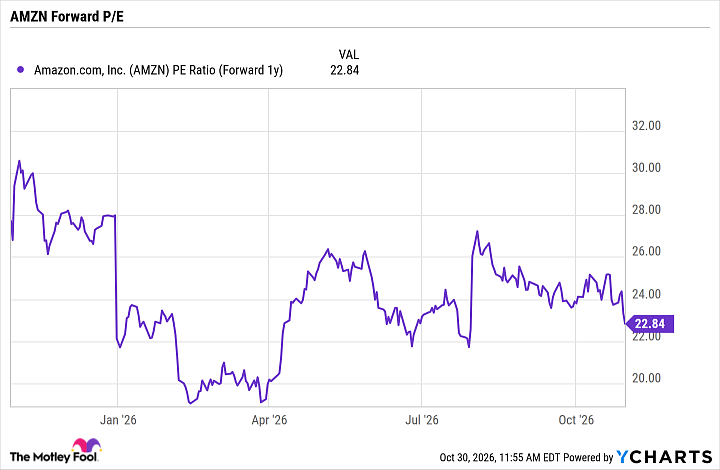
AMZN PE Ratio (Forward 1y) data by YCharts
Trading at a forward price-to-earnings ratio of 23 times 2027 analyst estimates, Amazon is a bargain at current levels and is a stock I’ve been scooping up on recent weakness.