1 ETF I’m Loading Up On Right Now — Even if a Recession Is Coming
There’s a saying I always like to keep in mind as I go through life: It’s much better to be overprepared than underprepared. It applies to many areas of life, including your finances and investing. So, while there are no immediate signs of a recession, it’s never too early to begin building your portfolio with investments built to last.
If a recession were on the way, the Vanguard S&P 500 ETF (VOO +0.56%) is an ETF I would continue loading up on without thinking twice. VOO has only been around since September 2010, but the S&P 500 (^GSPC +0.58%) — which VOO mirrors — has proven to be one of the most resilient and rewarding investments for long-term investors.

Image source: Getty Images.
Investing in VOO is akin to investing in the U.S. economy
Since it has 518 holdings representing 500 of the largest public U.S. companies, investing in VOO (and the S&P 500 in general) is one of the best ways to benefit from U.S. economic growth. Economic activity doesn’t directly control stock prices, but when S&P 500 companies are thriving, so is the U.S. economy, and vice versa.
VOO is currently dominated by big tech stocks (tech is 39.7% of the ETF), but it holds stocks from every major sector. So, while it might not be as diversified as it has historically been, it still covers a lot of ground. This diversification is one of the main reasons it can weather recessions. When certain industries are down, others can serve as a crutch.
VOO Vanguard S&P 500 ETF
$710.72+$3.92 (+0.56%)
NYSEMKT · As of 4:00 PM ET 10/21/26
Down but never out
This may not be music to investors’ ears, but recessions are an inevitable part of the modern economy. Their lengths and severities differ dramatically, but they’re bound to happen eventually. It might not be next week, next month, or in the next few years, but … eventually.
Many businesses don’t survive recessions because they don’t have the resources to stay afloat. That isn’t the case for a broad index like the S&P 500. It has bounced back from every recession that’s ever occurred in the U.S.
Below are the past five recessions and how much the S&P 500 has grown since bottoming out:
| Recession | S&P 500 Decline | Trough Date | S&P 500 Gains Since Trough |
|---|---|---|---|
| Early 1980s (1981 to 1982) | (27.1%) | Aug. 12, 1982 | 7,409% |
| Early 1990s (1990 to 1991) | (19.9%) | Oct. 11, 1990 | 2,503% |
| Dot-com bust (2001) | (49.1%) | Oct. 9, 2002 | 890% |
| Great Recession (2007 to 2009) | (56.8%) | March 9, 2009 | 1,037% |
| COVID-19 pandemic (2020) | (33.9%) | March 23, 2020 | 244% |
Data source: YCharts. Gains as of the S&P 500’s closing level on Oct. 19.
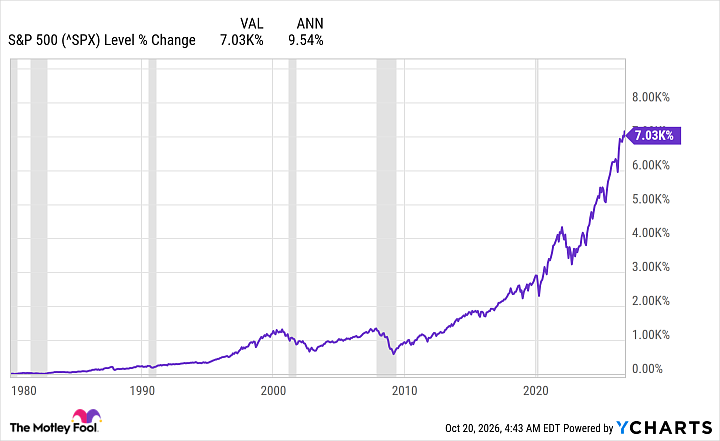
Data by YCharts. Vertical grey lines represent U.S. recessions.
Past results don’t guarantee future performance in the stock market, but betting on the S&P 500 to recover from a recession is one of the surest bets you can make. The companies leading the charge will inevitably rotate over time, but as a whole, the S&P 500 companies will continue to drive long-term growth.
VOO is an investment I regularly add to without thinking twice. It doesn’t matter if the market is rising, plunging, or stagnant.