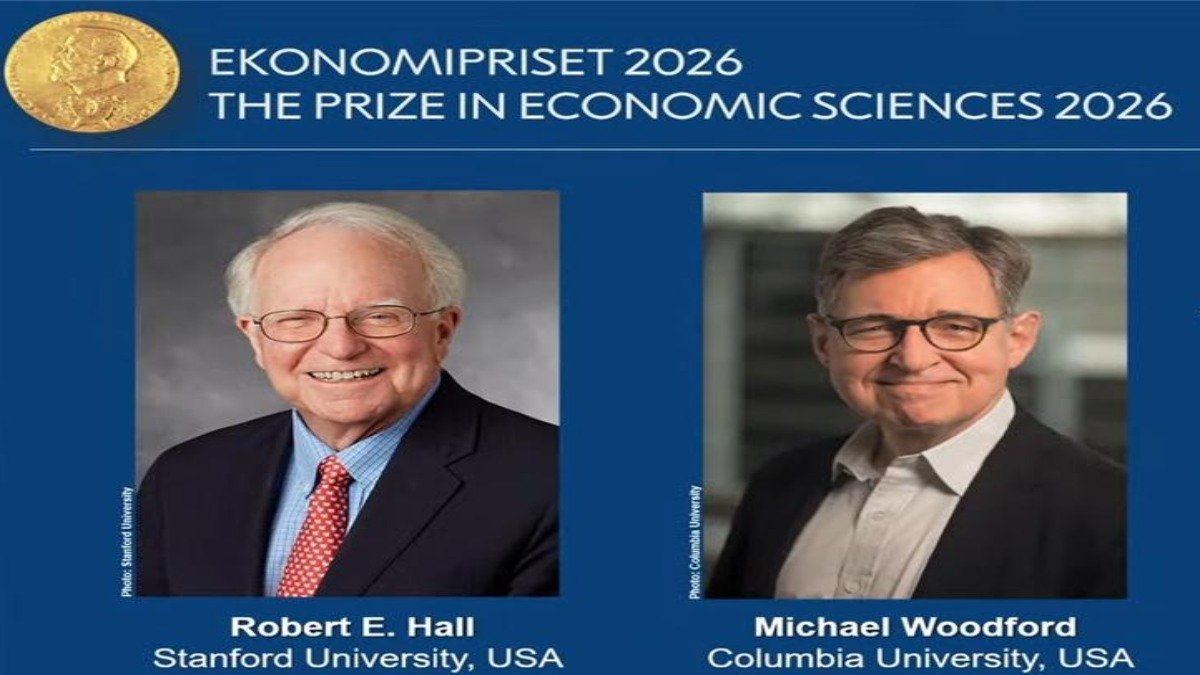
Nobel Prize In Economics 2026: US Economists Robert E. Hall, Michael Woodford Win; Know Their Research
The 2026 Nobel Prize in Economic Sciences has been awarded to American economists Robert E. Hall and Michael Woodford for their contributions to understanding how governments and central banks can stabilise economies through monetary and fiscal policy. The Royal Swedish Academy of Sciences announced the award on Monday, October 12, recognising research that has helped explain how economic decisions influence inflation, employment and growth.
Nobel Prize In Economics 2026: Robert E. Hall And Michael Woodford Won
Their work examines how households, businesses and policymakers interact to shape economic outcomes. It is particularly relevant when governments and central banks must respond to recessions, rising prices or weakening demand, as the effects of policy decisions often depend on economic conditions and public expectations.
/img/2026/10/economicsnobel2-12751791815929.jpg "Nobel Prize In Economics")
Hall and Woodford have made important contributions to macroeconomic theory, but their research focuses on different aspects of the economy. Hall is known for his work on consumption, labour markets and economic fluctuations, while Woodford has influenced modern monetary policy theory, particularly the relationship between interest rates, inflation and expectations.
Their research helps explain why a policy measure may produce different results depending on the circumstances. An interest-rate cut, for instance, may encourage borrowing and spending, but its impact also depends on consumer confidence, business expectations and the prevailing inflation outlook.
Similarly, changes in government spending and taxation can influence household consumption, employment and business investment. Understanding these relationships helps policymakers assess the potential effects of economic interventions before implementing them.
Who Is Robert E. Hall, Who Won Nobel Prize In Economics 2026
Robert E. Hall is an American economist and professor emeritus at Stanford University. His research spans macroeconomics, labour economics, financial economics, productivity and monetary policy.
Hall’s work has examined how households make spending decisions, how businesses respond to changing demand and how economies move through periods of expansion and contraction. His research helps explain why changes in income do not always lead to immediate changes in consumption, an important factor in understanding overall economic activity.
Hall has also contributed to the study of employment and business cycles, helping economists analyse how economic slowdowns affect hiring, output and household spending.
Beyond academia, Hall served as president of the American Economic Association in 2010. He also directed the National Bureau of Economic Research’s research programme on economic fluctuations and growth for several decades and has advised US government institutions on economic matters.
Who Is Michael Woodford? Winner of Nobel Prize In Economics 2026
Michael Woodford is an American economist and the John Bates Clark Professor of Political Economy at Columbia University. His research focuses on macroeconomic theory and monetary policy, including how central bank decisions affect inflation and economic activity.
Woodford is widely known for his book Interest and Prices: Foundations of a Theory of Monetary Policy, which has become an influential work in modern monetary economics. It examines how central banks can influence the economy through interest-rate decisions and credible policy commitments.
A key theme in Woodford’s research is the role of expectations. Households and businesses consider not only current interest rates but also what they expect central banks to do in the future. These expectations can influence borrowing, spending, investment and decisions about pricing.
His work has helped shape New Keynesian economic models used to analyse inflation, output and monetary policy. Woodford earned degrees from the University of Chicago and Yale University before completing his doctorate in economics at the Massachusetts Institute of Technology. His previous honours include the Deutsche Bank Prize in Financial Economics in 2007 and the Erwin Plein Nemmers Prize in Economics in 2024.
The research associated with Hall and Woodford offers policymakers frameworks to understand how economic decisions affect the wider economy. Monetary policy generally works through interest rates and financial conditions, while fiscal policy operates through government spending and taxation.
Nobel Prize In Economic Sciences: How Is It Different?
The economics award is formally called the Sveriges Riksbank Prize in Economic Sciences in Memory of Alfred Nobel. Unlike the original Nobel prizes, it was not included in Alfred Nobel’s 1895 will.
Sweden’s central bank, Sveriges Riksbank, established the prize in 1968 to mark its 300th anniversary, and the first award was presented in 1969. The Royal Swedish Academy of Sciences selects the laureates.
Disclaimer: The views and recommendations expressed are solely those of the individual analysts or entities and do not reflect the views of Goodreturns.in or Greynium Information Technologies Private Limited (together referred as “we”). We do not guarantee, endorse or take responsibility for the accuracy, completeness or reliability of any content, nor do we provide any investment advice or solicit the purchase or sale of securities. All information is provided for informational and educational purposes only and should be independently verified from licensed financial advisors before making any investment decisions.