India’s richest families invest crores in green energy: Want to join in? Here are your options
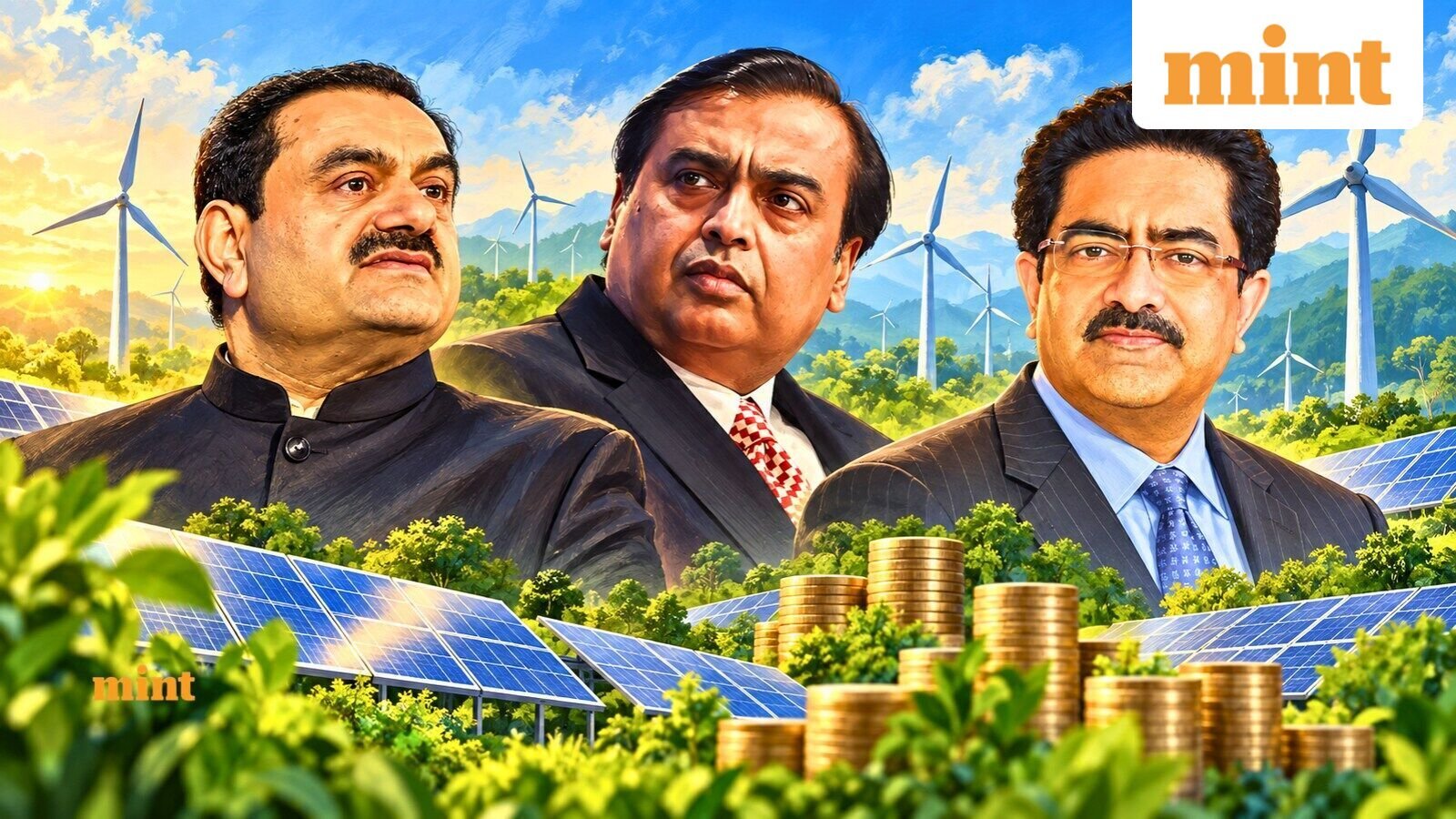
India’s wealthiest business families are investing in green energy. Their businesses earlier grew through ports, refining, metals, medicines, steel, vehicles and power. Now, they are expanding into solar, wind and other clean energy businesses.
The M3M Hurun India Rich List 2026 identifies 10 established groups making this shift. Gautam Adani and his family lead this group with a wealth of ₹9,22,800 crore. Their green businesses include Adani Green Energy and Adani New Industries.
Mukesh Ambani and his family follow with ₹8,63,400 crore, alongside Reliance New Energy. Other groups include Aditya Birla, Torrent, JSW, INOXGFL, RPSG, Mahindra, Welspun and O.P. Jindal.
Their involvement shows how green energy is attracting money from established industries. Ordinary investors also have several ways to participate, depending on their comfort with risk.
How to invest in green energy
One option is buying company shares listed on the NSE or BSE. Power producers such as Adani Green Energy, JSW Energy and NTPC offer exposure. Equipment makers include Inox Wind, Suzlon and solar panel manufacturers. Reliance Industries and Larsen & Toubro are investing in hydrogen and solar manufacturing.
However, individual shares can rise or fall sharply. Changes in rules, land delays and large debts can affect these businesses. Investors choosing this route must be comfortable with price swings.
Mutual funds offer another option through professionally-managed investments across several companies. Examples include ICICI Prudential Energy Opportunities Fund and SBI Energy Opportunities Fund.
These funds invest across traditional energy with a shift towards renewables. Environment, social and governance funds also focus on sustainable businesses. However, energy-focused funds remain heavily dependent on one sector’s performance.
Green bonds provide a route for investors seeking fixed income. Companies and financial institutions issue them to support renewable energy or energy-saving projects. Government-issued sovereign green bonds finance green infrastructure and offer fixed returns backed by the Indian government.
PM Surya Ghar
Households can also invest directly by installing rooftop solar panels. Government subsidy schemes, including PM Surya Ghar, help support these installations. Solar panels can reduce electricity bills and provide savings over their working life.
Under this scheme, you can get a subsidy of up to ₹78,000 for a 3 kW system, ₹60,000 for a 2 kW system and ₹30,000 for a 1 kW system. According to Moneycontrol, the pre-subsidy cost of installing a 1 kW system is around ₹60,000 to ₹80,000.
For 2 kW, it’s ₹1.2 lakh to ₹1.6 lakh. It’s ₹1.8 lakh to ₹2.4 lakh for a 3 kW system installation. The cost recovery period is estimated at 2-4, 3-5 and 4-6 years, respectively, according to the publication.
EVs
Electric vehicles offer another way to reduce regular household spending. The material estimates running costs are around 70% lower than those of petrol vehicles. This makes them relevant for everyday city travel.
Before investing, consider how long you can keep your money committed. Green infrastructure projects often take years to develop. It may take a 5-10-year investment period.
Each option carries different financial risks. Choose whether you prefer growth opportunities or a steadier income. Your choice should match your willingness to accept risk.
Disclaimer: This article is for general information and does not offer investment advice or endorse any stocks. Green energy investments may offer high returns but also carry high risks. Returns are not guaranteed, and you could lose money. Assess your financial goals and risk tolerance before investing. Consult a qualified financial adviser before making investment decisions.