How Advisors Can Guide Clients Through Tariff Uncertainty
After over 50 years in this business, I’ve watched the market forget almost everything it has learned the hard way. But it’s not likely to forget tariffs. Tariffs are no longer a policy. They are a structural change in how exporters and importers think about trade. The arguments for tariffs include the benefits of reshoring, reengineering of industrial policy, and reciprocity between trading partners. Each describes the same shift. Regardless of who is in the White House in 2029, they’ll inherit the tariff overlay and have to deal with both its merits and its problems.
“Everybody talks about tariffs as the first thing. Tariffs are the last thing,” asserted Wilbur Ross when he was Secretary of Commerce. “Tariffs are part of the negotiation. The real trick is going to be to increase American exports,” Ross added.
What most people don’t realize is that a tariff announcement is not the new policy; it’s just an opening bid. The goal is to strike a deal to open foreign markets, and the U.S. trade team thinks tariffs are a lever to bring both parties to the table. As advisors, understanding the nature of the negotiations takes the fear out of the process. Tariffs are the first move in a long game; they’re not an earthquake.
What Has Changed Since Liberation Day
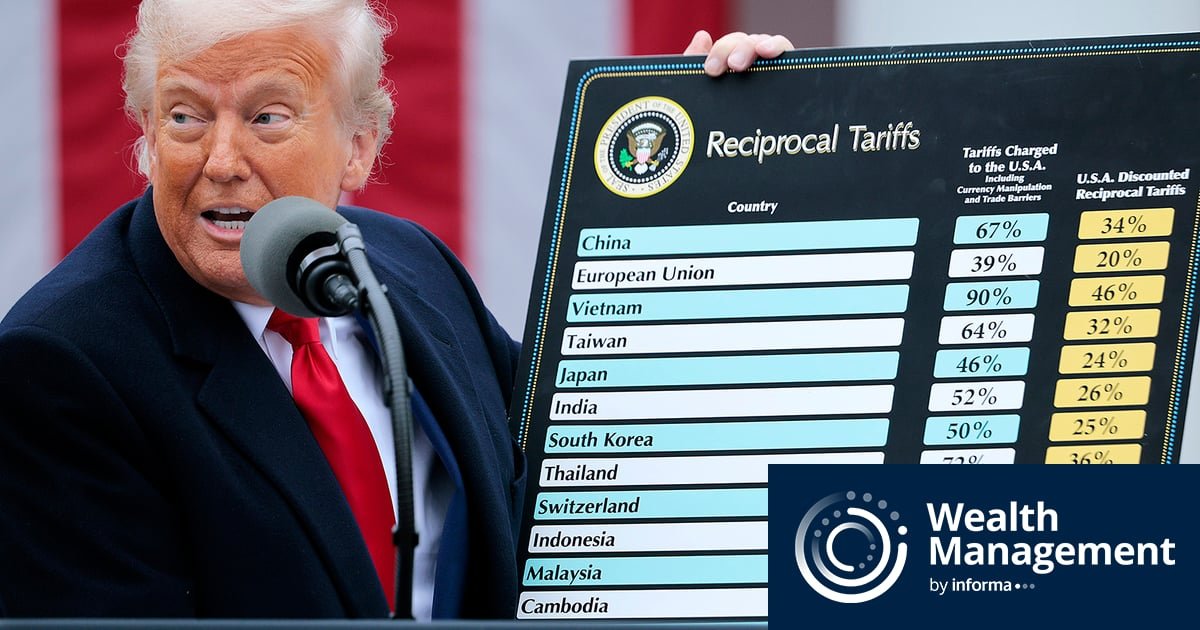
When President Donald Trump’s broad tariffs were announced in early April 2025 (aka Liberation Day), there was no time to sort winners from losers. So, the market convulsed and sold everything. Today, the landscape is more complicated, but less dangerous. Duties are specifically targeted by country and product. Industries are allowed carve-outs. Court cases have narrowed what the executive branch can do on its own, and companies have rerouted supply chains and raised costs to offset the tariffs. The market has moved from panic to analysis. It is no longer about whether tariffs are good or bad. The market is asking which companies are handling tariffs well and which ones aren’t.
A Client Conversation
A retired couple wanted to review their portfolio with us in light of the tariffs. The husband had been reading that tariffs would drive inflation toward 5% and wanted to switch to cash until things settled down, a classic market-timing mindset. We opened their plan and re-ran their spending using a 5% inflation rate for four years, instead of the three years originally built in. The impact was nominal. The couple’s income was covered by Social Security, a pension and a bond ladder that did not care about the stock market. Their equities were for discretionary spending and their heirs, so they had years to recover from any tariff-driven loss in value if it ever occurred.
After the husband saw our projections, going to cash was no longer a priority for him. He agreed he did not need to be right about the impact that tariffs would have on his and his wife’s portfolio. He just needed to know that he could relax and not worry about his nest egg.
This is our job, isn’t it? To bring peace of mind to our clients. Just remember, clients are not asking about trade policy because they want to understand it. They are asking about trade policy to ensure their financial future is secure. Showing them how their plan responds to a variety of assumptions does more than any forecast can. The biggest problem facing most investors is fear, and the more we can reduce a client’s dependency on media noise, the calmer they will be.
Reassuring Clients
Here are four considerations that can help you bring peace of mind to clients who are concerned about the impact of tariffs:
1. Inflation and spending. Stress-test every cash flow model using a 4% to 5% inflation assumption on their discretionary spending. Review the model every three to five years. If the plan still works, tell your client you looked at it for them and that it’s okay. If not, the answer is usually a modest spending adjustment rather than a portfolio overhaul.
2. Portfolio impact. Audit your client’s sector concentration. Import-dependent names in the electronics, auto, apparel and agriculture sectors carry some real exposure to tariffs, as do multinationals with heavy foreign earnings. Domestic producers and reshoring beneficiaries are on the other side. Most diversified portfolios hold both. The audit is to ensure a client is not accidentally overconcentrated in a single sector or stock.
3. Refunds and relief. Where courts have limited tariff authority, money may flow back to the companies that paid the duties. That is a tailwind for sectors beaten down by the initial wave. It is not a reason to speculate. It is a reason not to abandon these companies at the bottom of the cycle.
4. Market-based portfolios. If your client portfolios are market-based, then there is nothing to do other than to show the results of stress tests. You might want to take this time to discuss risk allocation and assess whether your portfolios are still aligned.
Tactical Moves
Rebalance with taxes in mind. Volatility gives your client losses to harvest, and harvested losses let them reposition without handing gains to the IRS.
Don’t rotate out of impacted sectors on a wholesale basis. Selling consumer goods, metals and autos after they have lost value is selling low. Tilt instead toward market leaders with pricing power and strong balance sheets.
Hold real inflation hedges. Treasury Inflation-Protected Securities (TIPS), a modest gold allocation, and real assets with pricing power can earn their place when trade friction keeps prices stable.
Use the dips. The 401(k) contribution limits for 2026 are $24,500, or $32,500 for clients over 50, and $35,750 for those aged 60 to 63. A client who is not at the limit during a pullback should be encouraged to buy more.
Plan for more than one future. Divide the portfolio into three buckets: one for liquidity events, a second for long-term appreciation, and a third as a buffer for the unexpected, which can include fixed income and alternatives.
The Real Wealth Destroyer
Tariffs will not reduce your clients’ value. But panic can. Remind clients that a paper loss is real only if they sell. If the noise convinces people that whatever is happening now will keep happening, they will be anxious and will never have peace of mind. But markets don’t work this way. Investors who sold after Liberation Day in April 2025 missed one of the fastest recoveries on record. Most of them had to buy back into the market at much higher prices than they had sold at. Markets go up, and markets go down. It is the nature of markets.
As advisors, we are leaders. Our role is to provide structure and calmness. Acknowledge the fear. Bring clients back to their plan and why they chose it. Reassure them that the numbers are working. Then, agree on action steps. Increase contributions, harvest some losses and review the rebalancing strategy. We need to avoid predicting government policy. No one has a crystal ball that works. Instead, we need to build plans and allocations that are impervious to predictions. We are the steady voice behind the headlines. If your client portfolios have tariff exposure, review them now. The clients who trust you most are the ones you called before they had to call you.