Top Key Candidates to Replace ECB President Christine Lagarde
Leading Candidates Set to Succeed ECB President Christine Lagarde
Overview of Potential Successors
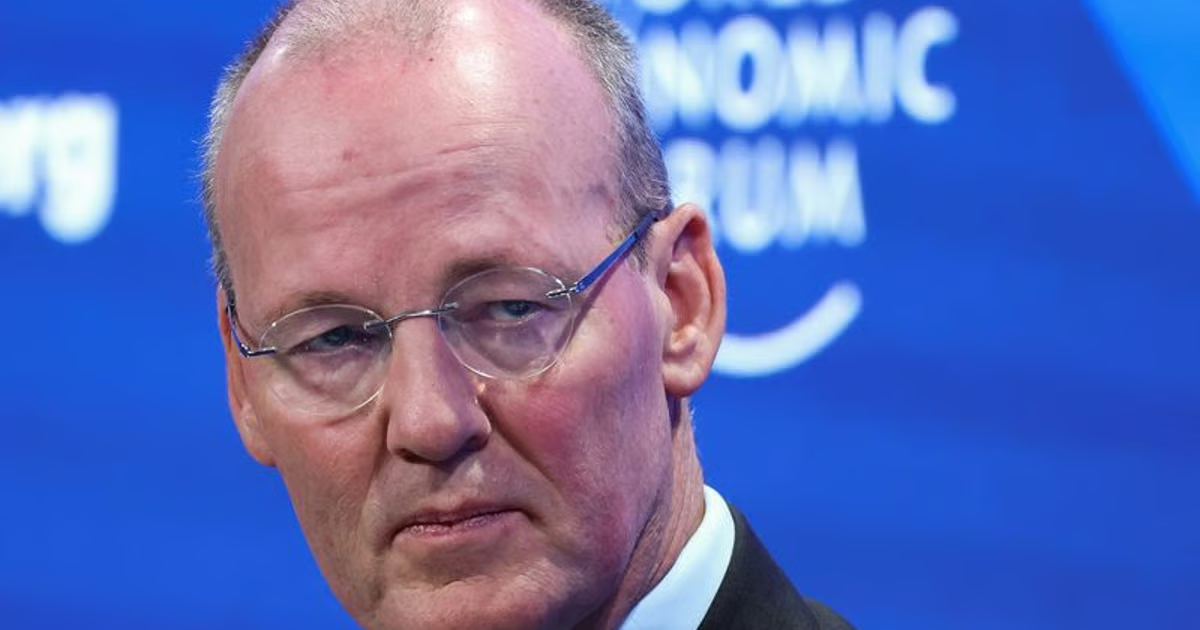
FRANKFURT, Sept 15 (Reuters) – France could back former Dutch central bank chief Klaas Knot to succeed Christine Lagarde as head of the European Central Bank as part of a bargain in which a French candidate would be picked for chief economist, sources told Reuters.
While Lagarde’s term extends until October 2027, rumours of her early resignation have persisted for most of this year.
The following are key candidates for the ECB Presidency.
Klaas Knot
Background and Experience
A trained monetary economist, Knot, 59, served two full terms as the head of the Dutch central bank from 2011 to 2025 and has spent most of his time since then in an advisory role or campaigning for the ECB presidency.
ECB Governing Council Tenure
His 14 years on the ECB’s rate-setting Governing Council can be characterized by two distinct periods: increasingly open hostility to ECB President Mario Draghi’s stimulus measures and perfect harmony with Christine Lagarde, who succeeded Draghi in 2019.
Policy Stance and Influence
Considered a pragmatic policy hawk, Knot joined in a period of upheaval as the euro zone suffered a series of financial and debt crises that threatened to rip it apart. He had initially expressed reservations about Draghi’s “whatever it takes” pledge to preserve the euro but came around, unlike his German colleague, and eventually called it a pivotal moment.
However, he came into open conflict with Draghi in the following years when the ECB unleashed a massive stimulus effort to rekindle inflation during a decade it undershot the 2% target.
The criticism was initially reserved for private discussion but came fully into the open in late 2019 when Draghi pushed through a new stimulus scheme, despite the opposition of a third of policymakers, an unprecedented rift for a collegial body that usually decides matters unanimously.
Under Lagarde, Knot came back into the fold, even if he was an early advocate for tighter policy in response to the historic 2022 inflation surge.
International Roles
From 2021, Knot also served as Chair of the Financial Stability Board, a global body responsible for monitoring financial stress and devising policy recommendations.
Pablo Hernandez de Cos
Professional Background
Considered a moderate policy dove, de Cos, 55, has been heading the Bank for International Settlements, the global umbrella group of central banks, since 2025.
He also served one six-year term as the Bank of Spain governor from 2018 to 2024, a tumultuous period that started with ultra-low inflation, followed by the pandemic and a historic interest rate hike cycle to tame runaway inflation.
Reputation and Approach
De Cos also served as the Bank of Spain’s chief economist, taking the rare step of moving from staff to a policymaking role, a reflection of his success in elevating the profile of research at the bank.
Colleagues describe him as a pragmatic economist, possibly even a swing voter, who always brings a wealth of evidence and data to back his points, avoids dogma, and is known for being a team player.
International Recognition
Earlier this year when some of the world’s top central bankers openly backed Jerome Powell, then the Chair of the U.S. Federal Reserve, against political pressures, de Cos was said to be a key coordinator of the process.
De Cos also gained an international profile when he served as the Chair of the Basel Committee on Banking Supervision, the most important global forum dedicated to monitoring and harmonising banking rules.
Joachim Nagel
Leadership at Bundesbank
The head of the Bundesbank since 2022, Nagel, 60, has fundamentally altered Germany’s relationship with the ECB.
While his predecessor, Jens Weidmann, was in open conflict with Mario Draghi’s ECB for years, Nagel has toned down the rhetoric and rejoined the fold, even if he remains a moderate hawk.
Policy and Influence
Colleagues say Nagel, also a PhD economist, clearly expresses his red lines but can compromise on other issues and he is not known to have opposed any key policy decision during his tenure, a big change to the hostilities of his predecessors.
He has also supported the creation of the European Deposit Insurance Scheme, a project Berlin has long opposed, fearing that the German taxpayer would have to pay for the financial irresponsibility of others.
Defending ECB Independence
Nagel has fiercely defended the ECB’s independence, pushed back on political criticism of the bank, and recently argued that some of the proposals of the far-right AfD party were self-defeating and could scare away investors.
A member of Germany’s Social Democratic Party, Nagel previously held senior roles at the Bank for International Settlements and the KfW Group.
Nadia Calvino
Profile and Strengths
Calvino, the President of the European Investment Bank, has never expressed public interest in the ECB job but her name comes up in private conversations from time to time.
She is known as a good public speaker, and a ruthless, effective manager, a key quality in running a large organisation and a 27-member Governing Council, most of whose members are used to being top bosses in their own central banks.
Potential Advantages
While Calvino, 57, a former Spanish cabinet minister, is not a monetary economist, Lagarde has proven this was not an essential quality. Her gender may also play in her favour since there are only two women on the Council and both are set to leave in the next year.
(Reporting by Balazs Koranyi and Francesco Canepa; Editing by Tomasz Janowski)