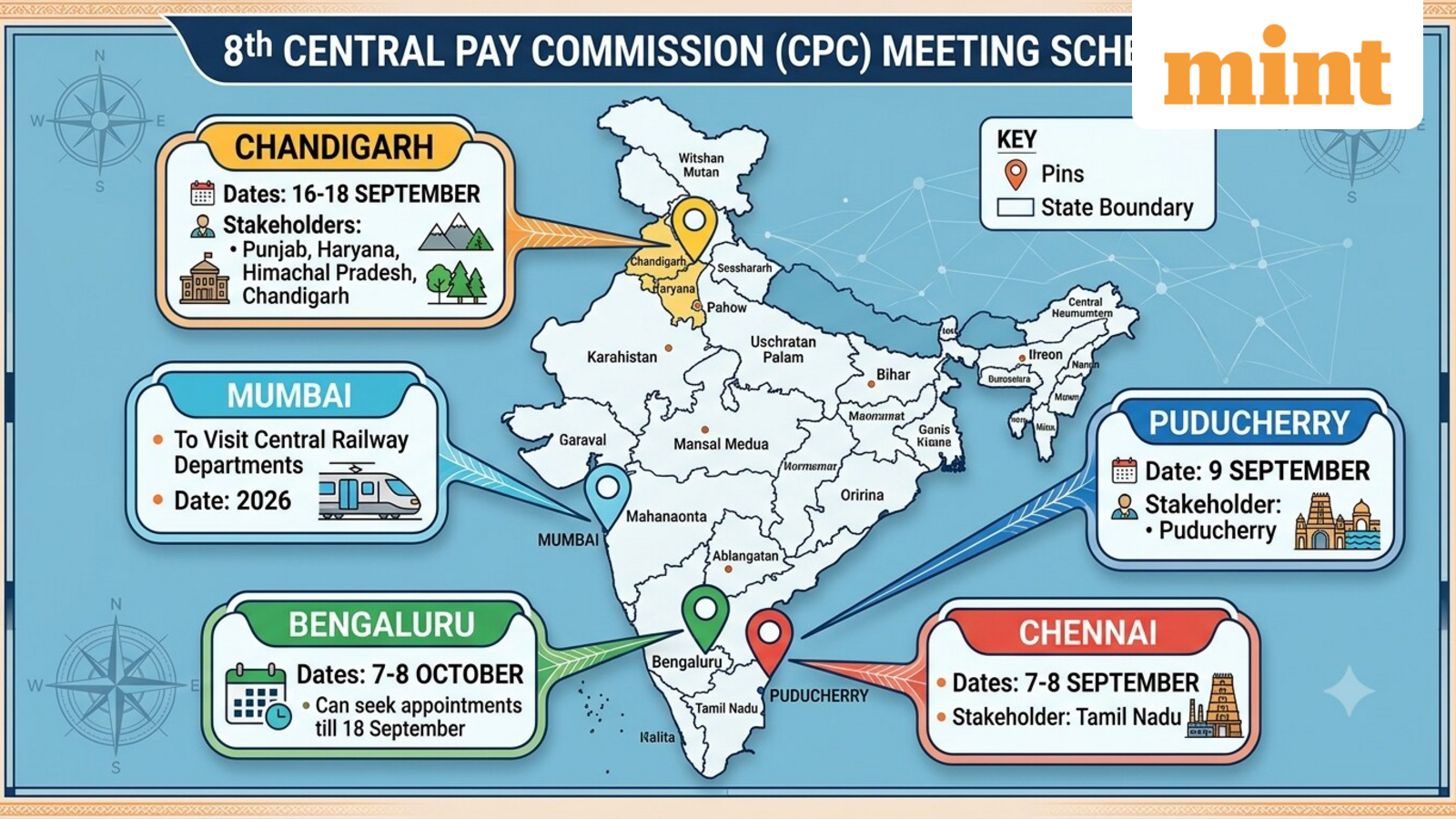
8th pay commission begins three-day state visit to Chandigarh tomorrow — What’s on the agenda for meetings?
The 8th central pay commission (CPC) is scheduled to be in the union territory of Chandigarh for an official three-day state visit from 16 to 18 September this week (Wednesday-Friday).
The panel will hold meetings and discussions with employee unions, representative groups, pensioner associations, federations, and stakeholders who submitted an appointment request by the 25 August deadline.
Why are these consultation meetings important?
Since March, the commission has met employees, pensioners and stakeholders to collect and analyse opinions and data before deciding on pay, allowances, and pension for employees and pensioners.
In the Chandigarh meetings, discussions are likely over a number of key issues with representatives from the states of Punjab, Haryana, Himachal Pradesh and the UT of Chandigarh. Meetings with these unions, groups and stakeholders collectively represent a large number of employees and pensioners, including defence and railway staff, are expected to shape the panel’s final recommendations.
The panel’s decisions are expected to benefit over 1 crore individuals, including about 50 lakh central government employees and some 65 lakh pensioners, including defence and railway personnel and retirees.
8th CPC in Chandigarh: What’s on the agenda?
Chaired by former Supreme Court Justice Ranjana Prakash Desai, the commission includes Member-Secretary — Pankaj Jain, a former IAS, and Member — Professor Pulak Ghosh, tenured Professor of Finance, Member of the Economic Advisory Council to the Prime Minister.
The commission has not formally released an official agenda for the visit; however, meetings are likely to feature issues listed in the Terms of Reference (ToR) released last year. As such, talks are expected to touch several recurring issues stated in the memorandums submitted by prominent unions. These include:
- Revision of the fitment factor,
- Revision of basic pay structure,
- Hike in dearness allowance (DA) for employees,
- Salary revisions and improvements, keeping pace with inflation and cost of living,
- Reorganisation of allowances such as House Rent Allowance (HRA) and transport allowance,
- Pension reforms with a broader focus on retirement security,
- Consideration of aspects such as employee welfare, morale, and service conditions, and
- Measures aimed at improving compensation competitiveness, among other topics.
The commission is expected to announce its final recommendations within 18 months since constitution (on 3 November 2025), as per the official timeline stated in the ToR. This means its absolute deadline to submit the report is May 2027. Further, based on previous rollouts, the recommendations are likely to be fully implemented over a period of two years, by 2029 or 2030.