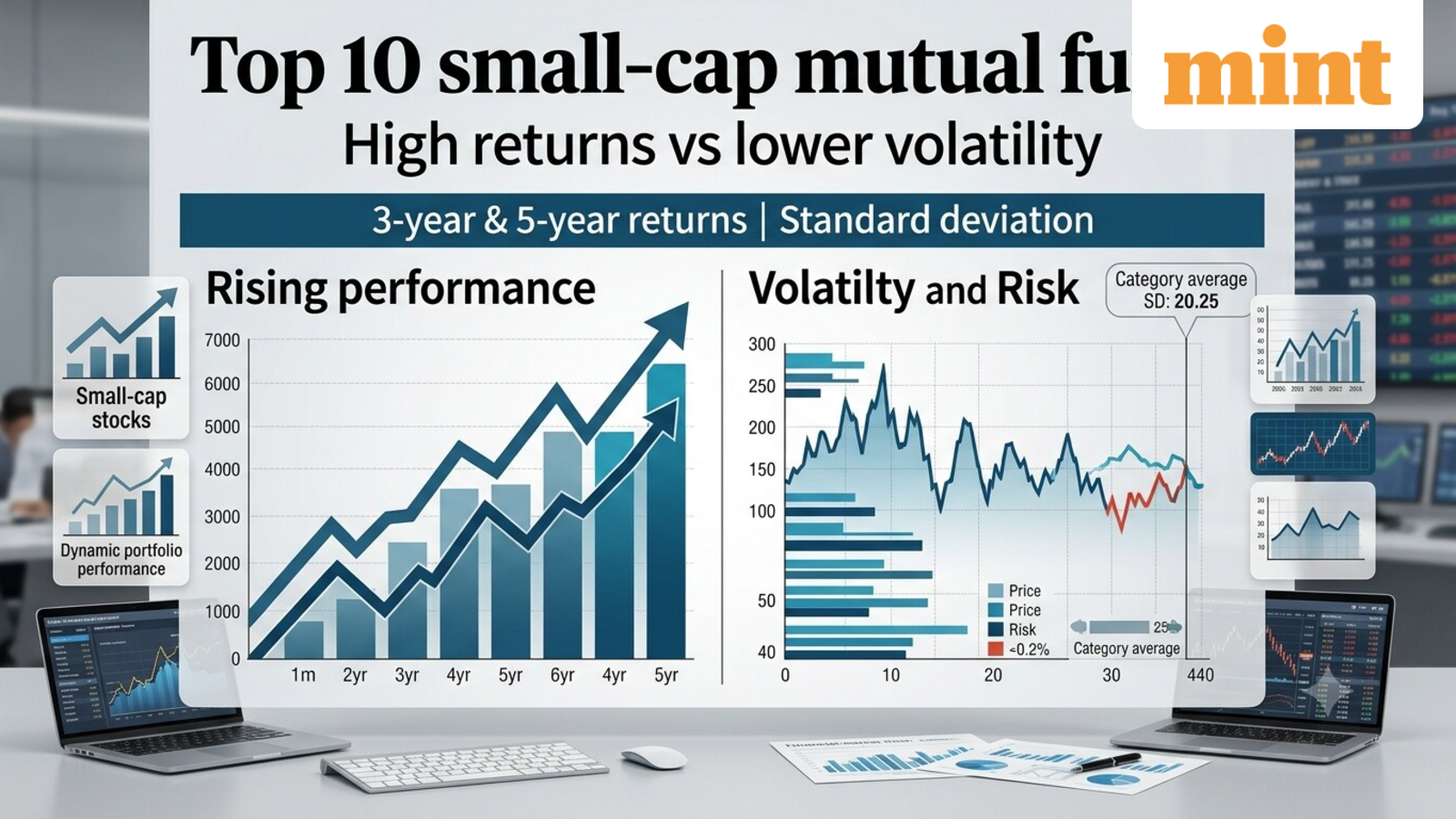
Top 10 small-cap mutual funds: Which schemes delivered high returns with relatively lower risk?
Small-cap mutual funds have continued to attract investor money, with the category recording a record net inflow of ₹7,973 crore in August 2026, the highest among active equity fund categories.
Among the 10 largest small-cap funds by assets under management (AUM), the focus is on which schemes delivered the highest returns over three years and whether those higher returns came with lower volatility.
Which small-cap funds delivered the highest returns?
| Small-cap funds | AUM ( ₹ crore) | 3-year returns | 5-year returns |
| Bandhan Small Cap Fund | 34,176 | 24.38% | 20.13% |
| Invesco India Small Cap Fund | 15,744 | 22.36% | 20.49% |
| DSP Small Cap Fund | 21,659 | 16.99% | 18.84% |
| Quant Small Cap Fund | 35,557 | 16.91% | 19.90% |
| Axis Small Cap Fund | 31,448 | 15.22% | 16.49% |
| Nippon India Small Cap Fund | 82,580 | 14.44% | 19.22% |
| HSBC Small Cap Fund | 19,076 | 14.14% | 18.05% |
| SBI Small Cap Fund | 42,631 | 11.63% | 14.78% |
| Kotak Small Cap Fund | 19,679 | 11.44% | 13.14% |
| HDFC Small Cap Fund | 41,891 | 10.17% | 15.30% |
Source: Value Research; Only the top 10 small-cap funds by AUM considered; Direct Plans, AUM as on 31 August 2026; CAGR as on 11 September 2026
Based on three-year returns, Bandhan Small Cap led the group with a 24.38% annualised return, followed by Invesco India Small Cap at 22.36%.
DSP Small Cap and Quant Small Cap were next, with returns of 16.99% and 16.91%, respectively.
Over five years, Invesco India Small Cap had the highest annualised return at 20.49%, followed by Bandhan Small Cap at 20.13%.
Which small-cap funds delivered higher returns with lower volatility?
Returns alone do not show how much the fund’s performance fluctuated to generate those returns. Standard deviation is one way to measure this volatility.
In simple terms, a higher standard deviation means the fund’s returns have fluctuated more, while a lower figure indicates relatively lower volatility.
For example, if Fund A and Fund B both deliver 14% annualised returns, but Fund A has a standard deviation of 12% and Fund B has 6%, Fund B’s returns have been less volatile.
Here is how the 10 funds compare on three-year returns and standard deviation:
| Small-cap funds | Standard deviation (%) | 3-year returns |
| Axis Small Cap | 16.81 | 15.22% |
| SBI Small Cap | 17.39 | 11.63% |
| HDFC Small Cap | 17.46 | 10.17% |
| Nippon India Small Cap | 19.17 | 14.44% |
| Kotak Small Cap | 19.43 | 11.44% |
| Invesco India Small Cap | 19.57 | 22.36% |
| Quant Small Cap | 20.18 | 16.91% |
| Bandhan Small Cap | 20.45 | 24.38% |
| DSP Small Cap | 21.23 | 16.99% |
| HSBC Small Cap | 21.81 | 14.14% |
Source: Value Research; Direct Plans; SD as on 31 August 2026; Standard deviation have been calculated using calendar month returns for the last three years; CAGR as on 11 September 2026
Bandhan Small Cap had the highest three-year return among the 10 funds, but its standard deviation was 20.45, indicating relatively high volatility.
Axis Small Cap had the lowest standard deviation among the 10 funds at 16.81, but its three-year return of 15.22% was well below the top performers.
Compared with the category average standard deviation of 20.25, only Bandhan, DSP, and HSBC Small Cap Funds had higher volatility. The remaining funds recorded standard deviations below the category average.
Therefore, investors looking at small-cap funds need to consider both returns and volatility, rather than judging a fund only by its past returns.
Disclaimer: This is purely for educational/informational purposes and should not be taken as any sort of investment advice. Always consult a SEBI-registered advisor before making any investment decisions.