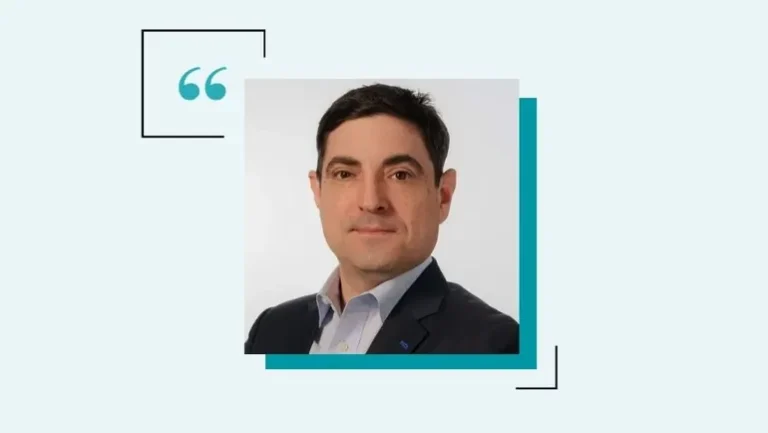
Podcast: Alexander Barzykin on modelling FX market-making
Market-making in foreign exchange is a balancing act. For modellers, it’s a complex optimisation problem that centres on the management of asset inventory and the determination of bid/ask prices.
Because FX trading predominantly happens over-the-counter, dealers are quoting prices directly to clients or aggregators, creating bilateral trading rather than a centralised market with a central limit order book. For FX dealers, risks are client-specific and may be more pronounced than in centralised markets.
Alexander Barzykin, director in the foreign exchange, rates and commodities team at HSBC in London, discusses how FX market-makers should deal with informational risk, in particular adverse selection and price reading. His modelling framework, published earlier this month, was developed with Philippe Bergault, Olivier Guéant and Malo Lemmel and formalises the theoretical principles of the model HSBC uses in production.
Barzykin connects the informational risk of FX market-making to the way the dealer optimises its strategy to manage its internal liquidity: “Once market-makers start skewing prices, this information provides a supply-demand imbalance message to the whole franchise, which can be read by some participants, and this creates information risk,” he says.
That optimisation method was introduced in a paper published on Risk.net in April, which Barzykin co-authored with Robert Boyce and Eyal Neuman.
A dealer faces adverse selection when a client has asymmetric information, either because the information is superior or through a latency advantage, which may arise in a delocalised market.
Price reading is a more subtle problem and harder to detect. It refers to how the dealer’s risk management inadvertently but inevitably reveals information about its inventory, which algos can take advantage of.
Barzykin explains that not taking adverse selection and price reading into account may lead to large losses or draining the account. “When you have a big inventory and you reveal too much information, essentially the price can be drifting away from you, and clearly this will lead to a significant loss, potentially,” he says.
Barzykin and co-authors set up the model as a stochastic optimal control problem – his April paper’s internal liquidity optimisation relies on the same technique.
In the model, the risks brought by adverse selection and price reading are factored in and perturb prices in a way that can be modelled by a stochastic differential equation.
The output is a strategy on how to skew prices so that the unavoidable trade-off between risk management and information leakage is optimised.
A takeaway of the paper is that adverse selection might not be so adverse after all. Barzykin gives the example of a client who may exhibit adverse selection because they rely on some long-term signal, and says that “you can rationally accept some adverse selection from this client if you can potentially use this information to risk-manage the rest of your franchise.”
The model was conceptualised with FX markets in mind but is potentially applicable to all markets where information risk is present, in particular OTC markets.
Barzykin says one stream of research that would build on the models presented here is the joint modelling of the client and dealer’s optimisation problems, which will require a game theory approach.
Another line of future research is connected to so-called reputation feedback, which refers to how market-maker behaviour – for instance the rate at which it rejects a client’s orders – influences the flow received from the client in the future.
Index
00:00 Introduction
04:06 Adverse selection and price reading
10:08 The model
15:50 Applications
20:55 Managing access to internal liquidity
28:54 Joint modelling of dealer and client problems
30:28 Future research
To hear the full interview, listen in the player above, or download. Future podcasts in our Quantcast series will be uploaded to Risk.net. You can also visit the main page to access all tracks, or go to Spotify, Amazon Music or Apple Podcasts to listen and subscribe.