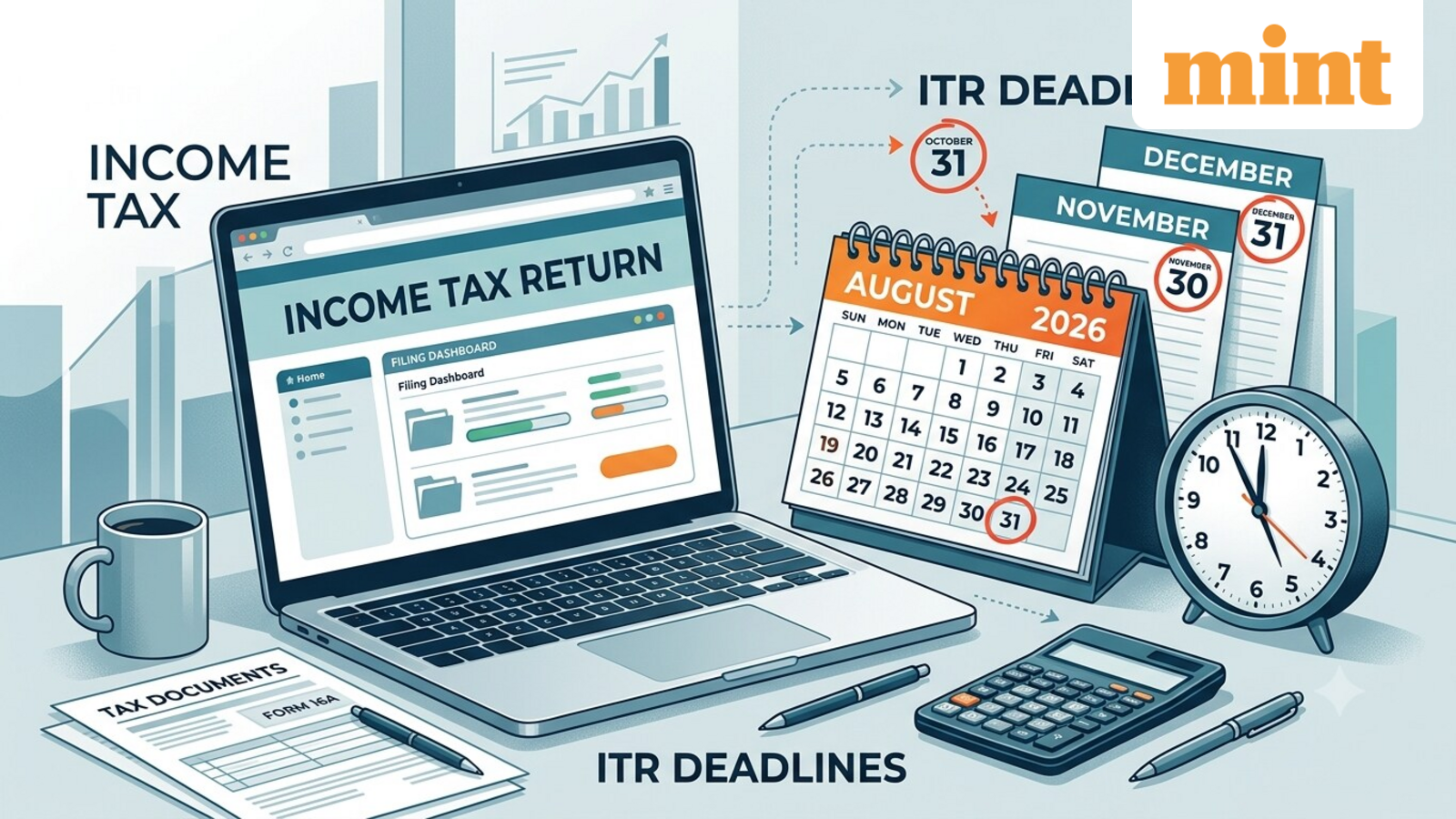
ITR deadline on 31 August: Here’s who must file their returns, checklist for taxpayers and top things to know
For those with business or professional (including freelancers) income, deadline to file their income-tax returns is fast approaching on 31 August. Taxpayers filing non-audit income tax returns will have to use the ITR-3 or ITR-4 forms, as applicable.
According to the I-T portal, more than 6.5 crore ITR filings (ITR-1, 2 and including over 2 crore ITR-3, 4) were completed by the 31 July deadline. This included salaried individuals, students with income, pensioners and those with income from multiple house properties, bank or post bank interest, dividends, capital gains, and / or other sources
Now, for those filing ITR-3 form, as well as those opting for the presumptive taxation scheme using ITR-4 (Sugam) form, the due date is as follows:
- 31 August 2026: Salary from freelance or business income that does not require a tax audit.
- 31 October 2026: Business or professional income requiring a tax audit.
How to file your ITR online?
Taxpayers can file their returns using the official e-filing portal here — https://eportal.incometax.gov.in/iec/foservices/#/login. Taxpayers can log in using their PAN details, select the applicable ITR form, verify their income and deduction details (if filing under old tax regime), pay tax due (when necessary) and complete e-verification after submission of the return.
The e-filing portal also provides access to pre-filled information based on available records, including details from Form 16, Annual Information Statement (AIS) and Taxpayer Information Summary (TIS).
Alternatively, if you so choose, you can engage with a Chartered Accountant (CA) or registered tax expert to file your returns by a third-party authorised representative. Further, a number of fintech and tax information platforms also provide services that include advice, assistance and filing of returns for a cost.
When should taxpayers choose ITR-3 or ITR-4?
The Income-Tax Department posted on X explaining how taxpayers filing non-audit income tax returns by 31 August can ensure they select the correct ITR form before filing.
When is ITR-3 applicable?
ITR-3 is applicable if you are an individual or HUF with business or professional income but do not opt for presumptive taxation, including cases where you maintain regular books of account, have total income above ₹50 lakh, or engage in F&O trading.
When is ITR-4 applicable?
ITR-4 is applicable if you are an individual, HUF or firm opting for presumptive taxation of business or professional income, with total income of up to ₹50 lakh.
Checklist for ITR-3 and ITR-4 filers
Filers of ITR-3 and ITR-4 must have Form 26AS, AIS, TIS, Form 16 and 16A, bank passbooks and advance/self-assessment tax challans. See the following checklist:
- Check the TDS break-up with Form 16 and match professional and other receipts with Form 16A, AIS and bank statements.
- Businesspersons must retain the Trial Balance, Profit and Loss Account, Balance Sheet, sales and purchase registers and invoices.
- Keep GST returns, payment-gateway statements and the fixed-asset register, and reconcile them with turnover, expenses and depreciation in the return.
- Keep brokerage statements, contract notes, demat statements and capital gains details.
- Property owners should retain rental agreements, municipal tax receipts, ownership records and housing loan interest certificates.
- Keep tax audit reports, Form 10-IEA acknowledgements, and evidence supporting deductions.
Disclaimer: This is only for informational and educational purposes. Please consult a qualified expert for the latest laws and regulations.