NPS asset classes explained: How can you allocate your retirement savings under active and auto choice?
When you invest through the National Pension System (NPS), choosing an account is only the first step. You also need to decide where your retirement money should be invested. NPS gives subscribers a choice of asset classes, ranging from equities and corporate debt to government bonds and alternative investments.
For those who do not want to decide the allocation themselves, NPS also offers Auto Choice, where the mix of investments changes with age.
What are the four asset classes in NPS?
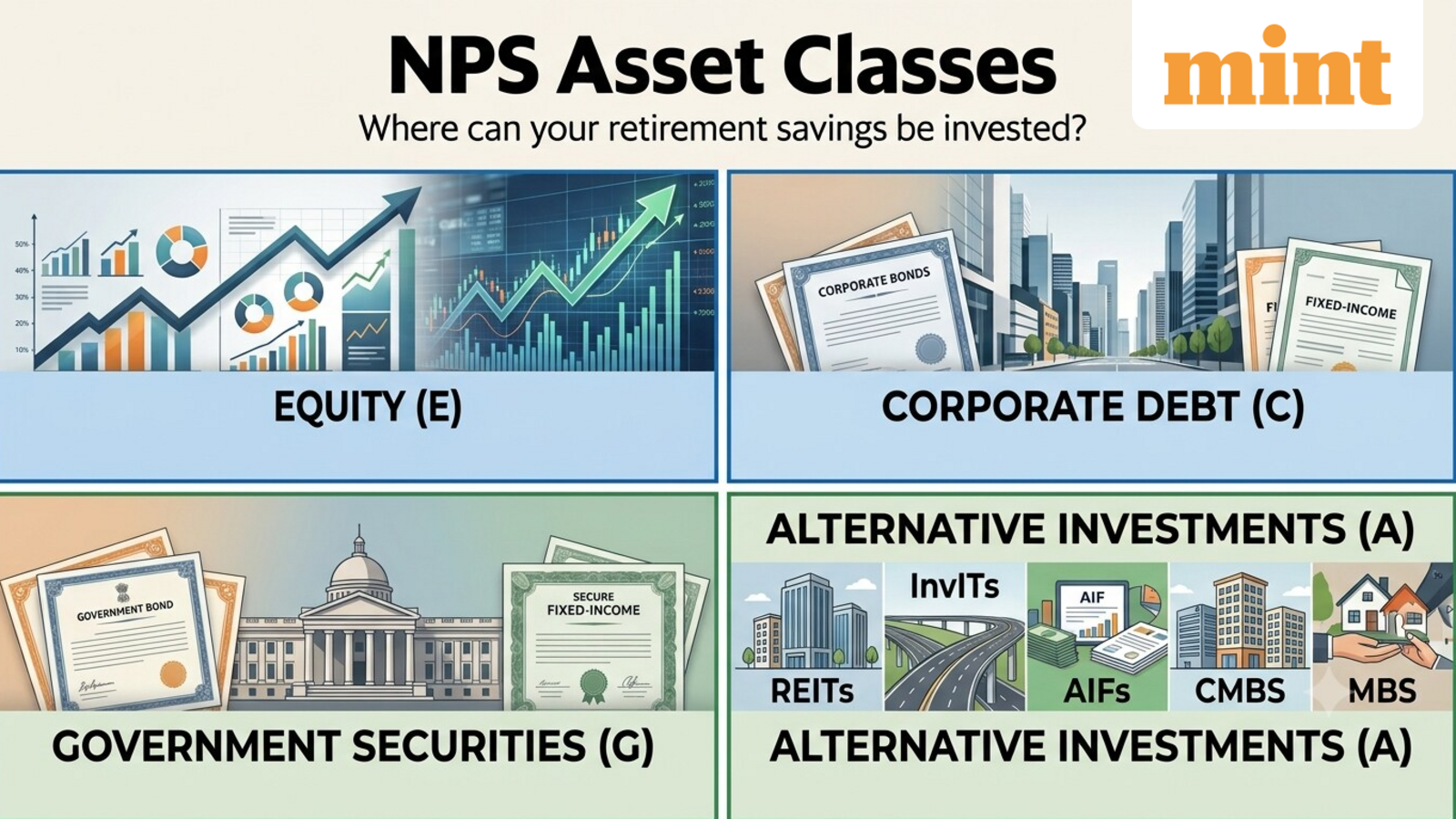
NPS offers four broad asset classes: E, C, G, and A. Think of them as different places where your retirement savings can be invested.
Asset Class E refers to investments in equities and related instruments. C covers corporate bonds and related debt instruments, while G comprises government bonds and related securities.
A covers alternative assets such as REITs, InvITs, AIFs, commercial mortgage-backed securities (CMBS) and mortgage-backed securities (MBS).
Subscribers need to choose both the Pension Fund Manager (PFM) and the asset classes, along with how much to allocate to each scheme.
However, the availability of an asset class and its permitted allocation can depend on the NPS investment option and account type.
How much can you invest in each asset class?
Under Active Choice, subscribers decide their own allocation. Equity (E) can account for up to 75% of the investment, while Corporate Debt (C) and Government Securities (G) can each go up to 100%. Alternative Investments (A) have a maximum allocation of 5%.
The allocation across all selected asset classes must add up to 100%. For example, a subscriber could divide the investment between equity, corporate debt, and government bonds, provided the overall allocation and individual limits are followed.
There is one important distinction between NPS tiers. In Tier-I, equity allocation can go up to 75%, while Tier-II allows up to 100% allocation to equity. Asset Class A is available only in Tier I.
What is Active Choice in NPS?
Active Choice is for subscribers who want to decide their own asset mix. The subscriber can choose the Pension Fund Manager (PFM), the scheme and the percentage to be allocated to different asset classes.
In simple terms, you decide how your NPS money is divided between equity, debt, government securities, and alternative investments.
What is Auto Choice in NPS?
Instead of asking subscribers to decide the allocation themselves, NPS follows a predefined life-cycle strategy. The allocation changes as the subscriber gets older.
Under Auto Choice, the proportion invested across the asset classes changes according to the subscriber’s age.
NPS offers four Auto Choice options:
- Life Cycle 75 – High (15E / 55Y): Equity exposure remains at 75% until age 35, after which it gradually reduces to 15% by age 55 and remains at 15% until exit.
- Life Cycle 50 – Moderate (10E / 55Y): Equity allocation starts at 50% and reduces to 10% by age 55.
- Life Cycle 25 – Low (5E / 55Y): Equity allocation starts at 25% and reduces to 5% by age 55.
- Life Cycle – Aggressive (35E / 55Y): Equity exposure remains at 50% until age 45, after which it gradually reduces to 35% by age 55 and remains at 35% until exit.
The high, moderate, and low options begin reducing equity exposure after age 35, while the aggressive option starts reducing it after age 45. The respective equity allocations then remain unchanged until exit.
Disclaimer: This is purely for educational/informational purposes and should not be taken as any sort of investment advice. Always consult a SEBI-registered advisor before making any investment decisions.