Wrong ITR form filed by 31 July: Should you submit a fresh ITR-3 by August-end or revise it later?
If you are a salaried individual who rushed to file your tax return ahead of the 31 July deadline, you might have accidentally used the wrong form. Certain hidden or overlooked income streams can make you ineligible to file your returns on simple forms such as ITR-1 or ITR-2.
In fact, certain types of income require you to file ITR-3 or ITR-4 — even if your primary income comes from your salary and you do not consider yourself a business owner or a professional taxpayer.
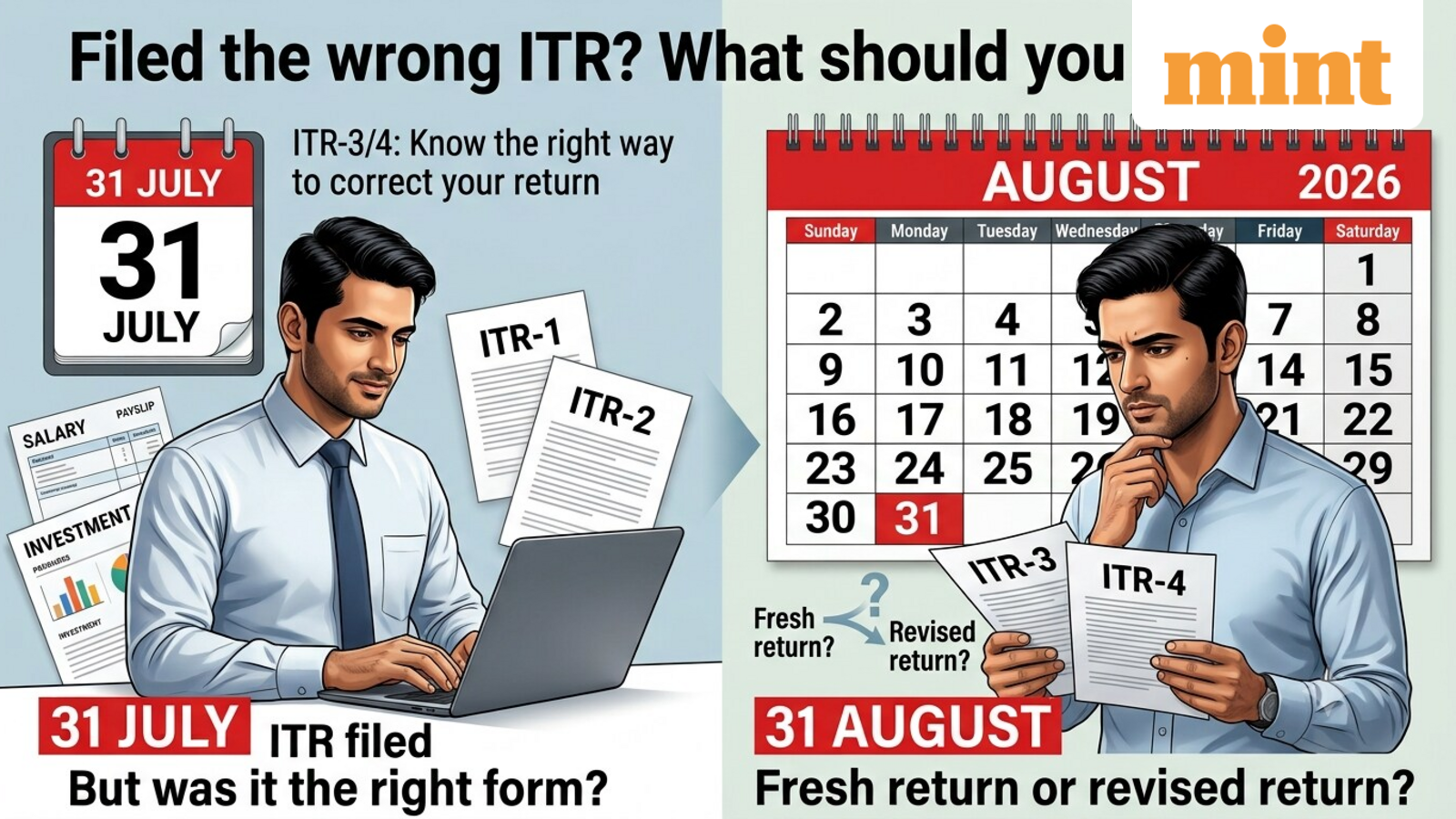
If you have spotted this error, what can you do now to avoid facing penalties? With the ITR-3 and ITR-4 deadline set for 31 August for AY 2026-27, should you file the correct form now? Here’s what you need to know.
Which income triggers ITR-3 or ITR-4?
If an individual has income other than business or professional income, they may still not be eligible to file ITR-1 or ITR-2.
Siddharth Maurya, Founder and Managing Director, Vibhavangal Anukulkara, explained that certain types of income can trigger the requirement to file ITR-3 or ITR-4. These include income earned from services (freelancing or consultancy), commission, brokerage income, side businesses, intraday trading, F&O trading, income earned as a partner in a firm, or remuneration and interest earned as a partner in a firm.
For example, a salaried person with F&O income or loss will have to file ITR-3.
He said ITR-4 will have to be filed only if the taxpayer has opted for and is eligible for presumptive taxation under any of the sections 44AD, 44ADA or 44AE, and all other prescribed conditions are satisfied, including the total income limit of ₹50 lakh.
“In case of gains from delivery-based investments or dividends or interest or rental income, filing ITR-3 or ITR-4 is not mandatory. Under certain circumstances, such income can be reported in ITR-1 or ITR-2,” he clarified.
Should taxpayers correct the mistake by filing ITR-3 or ITR-4 by 31 August?
No. Maurya noted that “If a taxpayer has already e-verified an incorrect ITR-1 or ITR-2, then the taxpayer should not file a new original return”.
He further added that if the earlier return is unverified, then the taxpayer can use the option to discard on the portal to file a return in the correct form by 31 August, provided the return status is ‘Unverified’ or ‘Pending for verification’ and ITR-V has not already been sent to CPC.
“Discarding is permanent, so the correct return should be prepared before taking this step. It is important to make the corrections in time, as a taxpayer may have a business or F&O loss to carry forward or may want to opt for the old tax regime,” he noted.
How can taxpayers rectify their filing mistake?
Maurya said the taxpayer should file a revised return of ITR-3 or ITR-4 by 31 August or later. For AY 2026-27, a revised return may be filed on or before 31 March 2027, or before completion of assessment, whichever is earlier.
“The utilities for AY 2026-27 for ITR-3 and ITR-4 are available, and taxpayers are able to file these forms. While revising, taxpayers have to select Section 139(5), provide the acknowledgement number and filing date of the original return, and disclose the entire income, rather than the omitted amount,” he said.
He further added that Form 16, Form 26AS, AIS and bank statements, broker reports and business records must be checked. F&O turnover must be correctly determined, and audit applicability must be checked.
“Additional self-assessment tax and interest must be paid. The revised return must be verified by the taxpayer within 30 days,” says Maurya.
Disclaimer: This is only for informational and educational purposes. Please consult a qualified expert for the latest laws and regulations.