What $1 Million Buys in the Florida Keys vs. San Diego
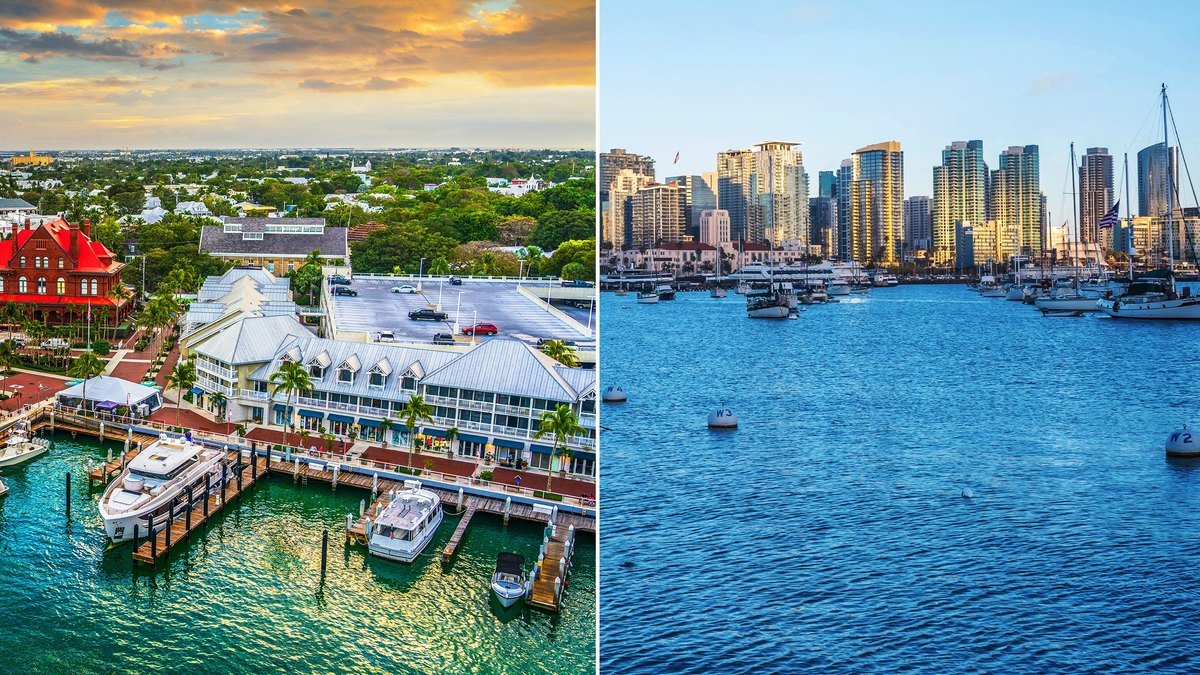
Both have year-round temperate climes, glorious beaches, and a hot luxury market. However, the coastal paradises of San Diego and the Florida Keys, nestled on opposite shores, tell different stories.
“Beyond the warm climate and sought-after beaches, both carry deep Native American histories, and both saw Spanish contact in the 1500s,” writes Realtor.com® senior economist Anthony Smith in his latest luxury report spotlighting San Diego County and the Florida Keys, including Key West and the rest of Monroe County.
“Over the years, each has drawn buyers willing to pay for permanent access to the water, and today, both sit well above the national luxury threshold,” says Smith.
A decade ago, San Diego was the pricier coastal town. Today, that has reversed. While both metros’ entry-level luxury threshold (the top 10% of sales) soars above the nationwide benchmark of $1,250,459, the Keys is significantly outpacing San Diego.
The top 10% threshold in the Keys stands at $4,525,000, roughly 262% above the national level. Meanwhile, San Diego comes in at at $2,768,201, about 121% above.
When it comes to the top 5% (high-end luxury) and top 1% (ultraluxury) of sales, the gap is even wider: The Keys’ high-end threshold is $7,119,000, while its ultraluxury is a whopping $23,572,583. Meanwhile, San Diego’s two highest-priced tiers come in at $4,404,476 and $9,999,055, respectively.
The market size carries a lot of weight here. San Diego’s 5,800 active listings puts roughly 580 homes above its 90th percentile, while the Keys’ 1,280 listings puts only about 130 above the same threshold.
“Large metros hold a deep base of moderately priced inventory that pulls the line lower,” explains Smith. “Key West micropolitan has almost none.”
More than half of the Keys’ active listings, 55.9%, are already above the $1 million price point, compared to 42.9% in San Diego and only 13.2% nationally.
Another issue is scarcity. While both places are running out of room, especially oceanfront land, the Keys’ sits within Florida’s “Area of Critical State Concern.”
According to , this is a program within designated geographic areas that would protect them from uncontrolled development that would “cause substantial deterioration of [their] resources.”
New residential construction is rationed in the Keys through a permit allocation system tied to maintaining a 24-hour hurricane evacuation time, says the report. Since new builds are severely restricted, this pushes prices even higher upward.
While both metros, like much of the country, saw massive gains during the COVID-19 pandemic era, San Diego has since given back nearly 30% of those gains, which peaked in July 2023. The Keys’ peak came much later—January 2026—but the market has since given back only 14.5% of that.
“Although the Keys’ smaller size means somewhat more volatile pricing trends than in San Diego, the floor of the Keys’ threshold still sits above every monthly reading San Diego has posted in the past decade,” concludes Smith.
The San Diego luxury market
While Rancho Santa Fe, in the northeast of San Diego County, carries the highest median list price at $6,889,750, it is Coronado, a thin barrier island to the southwest, that has the highest median price per square foot at $1,721.
Both ZIP codes essentially have no listings priced below $1 million—with Rancho Santa Fe at 100% in terms of listings over that price point, and Coronado at 98%.
“I don’t think I’ve ever sold anything below $1 million,” Whitney Benzian of Douglas Elliman – San Diego, who also grew up on the island, tells Realtor.com. “Or even $2 million.”
“The main thing about Coronado is how small it is,” he says. “That scarcity drives the real estate prices.”
Beyond the scarcity of properties, Benzian points to a huge advantage for the area: The flat peninsula is very walkable, something that lures in buyers from all over.
“You don’t ever have to get in your car,” he says. “You can walk everywhere or ride your bikes. Most people these days have golf carts. You can go weeks and never leave Coronado.”
Coronado’s public beach, its bay with public and private marinas, its wraparound bike path, plethora of retail, and new restaurants such as By the Sea and Night Hawk (in the Baby Grand Hotel) mean there’s really no reason to leave.
A popular attraction is the Hotel del Coronado, built in 1888 and named a National Historic Landmark. The area is also dotted with historic Victorian and Craftsman homes, many of which are snapped up and renovated, then given steep tax breaks in return.
Benzian says the peninsula has high-quality schools, and parents appreciate that kids can walk or bike around on their own.
“You don’t have to schlep your kids to the soccer or baseball fields,” he says. “It leaves you with so much more free time.”
There’s also an affordable public golf course, tennis courts, and the public Coronado Beach on the Pacific, with Point Loma to the north and Mexico to the south. Being on the beach means a constant breeze that draws those who want to flee the heat of Texas, Nevada, Arizona, and Mexico, says the agent.
“Right now, I think it’s the hottest we’ve experienced, and it’s like 80 degrees,” he says. “The breeze is constant. We have the classic Mediterranean climate.”
If you want nightlife, entertainment, or a Padres game, a trip over a 2-mile bridge (also bike-friendly) will bring you to downtown San Diego.
According to Realtor.com data, Los Angeles accounts for 29.3% of San Diego’s cross-market listing views. While the agent says he does see buyers coming in from L.A. and San Diego proper, he doesn’t view it as being a significant number.
“To the extent that one can live in Coronado, people certainly want to,” he says.
The most in-demand properties? A well-positioned lot where someone can build a dream home. An empty 10,000-square-foot lot or teardown can easily fetch $4 million or more, he says.
“The secret is out,” he says of Coronado.
But he admits prices have softened from pandemic-era peaks.
“The buyer is becoming more discerning,” he says. “There’s this battle between the buyer and seller. The seller still thinks they can have these really aspirational prices—and they can’t.
“The buyers are high net worth, but they don’t just spend for the sake of spending.”
Despite all that, the broker still thinks that Coronado is a bit undervalued.
“There’s room for continued growth,” he says.
The Florida Keys
The famous archipelago south of Miami is 120 miles of island paradise stretching between the Atlantic Ocean and Gulf of Mexico, from mainland Florida toward Cuba, and threaded together by the Overseas Highway.
There are five distinctive regions: Key Largo, Islamorada, Marathon, Big Pine and the Lower Keys, and Key West.
Islamorada is the priciest isle in both median list price and the price per square, at $2,667,500 and $1,163, respectively. It also has the highest share of homes priced above $1 million at 71.1%.
Summerland Key follows with a median list price of $1,299,250; then Key West at $1,211,000; Key Largo at $1,200,000; and Marathon at $1,097,000. All of the islands have more homes over $1 million than not, with Marathon having the lowest share at 51.7%.
Key Largo has the lowest price per square foot ($706) and is the closest to Miami.
“The trip takes about an hour, whether driving or boating, making it very convenient for my clients who want the best of both worlds,” Angel Nicolas at Serhant tells Realtor.com.
The Nicolas Team sold an Islamorada compound to Barstool Sports President David Portnoy for $27.8 million, setting a record for the Keys.
The sale price is 12 times the price it was last sold for in 2019, according to Realtor.com property data.
The eight-bedroom, 9.5-bath, 10,228-square-foot manse at Overseas Highway on a 1.65-acre lot was originally listed for $31.2 million.
Nicolas notes the private Ocean Reef Club, located on the northern tip of the Key Largo, as a major attraction to the area.
He says most buyers are second-home purchasers or retirees—people who love to boat and fish—with the majority coming from Palm Beach or Delray, and some migrating from California.
Key Largo also offers larger dwellings than some of the other islands—it’s median square footage is 1,632, just behind Islamorada—but Nicolas says it is all about the larger lot sizes.
“The homes … can sometimes be smaller, but they are typically set on larger waterfront lots and often include a guesthouse,” he says.
Prime luxury: Islamorada
“It’s like being in the Bahamas, but you’re in the U.S.,” Michael E. Petrusha of Find Florida Keys Homes tells Realtor.com. “If you want nice weather, the world’s best fishing, the best views, best diving, you want all the things the Caribbean offers, but you don’t want the hassle of going out of the country, then you come to the Upper Keys.”
Michael and his wife, Tracey, have been selling Upper Keys properties for a quarter-century, and have raised four children there. They also represented the sellers of Little Conch Key, a tiny 5-acre private island off Marathon once owned by Walt Disney, getting $13 million.
“We call it the Hamptons of the Keys,” he says of Islamorada, which has the highest median price point in the Keys by far at $2.66 million.
Petrusha, also a local lender, notes that the Upper Keys—closer to Miami and Broward County than the Lower—is more convenient to primary homes, offices, and larger hospitals.
Islamorada offers a bit more distance from all of that than Key Largo does, combined with a more village feel, full of artists and boutiques, restaurants, and clubs like the famous Cheeca Lodge and Spa.
“It’s tough to get off the rock,” Petrusha says of any of the islands lower than Islamorada.
He and his wife currently represent a $7 million listing with a rare 225 feet of prime waterfront and access to both Florida Bay and the Atlantic Ocean. The seven-bedroom estate comes with a deep-water canal that can park a megayacht.
They also represent a 61-acre island about 7 miles off Key West currently lowered to $495,000, which is less than the typical New York City studio apartment.
Islamorada also offers a quieter, more relaxed vibe than Key West, which Petrusha calls the “New Orleans of the Keys.”
“You could step outside your house, and there’s somebody drinking a beer,” he says with a laugh. “It’s very city-ish there.”
Since Portnoy bought his $27.8 million compound in late 2025, the couple say they have noticed a shift in buyers—with more big shots circling sprawling compounds.
“Islamorada is very upscale,” says Tracey. “A lot of mom and pop shops that cater to the upscale crowd.”
Several big buyouts—including Cheeca Lodge and Spa, bought by Bass Pro Shops in June for an undisclosed sum—means major equity is pouring into the little island.
Adds Petrusha: “You definitely got corporations that are acquiring a lot and making it more difficult to live if you’re local.”