Rhine River Water Levels Near Record Lows Disrupt German Transport
Editorial & Advertiser disclosure
Global Banking & Finance Review® is an online platform offering news, analysis, and opinion on the latest trends, developments, and innovations in the banking and finance industry worldwide. The platform covers a diverse range of topics, including banking, insurance, investment, wealth management, fintech, and regulatory issues. The website publishes news, press releases, opinion and advertorials on various financial organizations, products and services which are commissioned from various Companies, Organizations, PR agencies, Bloggers etc. These commissioned articles are commercial in nature. This is not to be considered as financial advice and should be considered only for information purposes. It does not reflect the views or opinion of our website and is not to be considered an endorsement or a recommendation. We cannot guarantee the accuracy or applicability of any information provided with respect to your individual or personal circumstances. Please seek Professional advice from a qualified professional before making any financial decisions. We link to various third-party websites, affiliate sales networks, and to our advertising partners websites. When you view or click on certain links available on our articles, our partners may compensate us for displaying the content to you or make a purchase or fill a form. This will not incur any additional charges to you. To make things simpler for you to identity or distinguish advertised or sponsored articles or links, you may consider all articles or links hosted on our site as a commercial article placement. We will not be responsible for any loss you may suffer as a result of any omission or inaccuracy on the website.
Rhine River’s Record Low Water Levels Disrupt Shipping, Impact German Economy
Current Situation and Economic Implications
Recent Changes in Water Levels
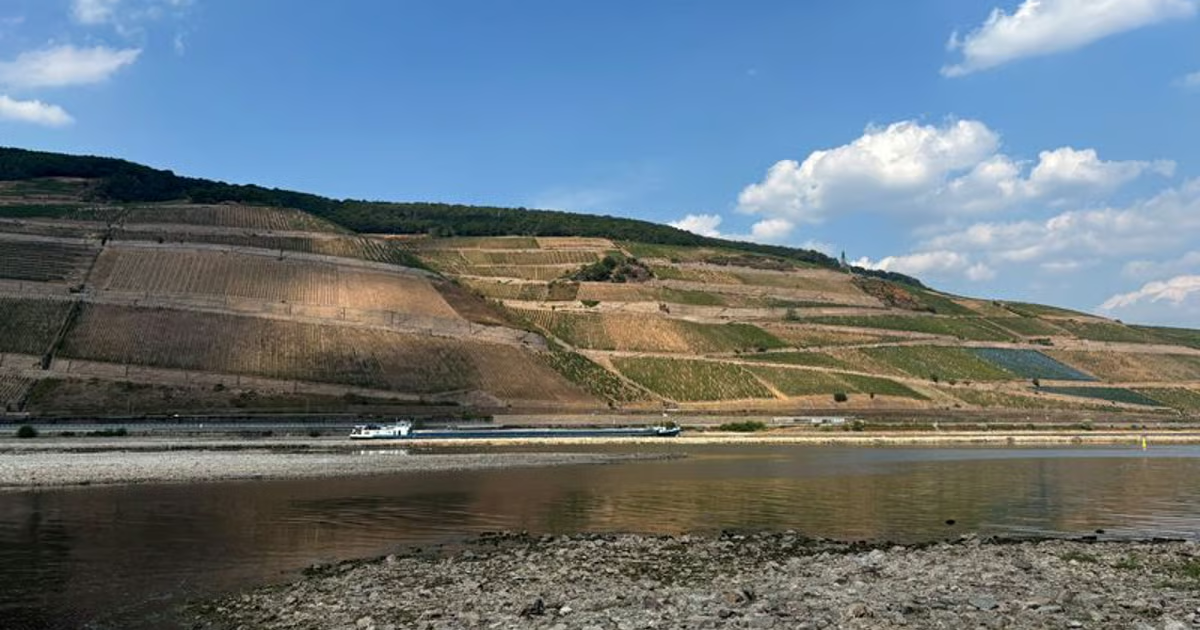
BERLIN, Aug 19 (Reuters) – Water levels on the Rhine River, one of Europe’s busiest shipping arteries, have slightly risen this week, official data showed on Wednesday, but remain near record lows, hampering transport and production.
Kaub Gauge Readings
• The water level gauge at the chokepoint of Kaub near the city of Koblenz rose to 14 cm (5.5 inches) on Wednesday morning, inland navigation agency WSV data showed, after 5 cm earlier this week.
Measurement Significance
• The river is about one metre deeper than the gauge, which has been traditionally used as an indicator to measure local levels.
Impact on Industry and Economy
Production and Transport Effects
• As a rule of thumb, if the Kaub gauge falls below 78 cm for 30 straight days, as was the case in 2022 and 2018, German industrial production falls by 1%, according to economic institute IfW.
Economic Outlook
• However, economists with BVR, Germany’s association of cooperative banks, said on Tuesday that the Rhine’s low water levels and heatwaves are only temporarily holding back the country’s economic recovery, raising their 2026 GDP growth forecast to 1% from 0.5%.
Industry Warnings
• Chemical producers, utilities, steelmakers and agricultural traders have warned of higher transport costs and lower production.
Forecasts and Future Prospects
• It could take weeks for water levels to rise to a level normal for this time of year, according to forecasts published by WSV, after a months-long drought in many parts of Germany.
(Reporting by Thomas Seythal, additional reporting by René WagnerEditing by Ludwig Burger)