
Entity Wrappers Do Not Neutralize Tax Anti-Abuse Rules
A June 16, 2026 article from AQR tackled a question that comes up more often than you’d think among sophisticated investors: if you hold a long position in your personal brokerage account and simultaneously short the identical position through a partnership you control, have you found a clever workaround to the wash sale, straddle and constructive sale rules—or have you just added complexity without changing your tax outcome?
The short answer is that U.S. tax law was built to follow economic substance rather than legal form. An entity wrapper—whether an LLC, a single-investor fund or a commingled partnership—doesn’t automatically neutralize the anti-abuse provisions that govern wash sales, straddles and constructive sales. Sometimes it does very little at all. The degree of protection depends entirely on the extent of genuine economic separation between the investor and the vehicle.
What AQR Examined
The paper walks through three anti-abuse frameworks that exist to make sure tax losses and gains track real changes in economic exposure rather than paper rearrangements:
Wash sales (Section 1091) disallow a loss if an investor sells a security and, within 30 days on either side of the sale, buys back a substantially identical security. The point is simple: you shouldn’t be able to harvest a tax loss while never actually leaving the position.
Straddles (Section 1092) defer a loss when offsetting positions—one with an embedded gain, one with an embedded loss—substantially reduce the investor’s risk. This prevents someone from locking in economic certainty while still claiming a current-year loss.
Constructive sales (Section 1259) treat certain hedges—tight collars, shorts-against-the-box, total return swaps—as taxable sales when they eliminate both the risk of loss and the opportunity for gain on a position, even though the investor technically still owns it.
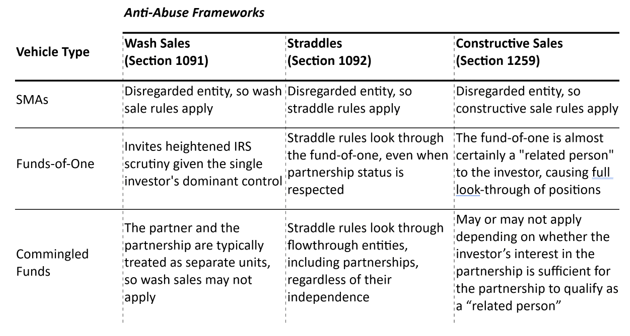
AQR then maps each of these three regimes against three entity structures: disregarded entities (a business the IRS ignores as separate from its owner for federal income tax purposes, typically a single-member LLC) and separately managed accounts, funds-of-one, and commingled multi-investor funds, asking in each case whether the wrapper actually changes the tax analysis.
Key Findings
The results are not uniform across entity types, and that’s really the point of the paper.
SMAs and single-member LLCs offer no protection at all. These are disregarded for tax purposes, so all three anti-abuse rules apply exactly as if the investor traded directly. There’s no wrapper effect to speak of.
Funds-of-one party is the riskiest gray zone. A fund-of-one may technically be structured as a partnership, but if the sole investor can dictate the mandate, restrict the asset universe, monitor positions in real time, or coordinate trades with personal accounts, that control collapses the legal distinction between investor and entity. AQR notes this is compounded when the general partner has thin economics—little capital at risk and minimal profit participation—which does nothing to support a separateness argument. Practically, this means a wash sale claimed inside a fund-of-one invites real IRS scrutiny, the straddle rules look through the structure regardless of whether partnership status holds up, and the fund is almost certainly treated as a “related person” for constructive sale purposes, triggering full attribution back to the investor.
Commingled funds get more genuine separation, but unevenly across the three regimes. A true multi-investor fund with pooled capital, independent third-party management, and no single investor directing trades stands on much firmer ground. For wash sales, the partner and partnership are typically treated as separate units, so the rule may not reach through to the investor’s personal account. Straddle rules, however, are far less forgiving—they explicitly look through flow-through entities, including partnerships, regardless of how independent the fund is. And constructive sale treatment depends on whether the investor’s stake is large enough for the fund to count as a “related person,” which a typical limited partner in a large fund usually isn’t.
The throughline across all three structures: even when a wrapper provides some technical separation, anti-abuse principles can still reach through if positions are coordinated across an investor’s personal accounts and fund holdings.
Key Takeaways for Investors
First, the test that matters isn’t “what entity did I use” but “does this entity have a pre-tax investment rationale?” If a structure exists for no reason other than to manufacture a different tax outcome, the analysis is effectively over before it starts—the IRS and the courts are looking at substance, not labels.
Second, funds-of-one deserve particular caution. They’re the structure most likely to create a false sense of security, since they look like a partnership on paper while functioning like a personal account in practice. The more control an investor retains, the less that wrapper is doing for them.
Third, even genuine commingled funds aren’t a blanket shield. Straddle rules in particular look through partnership structures almost without exception, so investors shouldn’t assume that simply being one of many limited partners insulates a position from straddle treatment if it’s economically paired with something they hold elsewhere.
Finally, the right lens for evaluating an LP or LLC is what it actually delivers—administrative efficiency, liability protection, operational flexibility—rather than treating it as a lever against rules specifically designed to resist this kind of structuring. As the paper puts it, if a structure’s main selling point is a tax result the underlying economics don’t support, that’s the signal to walk away, especially if it’s being marketed on that basis.
AQR’s note carries this caveat, worth heeding: Anyone considering one of these structures for tax-sensitive trading should work through the specifics with a qualified tax advisor before assuming a wrapper changes anything.