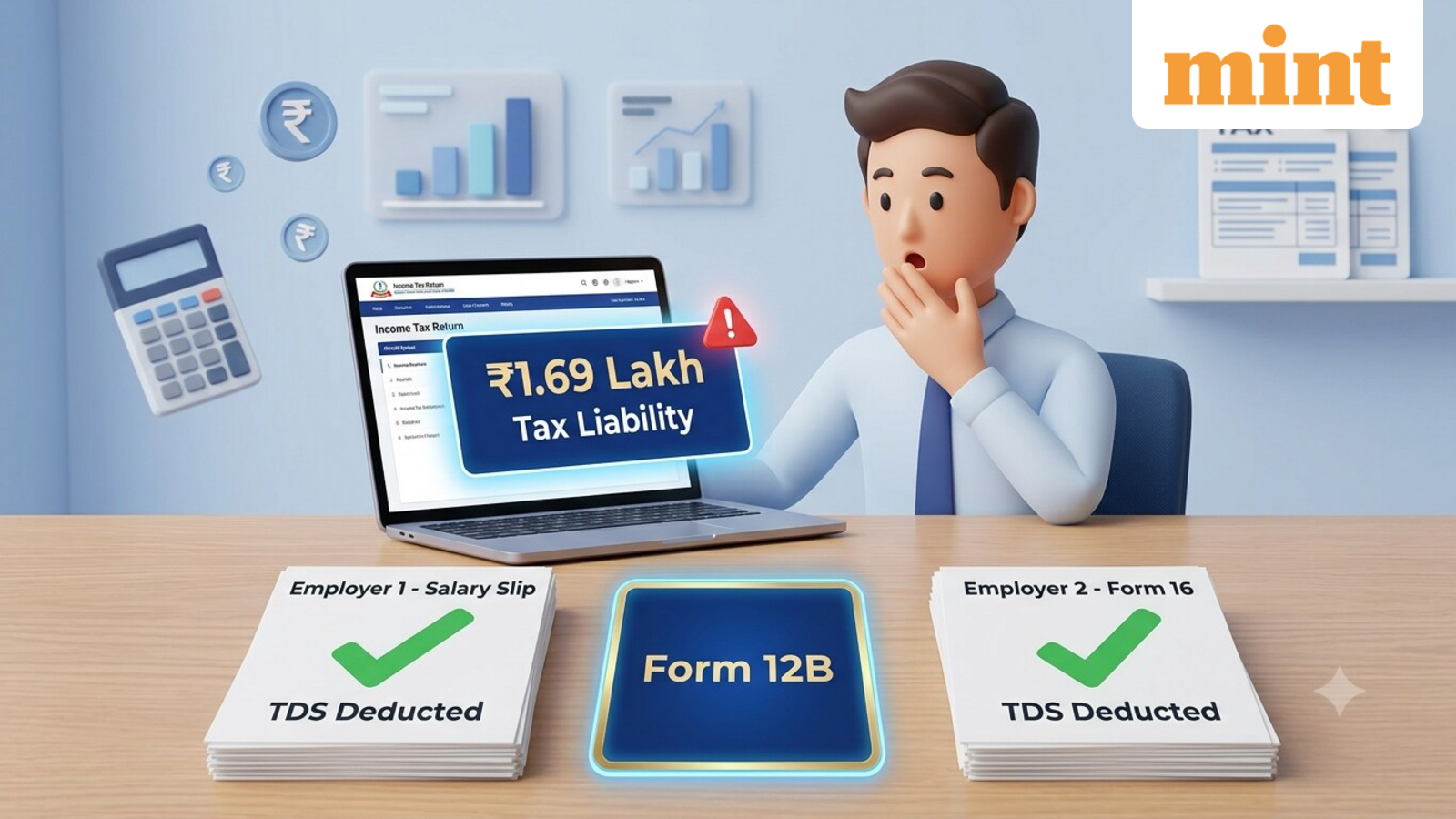
Job switch leads to ₹1.69 lakh tax liability despite both employers deducting TDS correctly: Here’s why Form 12B matters
A job switch during the financial year can lead to an unexpected tax liability, even if both employers have deducted TDS correctly. This happens because each employer calculates TDS only on the salary it pays, while your final tax is computed on your total annual income.
Dev Patel, Financial Advisor at 1 Finance, highlights a case in which an employee incurred a tax liability of ₹1.69 lakh despite both employers correctly deducting TDS.
Why can correct TDS deductions still lead to tax liability?
Explaining the case on X, Patel said, “A client of mine switched jobs last August.”
Patel said the employee received a salary of ₹7 lakh from the previous employer between April 2025 and July 2025, while the new employer paid ₹18 lakh between August 2025 and March 2026. The previous employer deducted zero TDS, while the new employer deducted ₹1.51 lakh. Both employers deducted TDS correctly, and the employee was certain that no additional tax was payable.
However, Patel wrote that when the employee filed the income tax return, a tax liability of ₹1.69 lakh emerged.
The reason, he said, is that employers calculate TDS based only on the salary they pay and do not automatically know about income received from another employer during the same financial year.
How do separate TDS calculations affect final tax liability?
In this case, Patel says, the first employer considered only a ₹7 lakh salary. Under the new tax regime, after considering the Section 87A rebate eligibility, no TDS was deducted.
“The zero on the first job looks like an error. It is actually where the story begins,” Patel explained.
The second employer calculated TDS only on the ₹18 lakh salary. It provided the standard deduction of ₹75,000 and calculated tax accordingly, resulting in TDS of ₹1.51 lakh. However, as Patel said, “The tax department does not see two salaries. It sees one person who earned ₹25 lakh.”
Since the standard deduction can be claimed only once and tax slabs apply to the combined annual income, the employee’s income falls into the 25% and 30% tax brackets, which the employer did not account for while deducting TDS.
As a result, the total tax liability on ₹25 lakh income for FY 2025-26 worked out to ₹3.20 lakh. With only ₹1.51 lakh deducted as TDS, the employee was left with an additional ₹1.69 lakh tax liability, apart from any applicable interest.
How can Form 12 B prevent such tax surprises?
When an employee changes jobs during a financial year, they need to submit Form 12B to the new employer. Under the Income Tax Act, 2025, this has changed to Form 122.
“Form 12B is to be given to your new employer with your previous salary and TDS details, and they compute TDS on your combined income from day one,” Patel said.
Using these details, the new employer can calculate TDS on the combined salary income for the entire year and deduct tax accordingly.
What should employees do after switching jobs?
Employees who have changed jobs during FY 2025-26 should not rely only on Form 16 from their current employer.
Before filing ITR for AY 2026-27, taxpayers should check:
- Total salary received from both employers (both Form 16s)
- Standard deduction eligibility (claimed only once)
- Compare the total tax liability with the TDS deducted by both employers
“If there is a gap, pay self-assessment tax before 31 July,” Patel wrote.
Disclaimer: This is only for informational and educational purposes. Please consult a qualified tax expert for the latest tax laws and regulations.