Harvard’s 2026 Housing Report Finds Affordability Reaching Breaking Point
Every year, the State of the Nation’s Housing report published by Harvard’s Joint Center for Housing Studies (JCHS) provides an overview of the circumstances faced by U.S. households in their quest for affordable housing. The 2026 report indicates a market characterized by subdued activity, declining demand, and elevated costs that are preventing numerous potential buyers and renters from entering the market, despite new construction gradually addressing supply deficiencies. JCHS outlined some key insights that highlight the severity of current housing issues and the pressing need for continuous action across all tiers of government.
Many signs in the report’s findings indicate that the housing market is experiencing sluggish activity into early 2026. Existing home sales have not bounced back since they reached a 30-year low in 2023. Overall, new home sales figures have stayed relatively constant, rental retention rates have increased, and new occupancy rates have declined. Further, construction starts have decreased by 1% over the last year, largely influenced by a 7% reduction in single-family home starts.
Despite ongoing supply shortages being a significant issue, weakened demand has emerged as a prominent topic in the housing sector over the past year. In 2025, the annual growth rate of households declined for the third consecutive year, and the annual increase in homeowner households was reduced by 50%, resulting in a decrease in homeownership rates for the second year in a row. Additionally, the demand for apartments has also diminished, as the year-over-year growth in the number of renters during Q1 of 2026 was less than 50% of the figure from the previous year.
Notable Factors Impacting Today’s Market Activity
The present decline in housing demand is a consequence of several fundamental economic factors. Employment growth experienced a dramatic fall from an increase of 1.5 million in 2024 to merely 116,000 in 2025. Additionally, consumer confidence plummeted by more than 20 percentage points during 2025, further declining after the onset of the conflict in Iran, reaching a record low in April 2026. These levels were even lower than those observed during the Great Recession of 2008 or the pandemic. In the absence of employment, graduates are less inclined to establish new households or relocate to different regions. Further, without confidence in job stability, families are less likely to relocate or make significant purchases such as buying a home.
The issue of unaffordability is significantly impacting demand, as it renders housing costs inaccessible for numerous households. Elevated home prices and interest rates have resulted in costs approaching historical highs. Currently, the median prices for both new and existing homes exceed $400,000 nationwide. Since 2020, existing home prices have surged by 54% nationwide and now stand at nearly five times the median income, a stark contrast to the standard ratio of three that was prevalent in the 1990s. Additionally, with interest rates remaining above 6%, the monthly payments for a median-priced home are projected to reach $3,100 in the fourth quarter of 2025, a substantial increase from $1,700 in early 2020. To manage this payment, households would require an income exceeding $120,000, compared to $66,000 in 2020.
Since 2022, there has been a surge in multifamily construction alongside consistent levels of single-family homebuilding, resulting in an increase in vacancy rates from historically low figures. The rental vacancy rate has risen from its unprecedented low of 5.9% in 2022 to 7.3% in Q1 of 2026, while the for-sale vacancy rate has grown from a record low of 0.81% in 2023 to 1.13%. Current rates are now approaching the average levels observed in the 1990s, where they remained relatively stable at an average of 7.7% for rentals and 1.6% for sales.
Recent increases in supply differ throughout the nation, primarily due to varying construction activities. In the Austin metropolitan area—characterized by substantial construction—the apartment vacancy rate has risen by 5 percentage points since 2021, and the number of for-sale listings has nearly tripled. Conversely, in the Chicago metropolitan area—where construction has been less vigorous—the apartment vacancy rate has only increased by 0.5 percentage points over the same period, while for-sale listings have decreased by 20%.
Recent increases in housing supply have not been uniform across different price ranges. Over the past decade, the growth in rental properties has been concentrated solely in higher-rent categories, while the availability of units renting for under $1,000—approximately the affordability threshold for a household with an income of $40,000—has decreased by 7 million, either lost entirely or converted to higher rents. Additionally, there is a scarcity of reasonably priced homeownership options, with data from NAR/Realtor.com indicating that the number of homes available for sale that are affordable to households earning $75,000 or less in March 2026 has dropped by 60% compared to March 2019.
However, the most significant shortfall is faced by the lowest-income renters. The latest Gap report from the National Low Income Housing Coalition reveals that 11 million extremely low-income renters are vying for merely 3.8 million units that are both affordable and available to them, resulting in a deficit of 7.2 million units.
Housing Shortages, Renter Affordability & More Hindering Consumers
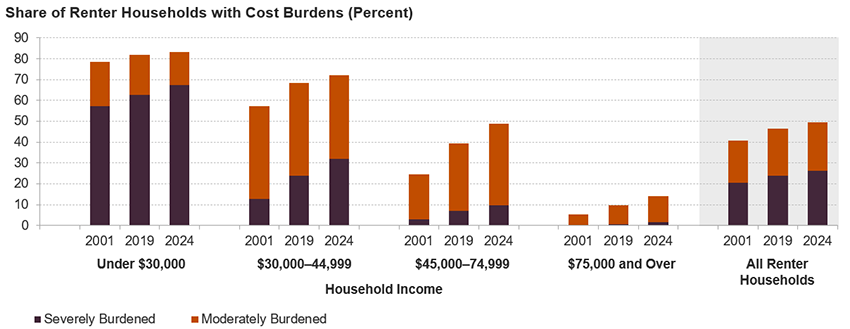
The severe lack of affordable housing is clearly reflected in the significant proportion of households facing unaffordable housing expenses. According to the latest data in 2024, the number of renters experiencing cost burdens has reached an unprecedented high. These financial burdens are increasing even among lower-income households, where the rates are already alarmingly elevated; some 83% of renters earning less than $30,000 annually allocate over 30% of their income to housing, and a substantial 66% are spending more than 50% of their income on housing. Additionally, low-income homeowners are experiencing record levels of financial strain, compounded by escalating insurance premiums, property taxes, energy and utility expenses, and overall inflation.
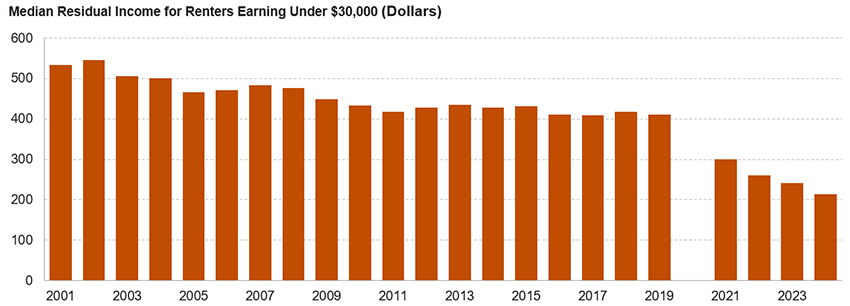
Due to the necessity of allocating a significant portion of their income to housing, millions of low-income families find themselves with limited resources for other essential needs. After covering housing expenses, the 13 million renter households with incomes below $30,000 are left with a median of only $210 per month for all other necessities. This figure represents a substantial decline from the already low $410 of disposable income for this demographic in 2019, even when adjusted for inflation. Concurrently, inflation has caused a sharp increase in non-housing expenses, further diminishing the capacity to sustain a household with such scant remaining funds.
As millions struggle with elevated housing expenses, an increasing number of state and local governments are implementing measures to boost housing production. The report emphasizes various states and local jurisdictions nationwide that are eliminating regulatory obstacles and introducing locally managed financial solutions, including revolving construction loans.
In conclusion, several constructive actions at the federal level have taken place, particularly highlighted by the rise in funding for the Low-Income Housing Tax Credit and the continuing dialogues surrounding the 21st Century ROAD to Housing Act. However, additional support will be essential to enhance the affordability and accessibility of housing for low- and moderate-income families, considering the significant demand outlined in this year’s report.
To read more, click here.