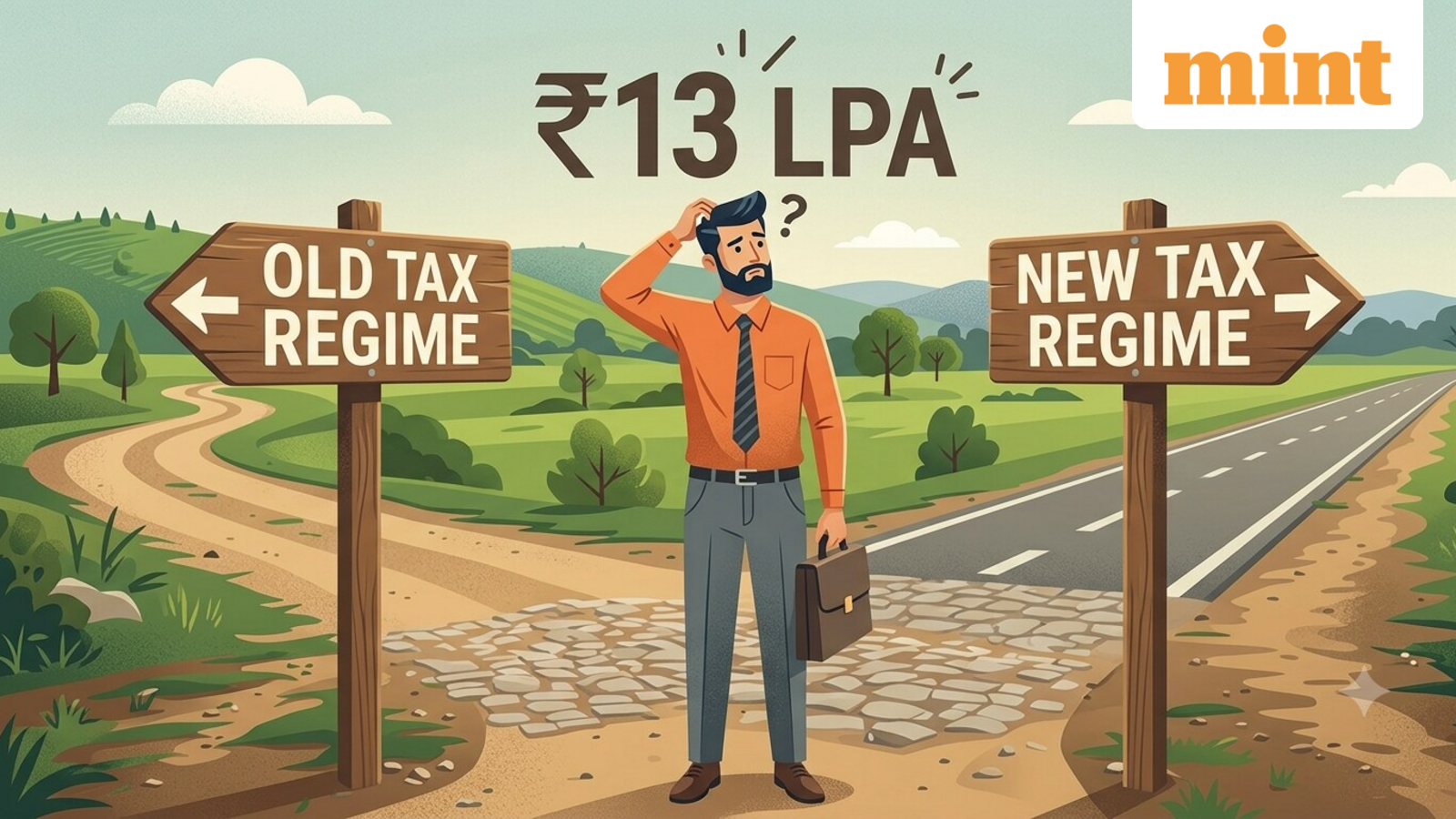
Earning ₹13 lakhs? Old vs new tax regime comparison shows which saves more tax
For salaried taxpayers earning around ₹13 lakh a year, the assumption that tax-saving investments automatically make the old tax regime the better choice may no longer hold true. The changes introduced in Budget 2025 have significantly altered the tax equation, with the revised slab rates and rebate under the new regime narrowing, and in some cases eliminating, the tax advantage offered by traditional deductions.
To understand the impact, consider the example of a salaried employee with a gross annual salary of ₹13.7 lakh. A comparison of the two tax regimes shows that the new regime can completely eliminate the tax liability, whereas the old regime still results in a tax outgo even after accounting for multiple deductions and exemptions.
How much tax do you pay under the new regime?
Under the new tax regime, taxpayers cannot claim most exemptions and deductions available under the old regime. However, salaried individuals can still claim the ₹75,000 standard deduction and the deduction for an employer’s contribution to the National Pension System (NPS) under Section 80CCD(2).
In this example by Cleartax, the employer’s NPS contribution amounts to ₹95,200, reducing the taxable income to ₹11.99 lakh. Although the income tax works out to ₹59,980, the taxpayer becomes eligible for the rebate under Section 87A, reducing the final tax liability to nil.
|
Particulars |
Amount ( ₹) |
| Gross salary | 13,70,000 |
| Less: Standard deduction | 75,000 |
| Less: Employer’s NPS contribution [Section 80CCD(2)] | 95,200 |
| Taxable income | 11,99,800 |
| Tax before rebate | 59,980 |
| Less: Rebate under Section 87A | 59,980 |
| Final tax payable | Nil |
Source: ClearTax tax computation for FY 2025-26.
Can the old regime’s deductions reduce your tax bill?
The old tax regime allows taxpayers to claim several exemptions and deductions, including HRA, Leave Travel Allowance (LTA), children’s education allowance, deductions under Sections 80C and 80D, an additional NPS deduction under Section 80CCD(1B), and the employer’s contribution to NPS under Section 80CCD(2).
For the same salaried employee, the following exemptions and deductions are claimed:
HRA exemption: ₹1,00,000
Children’s education allowance: ₹9,600
Professional tax: ₹2,400
Section 80C deduction: ₹1,50,000
Section 80CCD(1B) deduction: ₹50,000
Section 80D deduction: ₹25,000
Employer’s NPS contribution under Section 80CCD(2): ₹68,000
After accounting for these deductions, the taxable income falls to ₹8.25 lakh. Even then, the total tax liability, including the 4% health and education cess, works out to ₹80,600.
|
Particulars |
Amount ( ₹) |
| Gross salary | 13,70,000 |
| Less: HRA exemption | 1,00,000 |
| Less: LTA exemption | 20,000 |
| Less: Children’s education allowance | 9,600 |
| Less: Standard deduction | 50,000 |
| Less: Professional tax | 2,400 |
| Income under the head ‘Salary’ | 11,88,000 |
| Less: Section 80C deduction | 1,50,000 |
| Less: Section 80CCD(1B) deduction | 50,000 |
| Less: Section 80D deduction | 25,000 |
| Less: Employer’s NPS contribution [Section 80CCD(2)] | 68,000 |
| Net taxable income | 8,25,000 |
| Tax payable (including 4% cess) | 80,600 |
| Source: ClearTax tax computation for FY 2025-26. |
Which tax regime saves more at ₹13 lakh?
For a salaried individual earning ₹13.7 lakh annually, the new tax regime emerges as the more tax-efficient option in this illustration. While the old regime results in a tax liability of ₹80,600 despite multiple deductions and exemptions, the new regime brings the final tax payable down to zero after applying the Section 87A rebate.
That translates into a tax saving of ₹80,600 by opting for the new regime.
However, the choice between the two regimes should not be based on salary alone. Taxpayers with substantial deductions, such as higher HRA exemptions, home loan interest, or larger employer NPS contributions, should compare their tax liability under both regimes before making a decision. For many salaried individuals earning around ₹13 lakh, however, the revised tax slabs and rebate under the new regime make it the more tax-efficient choice.