Section 31 of IBC explained: Why EPFO may not recover ₹1,816 crore in unpaid Reliance Capital dues after insolvency
The Employees’ Provident Fund Organisation (EPFO) may have no legal route to recover ₹1,816.22 crore in unpaid principal and interest from Reliance Capital Ltd, following the company’s insolvency resolution. The legal hurdle is Section 31 of the Insolvency and Bankruptcy Code (IBC), 2016, which makes an approved resolution plan binding on the company and its creditors.
The provision is intended to give companies emerging from insolvency a degree of certainty by preventing creditors from raising fresh claims after a resolution plan has been approved by the National Company Law Tribunal (NCLT). While this protects successful resolution applicants from unexpected liabilities, it can also leave creditors with substantial unpaid claims, as EPFO’s Reliance Capital investment illustrates.
Here is what Section 31 says, how the Supreme Court has interpreted it and why it matters for EPFO.
What is Section 31 of the Insolvency and Bankruptcy Code?
Section 31 deals with the approval and legal effect of a resolution plan under the IBC. It states that once the NCLT approves a resolution plan cleared by the committee of creditors (CoC), the plan becomes binding on the corporate debtor, its employees, members, creditors, guarantors and other stakeholders.
The provision also explicitly includes the Central government, state governments and local authorities to whom statutory dues are payable. This inclusion was introduced through the IBC Amendment Act, 2019.
In practical terms, this means creditors cannot independently demand payments from a company outside the terms of an approved resolution plan. They must submit their claims during the insolvency process and receive payments according to the approved plan.
Section 31 is important because it gives a successful resolution applicant clarity about the liabilities it will inherit when taking over a distressed company. Without such finality, a new owner could face additional recovery demands even after completing the acquisition and paying creditors under the resolution plan.
The provision also requires the resolution applicant to obtain necessary statutory approvals within one year of the NCLT’s approval of the plan, or within the period prescribed under the relevant law, whichever is later.
What did the Supreme Court say about Section 31?
The Supreme Court clarified the scope of Section 31 in its April 2021 judgment in Ghanashyam Mishra and Sons Pvt Ltd vs Edelweiss Asset Reconstruction Company Ltd.
The court held that once the NCLT approves a resolution plan, all claims provided for in it stand frozen and become binding on the corporate debtor and other stakeholders.
More importantly, claims that are not part of the approved resolution plan stand extinguished from the date of its approval. Creditors cannot subsequently initiate or continue proceedings to recover such dues from the resolved company.
The court also clarified that statutory dues owed to the Central and state governments and local authorities would stand extinguished if they were not included in the approved resolution plan.
The reasoning was that a successful resolution applicant must be able to take over a company with certainty about its liabilities, without facing unexpected claims from creditors after the insolvency process is complete.
This principle is often described as the ‘clean slate’ approach to insolvency resolution. It seeks to balance creditors’ recovery rights during insolvency with the need to revive financially distressed companies.
Why is EPFO unable to recover its remaining ₹1,816 crore from Reliance Capital?
The issue dates back to 2013-14, when EPFO invested ₹2,500 crore in secured non-convertible debentures (NCDs) issued by Reliance Capital through its portfolio managers. The investments were scheduled to mature in 2023 and 2024.
However, Reliance Capital stopped servicing interest payments from October 2019 and subsequently defaulted on its repayment obligations.
Following the Reserve Bank of India’s intervention in November 2021, Reliance Capital entered the corporate insolvency resolution process under the IBC.
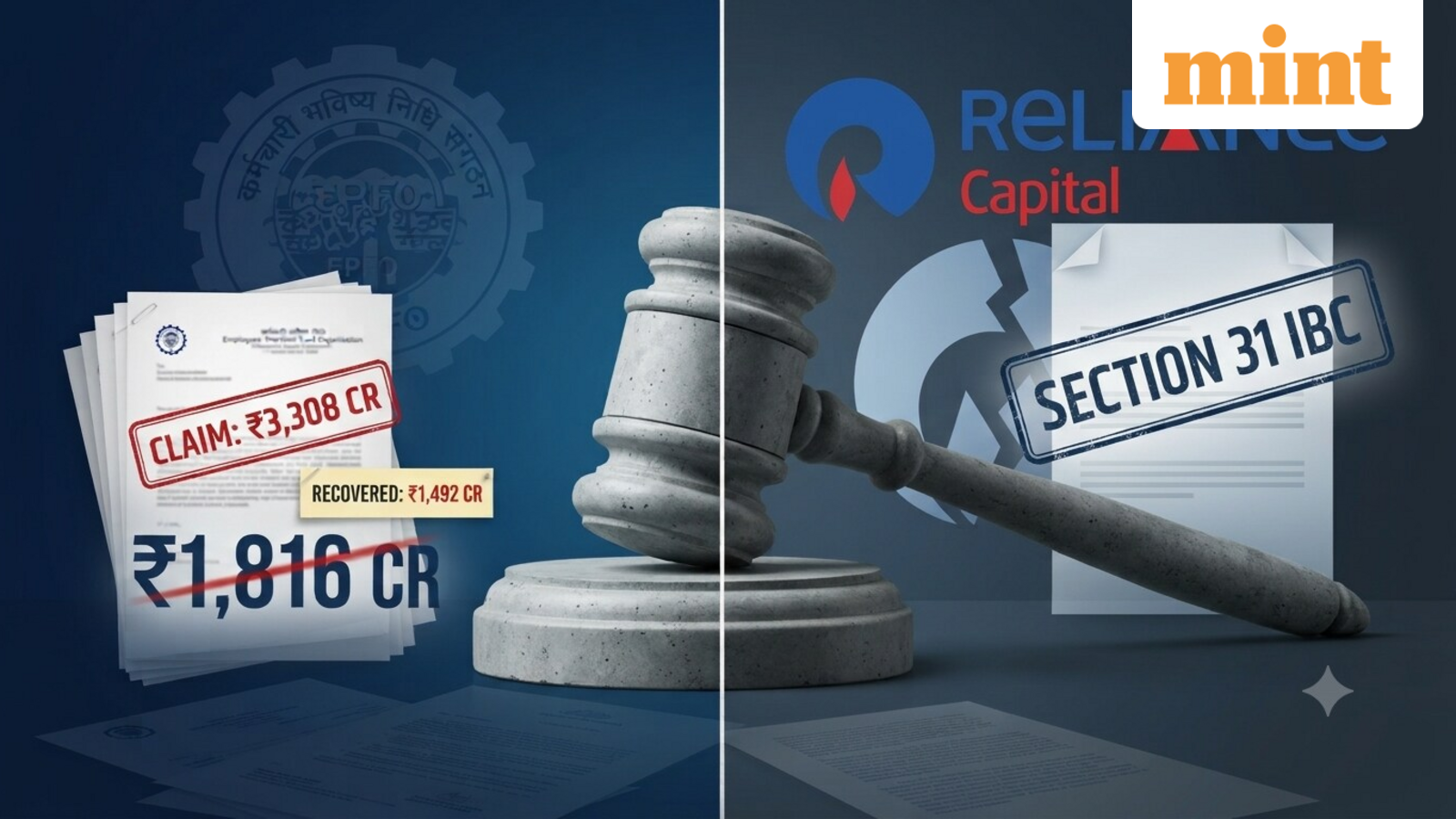
EPFO submitted a claim of ₹3,308.67 crore, comprising ₹2,500 crore in principal and ₹808.67 crore in accrued interest. However, the NCLT approved a resolution plan submitted by Hinduja Group entity IndusInd International Holdings in February 2024.
Under the resolution process, EPFO recovered only ₹1,492.45 crore. The remaining ₹1,816.22 crore comprises ₹1,007.55 crore in unpaid principal and ₹808.67 crore in interest.
According to an agenda note reviewed by The Hindu, EPFO’s legal advisers have concluded that the organisation has no further legal avenue to recover the outstanding amount from Reliance Capital. The insolvency resolution has attained finality, and Section 31 prevents creditors from reopening their claims against the resolved company.