Sold a house and bought another within 2 years? Here’s when capital gains could still be taxable – Section 54 rules
If you have sold a house and reinvested the sale proceeds in a new residential property within the prescribed timeline, you may still face capital gains tax if you fail to meet certain conditions. While reinvesting in a new house can help you claim tax exemption, taxpayers must understand the rules and timelines to avoid losing the benefit.
Section 54 of the Income-tax Act, 1961, allows individuals and Hindu Undivided Families (HUFs) to claim an exemption from long-term capital gains (LTCG) on the sale of a residential house by investing in another residential property in India.
Under the Income-tax Act, 2025, this provision has been renumbered as Section 82, with the corresponding conditions unchanged.
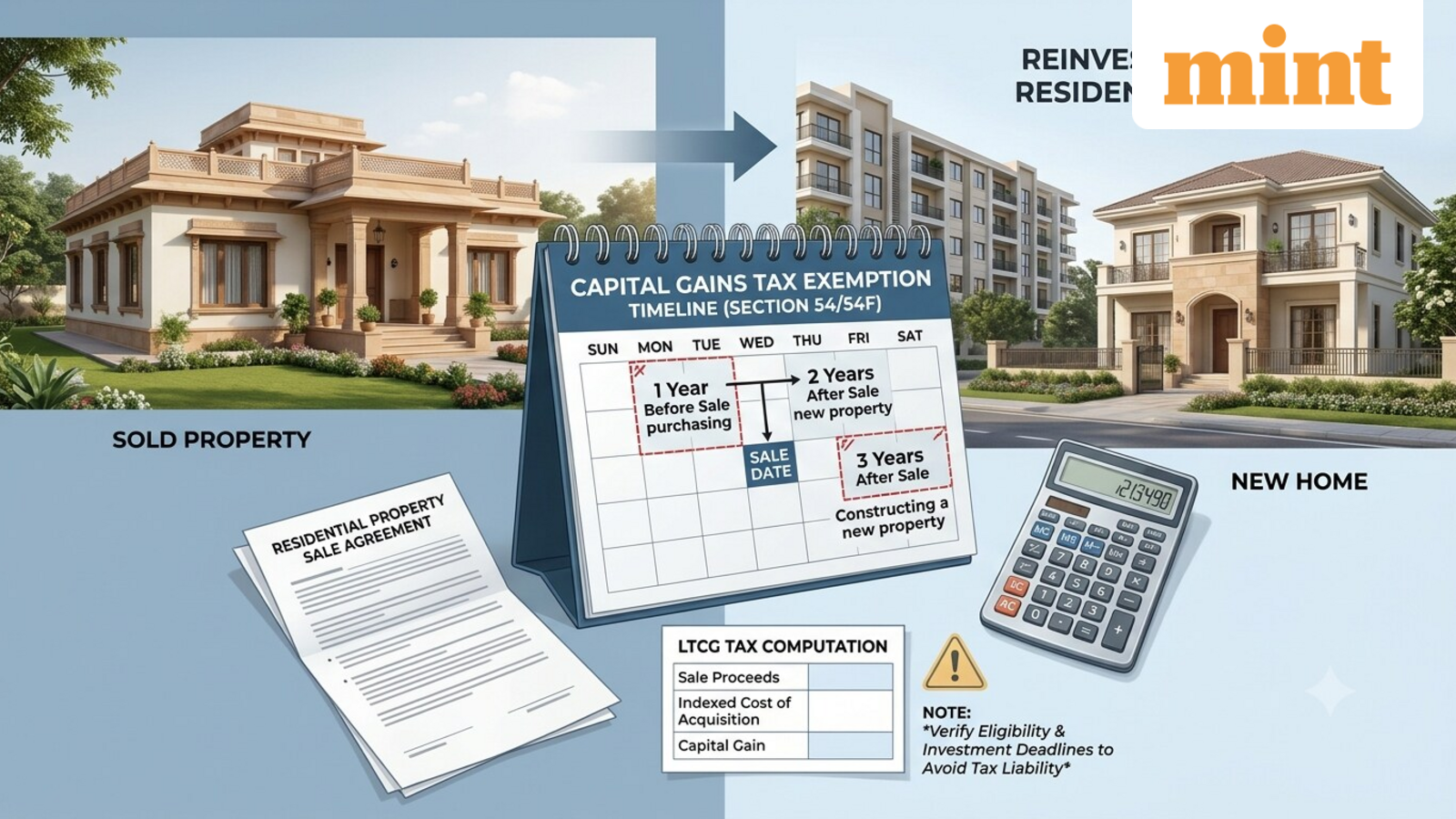
To claim the exemption, the taxpayer must purchase a new house within 1 year before or 2 years after selling the old property, or construct a new house within 3 years of the sale.
The exemption is subject to a maximum eligible investment of ₹10 crore. Here are the key situations in which the exemption can be denied or withdrawn.
When can the capital gains tax exemption be denied?
Here’s when the Section 54 tax exemption may not apply:
1. You fail to meet the purchase or construction deadline
If you do not purchase a new residential property within the prescribed two-year period after the sale, or complete its construction within three years, you may lose the exemption on the unutilised capital gains.
2. The property sold does not qualify as a long-term capital asset
To claim the Section 54 exemption, the property sold must qualify as a long-term capital asset. This means the immovable property, such as land or a building, must have been held for more than 24 months immediately before the sale. If the holding period is shorter, the gains will not qualify for the Section 54 exemption.
3. You sell the new house within three years
If you sell the new residential property within three years of its purchase or completion of construction, the earlier exemption can be reversed for the purpose of calculating capital gains on the new sale.
The amount of capital gains previously claimed as exempt reduces the new property’s cost for tax calculation, potentially increasing the taxable gains.
4. Your investment exceeds the eligible limit
The exemption is capped at ₹10 crore. Any investment above this limit is not considered for calculating the exemption.
5. You do not deposit the unutilised amount in the specified account
If you cannot use the capital gains to purchase or construct the new house before filing your income tax return, you must deposit the unutilised amount under the Capital Gains Accounts Scheme (CGAS) by the applicable return-filing due date to claim the exemption. Missing this requirement can affect your eligibility.
6. You fail to use the deposited money within the prescribed period
If you deposit the money under the Capital Gains Accounts Scheme but do not use it for purchasing or constructing the house within the prescribed timeline, the unutilised amount becomes taxable as long-term capital gains in the year the three-year period expires.
Can you buy two houses to claim exemption?
Yes. If your long-term capital gains do not exceed ₹2 crore, you can choose to invest in two residential houses in India instead of one. However, this option can be exercised only once in a lifetime.
Disclaimer: This is for informational purposes only. Please consult a qualified tax expert for advice.