Before you approve an ERP plan, negotiate these three essentials
Finance ERP negotiations often focus on commercial terms, project delivery and implementation obligations.
Processing Content
However, ERP programs can be delivered on time and on budget while still failing to achieve the outcomes that justified the investment. As a result, accountability for value realization often remains less explicitly owned than accountability for delivery, leaving CFOs carrying risk for outcomes they do not fully control.
CFOs must actively negotiate the conditions for success by which the ERP program will be measured, focusing on three areas: defining accountability, negotiating business outcomes rather than system features, and establishing governance that makes difficult decisions visible and timely.
1. Negotiate for value creation rather than cost reduction
ERP negotiations often focus on pricing, scope and delivery commitments. While important, these discussions can distract from the primary objective for the CFO: maximizing the value of the investment. Negotiations that focus solely on cost reduction can weaken accountability, flexibility and ultimately the likelihood of achieving the intended business outcomes.
CFOs should therefore negotiate for value creation rather than cost reduction. The objective is not the lowest-cost ERP implementation, but the highest probability of realizing the business value that justified the investment.
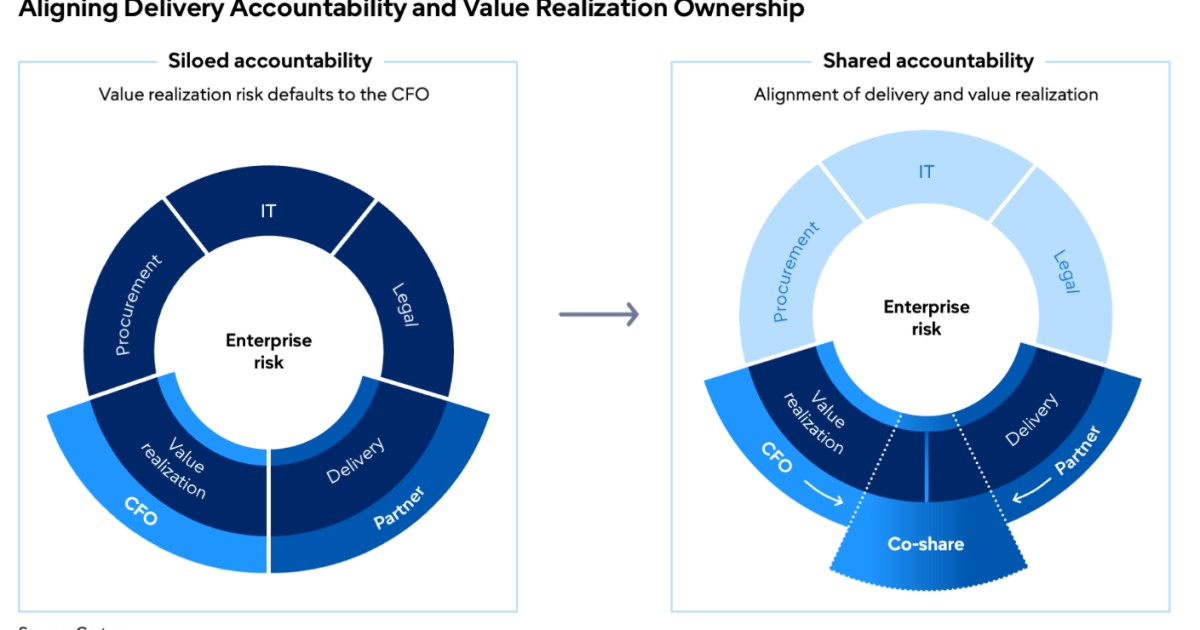
Many ERP implementations are delivered successfully yet fail to achieve the outcomes that justified the investment. As illustrated in Figure 1, accountability for delivering the project is often more explicitly allocated than accountability for delivering the business value. As a result, CFOs frequently inherit value realization risk that depends on decisions and actions across finance, IT, business stakeholders and implementation partners. CFOs should therefore negotiate governance, incentives and accountability arrangements that appropriately allocate responsibility for both delivery and value realization.
Figure 1: Aligning delivery accountability and value realization ownership

Source: Gartner (September 2026)
Without clear accountability, value realization risk can remain unallocated even when delivery responsibilities are clearly defined. This creates a common situation where stakeholders are accountable for delivering activities and milestones, but no one is explicitly accountable for achieving the business outcomes that justified the investment. CFOs should therefore ensure accountability for value realization is allocated with the same rigor as accountability for delivery.
The CFO should therefore negotiate explicit decision rights with the executive sponsor, CIO, business-unit leaders and implementation partner. The agreement should define accountability for key outcomes, decision rights and escalation mechanisms, together with the responsibilities of each stakeholder. It should also define what happens when stakeholders cannot agree. Clear accountability is not bureaucracy; it’s a mechanism for protecting value.
2. Negotiate outcomes, not a list of features
The second essential action is to shift negotiations away from features and toward measurable business outcomes. ERP discussions can easily become detailed debates over screens, reports, workflows and customizations. Those items matter, but they are means rather than ends.
The CFO should anchor negotiations in outcomes such as a faster close, improved forecast accuracy, stronger internal controls, more reliable management reporting, reduced manual effort or a lower cost to serve. Once the desired outcome is explicit, the organization can decide which capabilities are essential, which are desirable and which can be deferred.
This is particularly important when negotiating with an implementation partner. A partner working through a list of features may meet every contractual milestone while the finance organization still struggles with adoption or fails to achieve the expected productivity gains. A contract focused only on deliverables can reward technical completion rather than business value.
Outcome-based negotiation does not mean transferring all risk to the vendor. It means making the value equation explicit. The CFO should ask: What must be true for the investment to pay off? Which outcomes depend on the software, and which depend on process decisions, data ownership, training or leadership behavior? How will success be measured, and what evidence will demonstrate that the intended outcomes have been achieved?
This discipline also helps resolve customization debates. A requested customization should be evaluated against its contribution to a defined business outcome, not simply against a stakeholder’s preference for the current way of working. If a customization increases complexity without improving control, insight or efficiency, it may not justify the long-term cost.
3. Negotiate for value governance alongside delivery governance
Even when delivery obligations are clearly defined, ERP implementations can fail to achieve the outcomes that justified the investment. A common reason is that accountability for implementation delivery is allocated across stakeholders, while accountability for value realization remains less explicit. As a result, CFOs often become the default owners of outcomes they do not fully control.
The CFO should negotiate a value governance structure before contracts are signed. Value governance focuses on the achievement of the outcomes that justify the business case, while delivery governance focuses on implementation execution. Outcomes such as reduced cost to serve, faster close cycles, improved process efficiency, stronger controls and productivity improvements should be monitored throughout the program and beyond go-live.
CFOs increasingly expect implementation partners to share accountability for outcomes they can materially influence. This requires clear attribution of each party’s ownership and contribution, defined measures, baselines and governance mechanisms to review progress and address issues as they arise.
Delivery governance ensures the system is implemented. Value governance increases the likelihood that the ERP investment achieves the business outcomes that justified the investment. Without value governance, delivery risk may be managed successfully while value realization risk remains with the organization.
ERP negotiations should focus as much on value realization as on delivery. CFOs who negotiate accountability, align incentives and establish value governance improve the likelihood that the investment delivers the outcomes that justified it. Successful negotiations do not eliminate uncertainty, but they ensure accountability, value realization responsibilities and governance are explicitly defined before implementation begins.