Burnham: Stability in UK Public Finances Crucial for Market Confidence
Editorial & Advertiser disclosure
Global Banking & Finance Review® is an online platform offering news, analysis, and opinion on the latest trends, developments, and innovations in the banking and finance industry worldwide. The platform covers a diverse range of topics, including banking, insurance, investment, wealth management, fintech, and regulatory issues. The website publishes news, press releases, opinion and advertorials on various financial organizations, products and services which are commissioned from various Companies, Organizations, PR agencies, Bloggers etc. These commissioned articles are commercial in nature. This is not to be considered as financial advice and should be considered only for information purposes. It does not reflect the views or opinion of our website and is not to be considered an endorsement or a recommendation. We cannot guarantee the accuracy or applicability of any information provided with respect to your individual or personal circumstances. Please seek Professional advice from a qualified professional before making any financial decisions. We link to various third-party websites, affiliate sales networks, and to our advertising partners websites. When you view or click on certain links available on our articles, our partners may compensate us for displaying the content to you or make a purchase or fill a form. This will not incur any additional charges to you. To make things simpler for you to identity or distinguish advertised or sponsored articles or links, you may consider all articles or links hosted on our site as a commercial article placement. We will not be responsible for any loss you may suffer as a result of any omission or inaccuracy on the website.
Burnham Emphasizes Stability in UK Public Finances to Reassure Investors
Government Strategies and Market Reactions
Burnham’s Approach to Public Finances
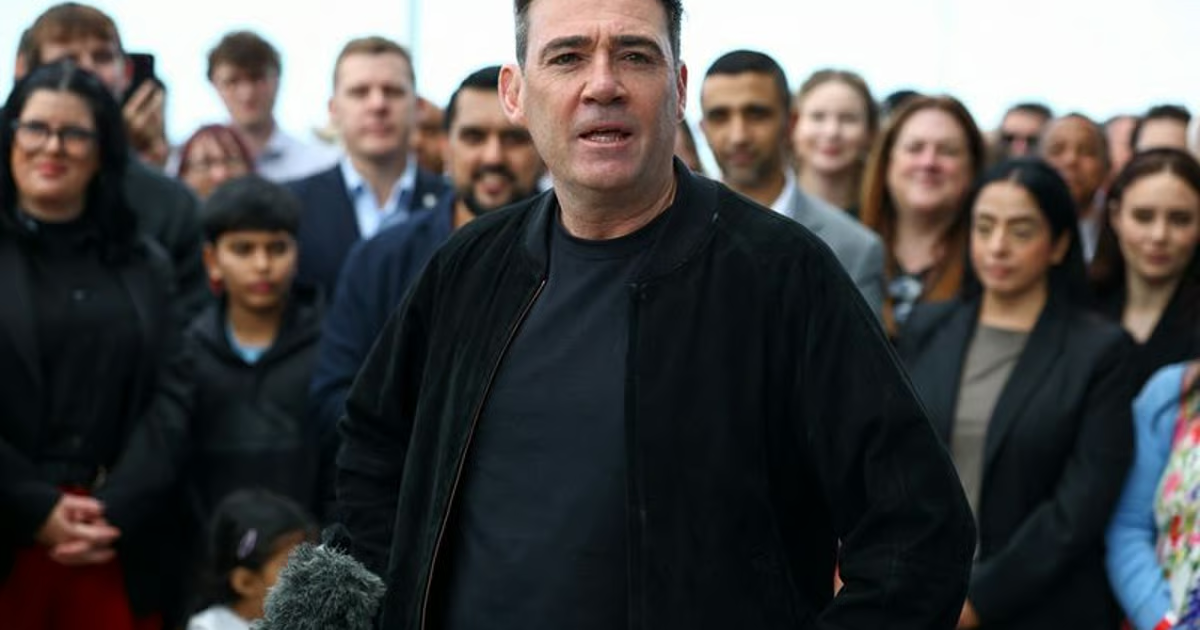
LONDON, Sept 26 (Reuters) – British Prime Minister Andy Burnham said on Saturday he knew he had to show investors he had faced “up to the reality” of the public finances in order to stabilise markets, before he can make bigger changes to the economy.
Rising Borrowing Costs and Inflation
Global Economic Pressures
Government borrowing costs across advanced economies have hit repeated multi-decade highs in recent weeks due to fears of persistent inflation caused by the Iran war and rising government borrowing.
UK-Specific Concerns
But Britain’s borrowing costs have also been driven higher by market concerns that its new government will struggle to rein in spending, with all eyes on its budget on October 28.
Labour’s Stance on Welfare and Stability
Opposition to Crude Cuts
Burnham added, however, that the will among his Labour lawmakers was “not there for crude cuts” of the welfare budget.
Importance of Stability for Future Change
Burnham’s Statement on Stability
“I do think it is crucial to have stability and to show that there’s a willingness to face up to the reality of some of these difficult things,” Burnham told the Guardian newspaper, ahead of the start of his governing Labour Party’s annual conference.
“But actually from that stability, the permission can come to make bigger change that, in the end, could put the country in a stronger position in relation to the public finances.
“You have to have stability, but you have to do what you can within that. You can’t pursue a major programme of change, which is what I believe the country needs, in a chaotic situation.”
Budget Constraints and Investor Sentiment
Limited Fiscal Headroom
Rising borrowing costs and higher inflation since the budget in March mean some economists think the relatively narrow £24 billion of headroom to meet the budget goals has roughly halved, limiting the government’s room for manoeuvre.
Legacy of Previous Fiscal Policies
Investors have also not forgotten the turmoil that was sparked by the mini-budget of former Prime Minister Liz Truss, which set out £45 billion of unfunded tax cuts.
Reporting Credits
(Reporting by Kate Holton; additional reporting by David Milliken; editing by Gareth Jones)