Wirehouse departures are up. How firms can appeal to those advisors
Processing Content
- Key insight: Despite transition deals reaching up to 425% of trailing revenue, sheer compensation is no longer the primary driver of broker movement..
- What’s at Stake: Wirehouses risk an accelerating exodus of elite talent — and the billions in AUM they control — if they continue to rely on shifting compensation hurdles.
- Expert Quote: “They feel like they have to kind of restructure the way they run their business to maximize their payout, and feel like they kind of have to jump from one foot to another to satisfy arbitrary hurdles that align with the corporate interests of the broker-dealer.” — Michael Rose, Cerulli Associates director of wealth management
With advisor departures from wirehouses on a possibly record-setting pace this year, a new industry poll suggests attractive compensation policies aren’t all broker-dealers need to obtain a piece of it all.
Cerruli Associates concluded from recent poll results that pay remains a significant factor for advisors looking for new firms, but it’s not the top priority. Meanwhile, the latest “Financial Advisor Transition Report” from the recruiting firm Diamond Consultant found that the four big wirehouse firms — Merrill, Morgan Stanley, UBS and Wells Fargo — lost a net total of 517 “experienced” advisors, with at least three years in the industry, in the first half of 2026. That’s already more than the 302 they lost in all of 2025, according to Diamond.
For firms eager to attract some of the advisors in movement, the Cerulli survey suggests they adopt these priorities:
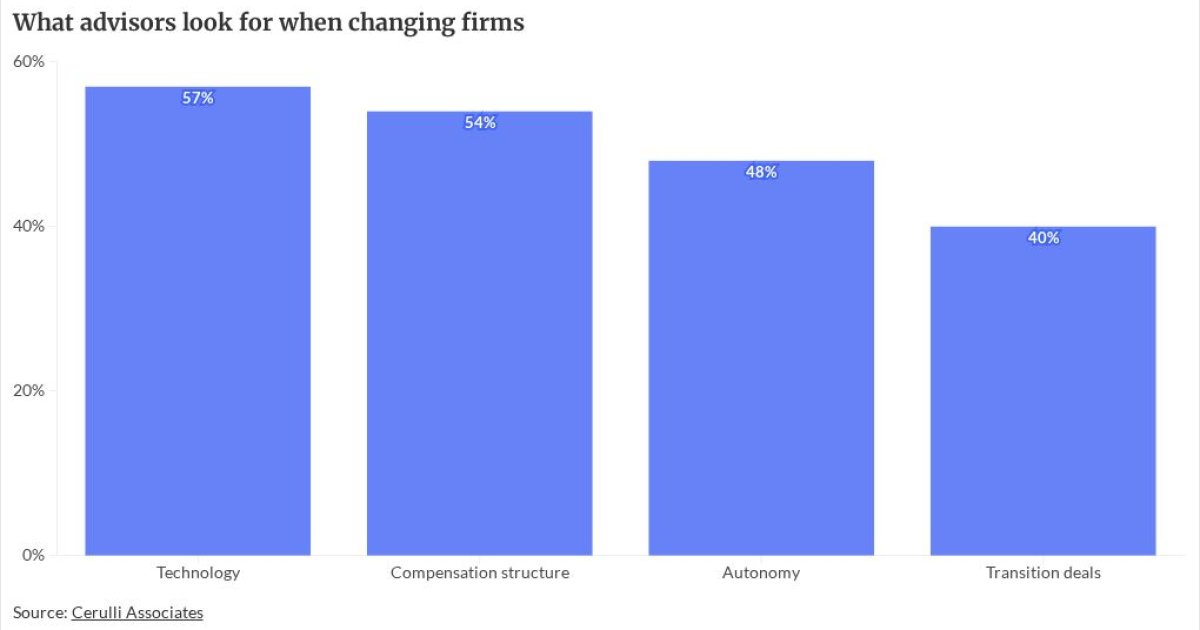
- Pay policies that are not only generous but also consistent from year to year. Fifty-four percent of the respondents to Cerulli’s poll cited the amount and structure of payouts as a top consideration when changing firms. (The survey-takers were allowed to pick three responses from a pre-assembled list.)
- Cutting-edge technology (cited by 57%). Michael Rose, Cerulli director of wealth management, said advanced tech helps advisors not only add new services like tax planning, but also reduce the costs of services they already provide.
- A degree of autonomy from central-office control (cited by 48%.) Advisors leaving wirehouses often say they are seeking “independence.” Although this word means many different things to people, many advisors leaving wirehouses are looking to work somewhere where they will be less hemmed in by corporate policies and compliance strictures.
Cerulli’s survey also suggested steps wirehouses can take to capture some of those advisors in transition for themselves. Eighty-nine percent of the respondents cited access to lending products as one of the most appealing services offered by wirehouses. Meanwhile, 84% cited support for high net worth clients, 80% research offerings and another 80% technology.
READ MORE:
What’s ailing wirehouses
Jason Diamond, the president of Diamond Consultants, said the wirehouses have a few handicaps in common. Many of their wealth management businesses have been built over the years through a series of acquisitions, and longtime advisors integrated into a much larger firm often complain of a loss of “culture.” Wirehouse advisors also tend to complain of onerous compliance requirements and pressure to sell products and services from the firm’s banks.
Diamond acknowledged there is likely some overshooting in his firm’s data — which was compiled by research firms like AdvizorPro, FINTRX and Discovery Data, as well as media reports and Diamond Consultants’ own tracking of advisor moves. Researchers trying to estimate advisor moves often look at how many firm representatives the Financial Industry Regulatory Authority reports have gone from one wealth manager to another. They then apply filters to sort out representatives without advisory responsibilities.
Most wealth management firms have meanwhile ceased reporting their own headcounts.
“I would absolutely love it if you would just share with me your complete ledger of teams that left and teams that joined,” Diamond said. “And then we wouldn’t have this problem at all.”
READ MORE:
Wirehouses losing big teams
Cerulli has estimated nearly 9% of advisors and more than $3 trillion in assets likely to change firms this year. Judging by Diamond Consultant’s latest report on advisor transitions, relatively little of that is likely to go to wirehouses.
Nearly half (46%) of all advisors leaving a wirehouse chose a firm offering some sort of independence — often by allowing them to work as independent contractors rather than employees, according to Diamond Consultants. Only 24% went to another wirehouse.
Perhaps even more telling were the size of some teams leaving wirehouses. Diamond found 41 advisory practices managing $500 million or more departed wirehouses during the first half of the year. Those included 20 with $1 billion or more under management.
Diamond said some firms recruiting large wirehouse teams have gone through growing pains trying to accommodate what they expect for product offerings and client services.
“Not every advisor is going to use your advanced financial planning and your trust and estate department and your tax integration,” he said. “But some advisors will, and some big teams will need them.”
READ MORE:
What wirehouse have going for them
Diamond said wirehouses’ indisputable advantage remains in their household names. Corroborating that, 78% of the respondents to Cerulli’s study cited the name recognition enjoyed by wirehouses as an advantage.
One way wirehouses try to compete with their rivals is by offering generous compensation. But Rose of Cerulli said total pay matters less to advisors than many may think.
More important is consistency in the policies and rules governing compensation. Advisors at wirehouses often express frustration when the rules governing their pay are changed. UBS, which has the lowest headcount among wirehouses with just over 5,600 advisors on staff, has particularly struggled in recent years with
Rose said Cerulli’s survey results are just further proof that advisors really don’t like it when pay rules are changed from year to year.
“They feel like they have to kind of restructure the way they run their business to maximize their payout, and feel like they kind of have to jump from one foot to another to satisfy arbitrary hurdles that align with the corporate interests of the broker-dealer,” he said.
Cerulli’s definition of compensation and payouts does not include the transition money advisors often receive in return for joining a new firm. These deals — usually made in the form of a forgivable loan — are certainly important.
But again, Rose noted, they don’t carry as much weight as many may think. Only 40% of the respondents to Cerulli’s survey cited recruitment packages and transition money as among their top reasons for choosing a new broker-dealer. Diamond’s report found that firms are offering deals equal to anywhere from 350% to 425% of a departing teams’ previous year’s revenue production.
Rose said what most advisors want is a firm that will help them achieve so-called organic growth by adding clients and assets. That’s when having technological and other types of supports becomes particularly beneficial.
“And if you don’t have the infrastructure that can allow advisors to grow their business at the highest possible rate, then that compensation doesn’t really offset the fact that they don’t have what they need to really empower their growth,” he said.
Introductory bullet points created by AI with editorial review.