8th Pay Commission Bengaluru meeting today: Postal employees seek higher pay, HSG-I upgrade
The 8th Pay Commission is set to begin its meeting in Bengaluru today. According to the commission’s official website, the Bengaluru meeting will conclude tomorrow, 8 October, before the commission proceeds to Mumbai for meetings scheduled for 22 and 23 October.
The 8th Pay Commission is a temporary body established by the central government. It has a three-member panel headed by Justice Ranjana Prakash Desai. The commission was constituted on 3 November 2025 with an 18-month mandate to submit its final report after extensive consultations.
As the 8th Pay Commission continues to hear the views and grievances of eligible employee unions and associations and examines aspects such as pay, allowances, employee morale, and service conditions of central government employees, postal employees have also placed several important demands before the panel through a memorandum submitted earlier this year.
What are the major demands of the postal employees?
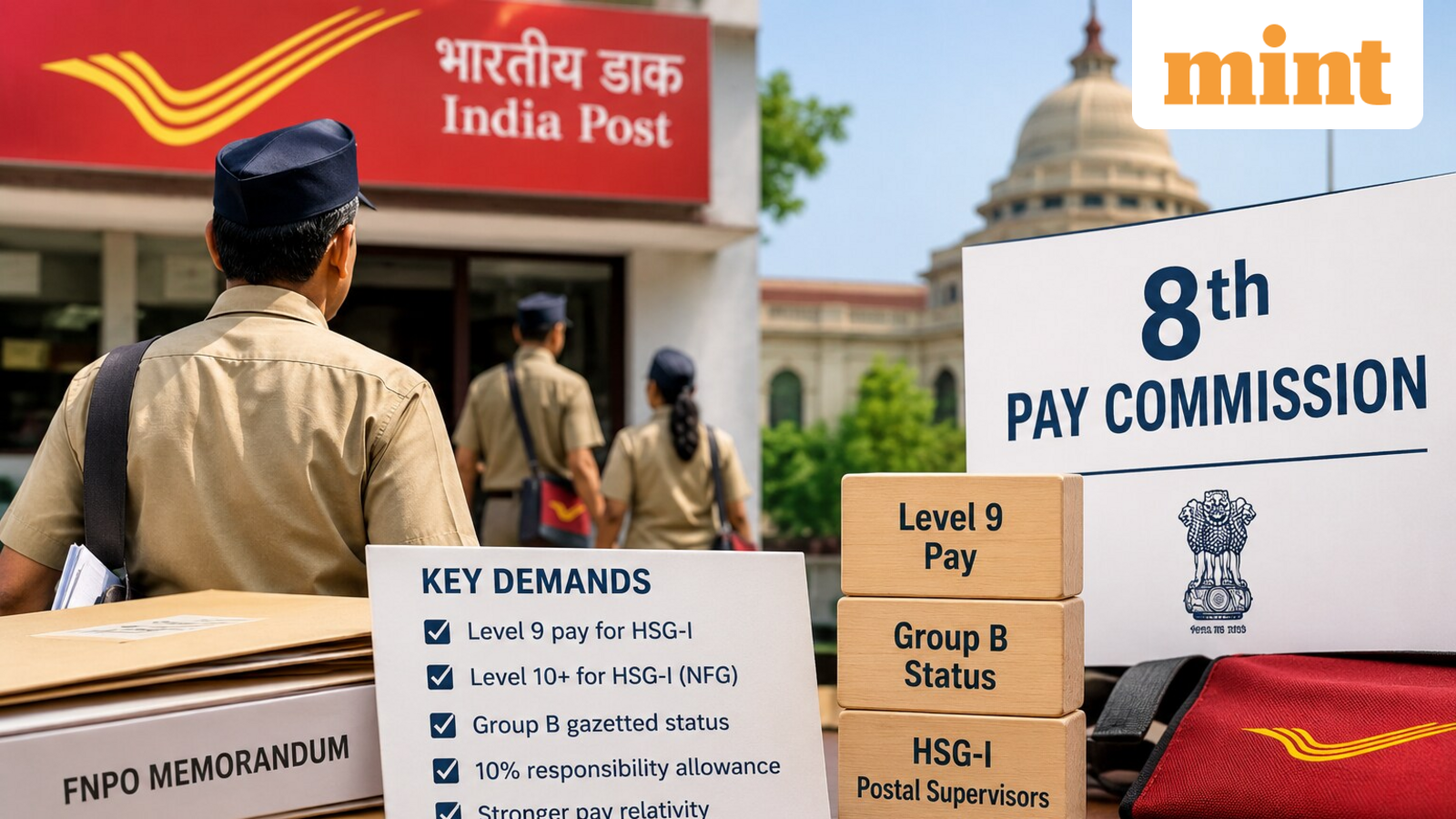
Among their key demands before the 8th Pay Commission is a proposal to revise the pay and status of Higher Selection Grade-I (HSG-I) and HSG-I (Non-Functional Grade) officials, who occupy senior supervisory positions in the Department of Posts.
This particular demand has been elaborated upon in Chapter 10 of the Federation of National Postal Organisations (FNPO)’s memorandum submitted to the 8th Pay Commission. The federation has discussed that the responsibility of HSG-I officials has expanded and evolved significantly, whereas the financial advantage attached to the post has progressively diminished.
What are the reasons for the same?
As per the memorandum, HSG-I officials can serve as Head Postmasters, Deputy Postmasters, and heads of major post offices, with primary responsibilities including financial management, administration, treasury operations, digital transactions, overall staff supervision, and regulatory compliance.
FNPO has underlined the pay gap between Postal Assistants and HSG-I officials across successive pay commissions. The memorandum explained how the approximate ratio declined from 1:4.2 under the 1st Pay Commission to 1:3 under the 2nd Pay Commission, 1:2.7 under the 3rd Pay Commission and 1:2.1 under the 4th Pay Commission. Subsequently, it narrowed further to around 1:1.6 under the 5th Pay Commission and 1:1.7 under the 6th Pay Commission.
The federation has also argued that, in the 7th Pay Commission era, the Modified Assured Career Progression (MACP) system has further weakened promotional differentiation, with employees potentially reaching Level 7 through career progression.
What are the proposals of FNPO to remedy the current situation?
For the 8th Pay Commission, FNPO has proposed Level 9 for HSG-I and Level 10 or above for HSG-I (NFG). It has sought Group B gazetted status, a Postmaster Responsibility Allowance of at least 10% of basic pay, and the restoration of stronger vertical pay relativity.
The core argument of FNPO is that as postal operations have become increasingly digital, complex, and regulatory in nature, the apy status of those heading these establishments should evolve alongside their responsibilities.
What should central government employees and pensioners focus on?
As the meetings in Bengaluru start today, central government employees and pensioners should wait for updates and further developments. Along with this, it is important to acknowledge that similar grievances and views are likely to be highlighted by eligible employee unions and stakeholders as they discuss concerns and views on aspects such as MACP, fitment factor, salary revisions, pension reforms, and employee working conditions.
It is also vital to keep in mind the basic timeline of the 8th Pay Commission, with the mandate of 18 months tentatively ending in May-June 2027, that is why, if the commission doesn’t requests for added time, it is about the middle of the next year when pensioners and employees should get clarity on the recommendations of the 8th Pay Commission panel and their decisions on fitment factor multiplier and other associated factors.
Furthermore, it is important to remember that during the 6th and 7th Pay Commissions, this metric was 1.86 and 2.57, respectively. This time, though, in order to combat inflation and lifestyle costs effectively, the demands are of a much higher fitment factor multiplier by prominent unions such as the National Council of Joint Consultative Machinery (NC-JCM) and Bharatiya Pratiraksha Mazdoor Sangh (BPMS), urging for a fitment factor of 3.833 and 4, respectively.
Given these facts, it remains to be seen what decisions the 8th Pay Commission makes in the coming months, as these decisions will impact the livelihoods of more than 1.1 crore serving central government employees and pensioners.
Disclaimer: The pay levels, allowances and Group B status mentioned are demands submitted by FNPO and are not approved recommendations of the 8th Pay Commission. Final decisions will depend on the commission’s recommendations and the government’s approval.