UPI MDR Charges: Start date, slabs and why is this Merchant Discount Rate being introduced now? All questions answered
The Centre will impose Merchant discount rate (MDR) charge on select online transactions conducted under the unified payments interface (UPI) system in India from this month, as per the National Payments Council of India (NPCI).
The NPCI in an announcement has month said that MDR would apply on person-to-merchant (P2M) UPI payments, above a certain threshold, under a revised UPI MDR framework. The rules come into effect from mid-October and keeping UPI free for all customer (person-to-person / P2P) transactions.
What is the start date for UPI MDR charge?
MDR charge will apply on each P2M UPI transaction above ₹2,000, with effect from 15 October 2026, according to the NPCI statement.
The rules keep 95% of low-value UPI transactions below ₹2,000 and small merchant transactions (P2PM) completely free and proposes a new fund to support the expansion of UPI acceptance among small merchants.
What are the slabs for UPI MDR charge?
- Flat MDR of ₹5 per transaction will apply to UPI payments above ₹2,000 in specified merchant categories — essential and thin-margin sectors — such as railways, telecom services, insurance, fuel and agricultural inputs.
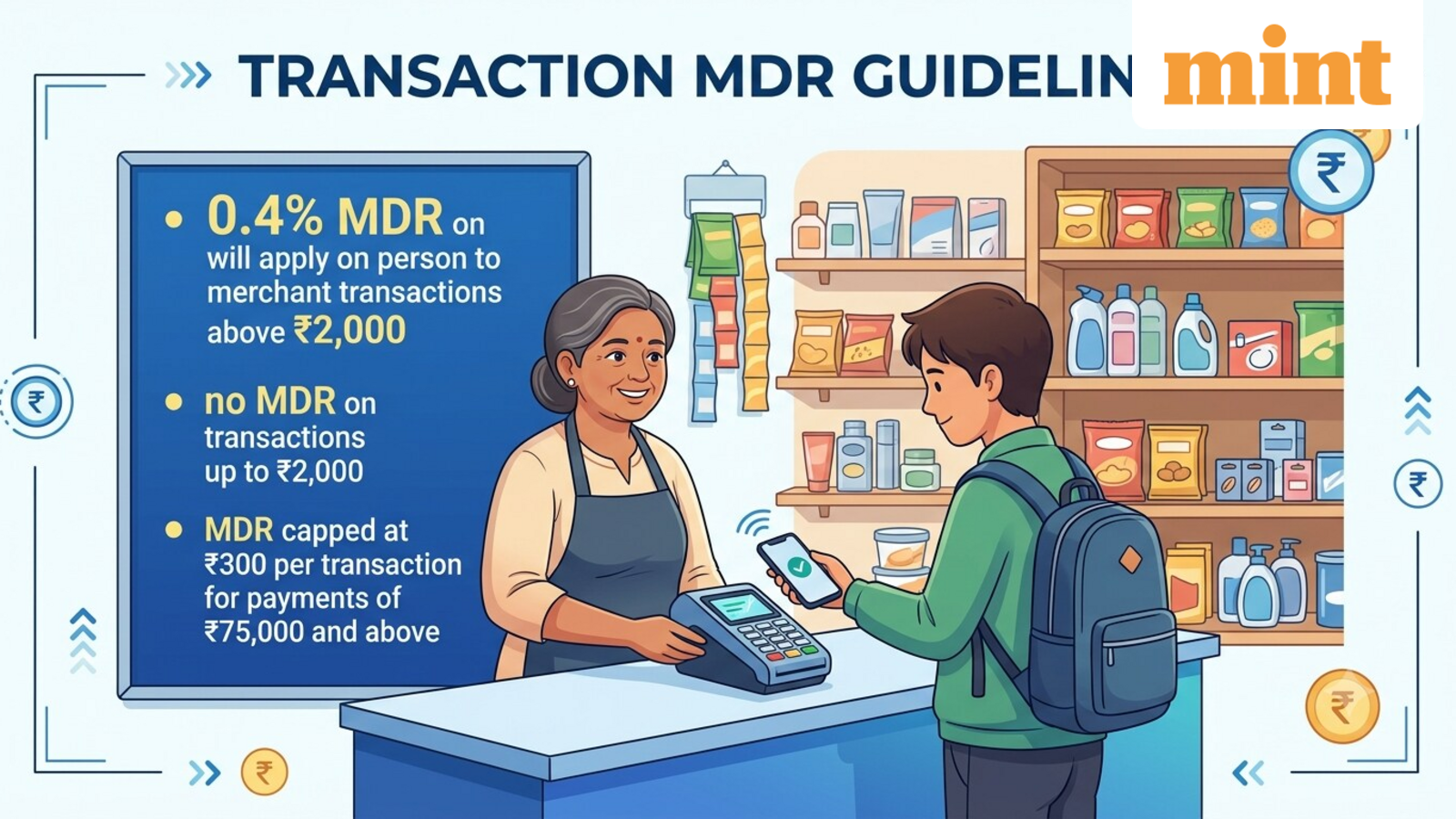
- MDR of 0.4% applicable on P2M UPI transactions above ₹2,000.
- For transactions of ₹75,000 and above, the MDR will be capped at ₹300 per transaction.
- Payments relating to mutual funds, securities, stockbrokers and dealers will attract an MDR of 0.02%, capped at ₹300 per transaction.
Who is protected from impact?
The NPCI statement said that there will be no impact on small-value UPI transactions up to ₹2,000 for all merchants, which account for more than 95% of all UPI P2M transactions.
Revised UPI MDR remains lower than charges associated with several other digital payment instruments, including credit cards, debit cards, and wallets, the FAQ document added.
According to the Ministry of Finance’s press release, small merchants, including street vendors receiving up to ₹1 lakh per month through UPI QR codes under the Person-to-Person-Merchant (P2PM) category, will continue to enjoy zero MDR on all transactions. “This provision will protect street vendors, neighbourhood shops and other small businesses from additional payment costs,” it added.
It added that overall, “UPI transactions accounting for 70% of (total) transaction value will remain completely outside the MDR framework”.
Why is MDR being introduced now?
UPI processes billions of transactions every month. Till now, costs of such transactions and the upkeep of the UPI platform are borne by banks, NPCI, and payment service providers. The Union Budget 2026 estimated subsidy payout at ₹2,000 crore, compared with ₹2,196.21 crore paid in 2025-2026 and ₹1,922.77 crore in 2024-25.
According to the release, MDR is not a tax or charge collected by the government or NPCI, but will be distributed among payment ecosystem participants, including banks and payment application providers, to support the operation and continued expansion of the UPI ecosystem.
According to the NPCI’s FAQ document, the MDR is distributed only among the UPI ecosystem to further invest into infrastructure resiliency, innovation, cybersecurity and customer service.
The finance ministry added that this framework has been introduced under the Payment and Settlement Systems Act, 2007, following “detailed deliberations by the UPI Steering Committee on the applicable rates, operational arrangements and consumer safeguards”.
“Revenue generated from larger merchant transactions will support banks, payment service providers and UPI application providers in expanding and improving payment infrastructure, including in rural and semi-urban areas,” it added.