Two Bushwick Buildings Reveal New York’s Odd Rent Policy
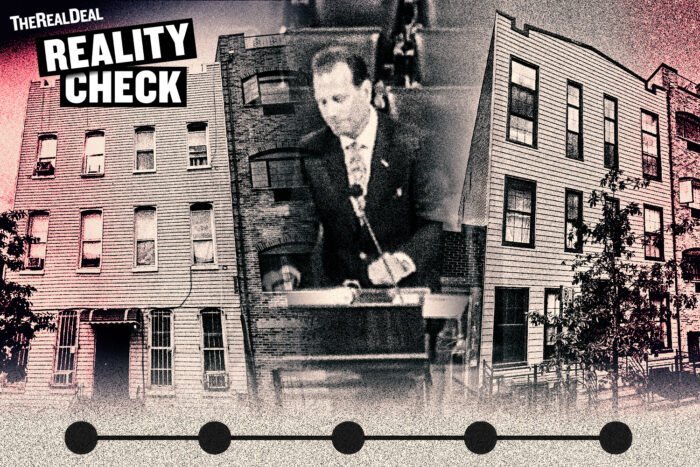
It’s undeniable that the walk-up at 219 Troutman Street has looked much better since 2016 than it did before.
Drab, white-framed windows have been replaced by larger, smart-looking black ones, Google photos show. The siding is brighter and wider.
Hideous metal bars over the windows have been removed, as have the graffiti and cable wires that marred the facade, which has been nicely framed by a black fascia board.
City records and apartment listings show the three-story, 95-year-old Bushwick building got a full interior renovation as well, along with a new roof.
What you can’t tell from the photos and building permits is that 219 Troutman was removed from rent stabilization. The market rents it now commands — $4,000 for a three-bedroom and $3,400 for a two-bedroom — allowed for its $400,000 overhaul on the heels of its $600,000 purchase by Phillip Miller.
Whether Miller made a praiseworthy investment in Bushwick’s housing stock or improperly wiped out affordable housing is in the eye of the beholder.
The state Division of Homes and Community Renewal takes the latter view. DHCR called the deregulation unjustified and ruled that the building must return to rent stabilization.
To save his investment, Miller’s 219 Troutman LLC sued, calling the agency’s decision arbitrary and capricious. The case was recently argued at the Appellate Division.
Along with several other lawsuits, including the Creas case at 117 North Fourth Street in Williamsburg and the Peak Capital Advisors case involving 31 buildings, Miller’s case will establish whether the state can retroactively apply unofficial, unannounced rules for substantially rehabbed and deregulated rent-stabilized buildings.
One of those unwritten rules is that buyouts of tenants mean units were “habitable” and thus not substandard as required for sub-rehabs. One appellate judge on the 219 Troutman case seemed to buy into this notion.
“The landlords would get an end run around the intent of the statute if you want to just buy out [tenants],” she said during oral arguments. “These were not nominal agreements. They were given substantial money to move out.”
Actually, the buyouts were for $40,000, a modest sum in the annals of tenant buyouts. But, as Miller’s attorney Nativ Winiarsky told the court, the amount is irrelevant, as is the buyout itself.
“A buyout only shows the economic value [for] the landlord to reclaim possession of the building,” he explained. “It does nothing to show the physical condition of the building.”
This should be obvious to anyone with a basic understanding of economics and real estate, which should be the minimal qualification to serve as an appellate judge. The court’s decision will reveal whether the jurists grasped that concept.
It will also determine if the state can redefine “substandard” to mean not “habitable,” a word that does not appear in the sub-rehab law or regulations.
“Where did they come up with the issue of ‘habitable’?” Winiarsky asked the court. “You can have a habitable premises and still be substandard.”
Miller made his investment relying on 1995 guidance from the agency he’s now suing. Operational Bulletin 95-2 entitled owners to a presumption that a building qualified for a sub-rehab if it were at least 80 percent vacant and the project replaced at least 75 percent of its major systems.
The guidance said the state could rebut that presumption, which DHCR attempted to do by pointing out Miller’s buyouts. When it asked the former tenants to submit photos or affidavits that the building was substandard, none did.
Stuck in stabilization
As for whether the state should be discouraging sub-rehabs, look at 299 Troutman Street, a block away from Miller’s fixed-up building. The top two floors have been unusable since a 2008 fire. The lower floors haven’t been much better.
In 2019, tenants in the long-neglected building, calling conditions “reprehensible,” successfully sued to force the city to have an administrator take it over.
But the legal rents are likely too low to pay for a proper renovation. That’s why it has languished.
A for-sale listing for 299 Troutman, updated in June after 320 days without any buyers emerging, is not encouraging:
“CASH BUYERS ONLY. 8-unit rent stabilized building in Bushwick under NYC HPD 7A Program. Approx. $1M+ HPD violations/fines. 4 occupied / 4 vacant. Sold AS-IS with all violations, liens, tenants, and DOB/HPD issues. No financials available. No interior showings.”
Seems like it needs rehabilitation. Something substantial.
Read more

How New York kneecapped rehabs

The Daily Dirt: Rent board rookie makes valiant but naive case to activists

“The prices just keep coming down:” Rent-stabilized broker’s epic rant