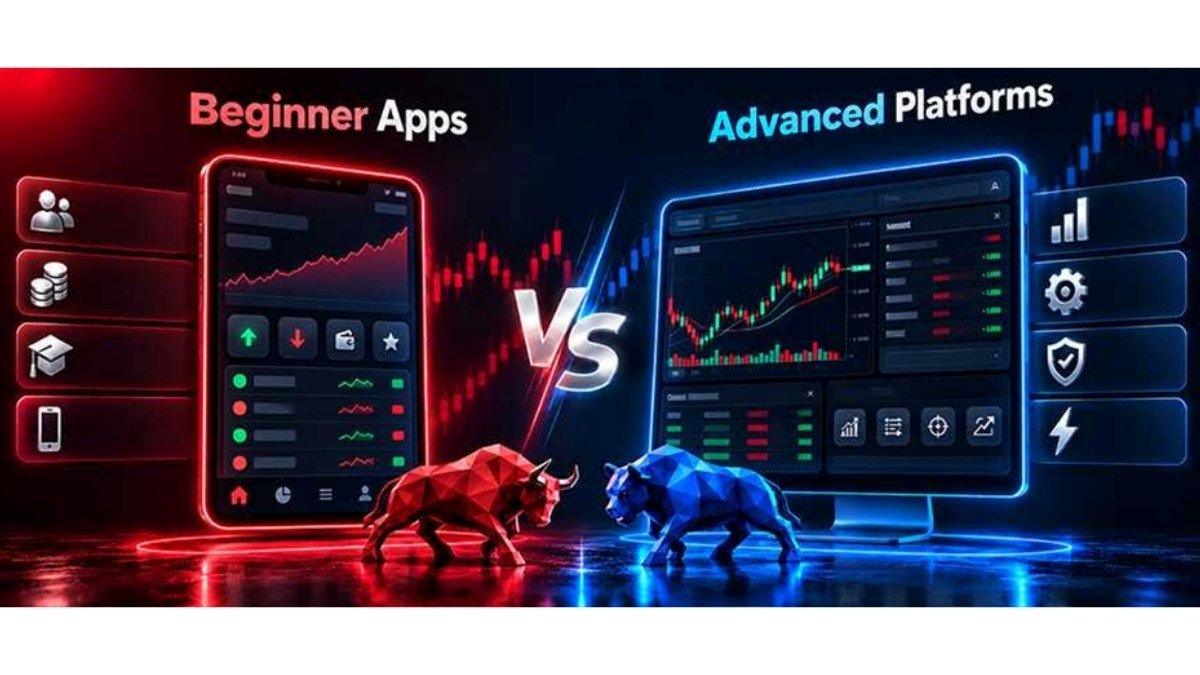
Beginner Trading Apps Vs Advanced Trading Platforms: Which One Is Right For You?
You may find your first trading app perfect until the day you need something it does not offer. A clean interface may be enough when you are buying a few stocks, but things can change quickly when you start analysing charts, comparing option strikes or managing multiple orders. This is when the difference between beginner-friendly trading apps and advanced trading platforms starts to matter.
The right platform is not necessarily the one with the longest feature list. It is the one that matches how you actually trade today and where you expect your trading journey to go. Here is how to make that choice without getting distracted by features you may never use.
/img/2026/10/trading61-57841790935326.jpg "Beginner Trading Apps")
What Makes A Trading App Beginner-Friendly?
Most trading apps for beginners tend to simplify the core journey to make it more digestible. Looking for a stock, verifying its price, making an order, and monitoring a portfolio shouldn’t involve switching across numerous confusing screens.
This simplicity can be particularly useful when your focus is long-term investing rather than frequent trading. For example, someone building a portfolio of equities, mutual funds and exchange-traded funds (ETFs) may benefit more from an uncluttered interface than from dozens of technical indicators.
That does not mean a beginner should avoid useful trading tools. It’s just that: a beginner who invests periodically in stocks and mutual funds may need an easy-to-use platform with straightforward order placement and portfolio tracking. Someone who trades frequently may have a very different requirement.
Kotak Neo offers an example of how a platform can keep investing accessible while providing additional ways to build a portfolio. Its StockCase feature allows users to invest in expert-curated stock baskets or create their own custom baskets depending on their interests and investing goals.
Usually, it’s best to find a platform where you can keep essential information accessible and get acquainted with more complex features step by step.
When Does An Advanced Trading Platform Start Making Sense?
The requirement changes once trading becomes more active. You may want live charts, technical indicators, option chains, Greeks, basket orders or faster ways to manage positions. At this stage, to-and-fro between multiple screens can make the trading process unnecessarily cumbersome.
Advanced platforms are designed around this workflow. They bring analysis and execution closer together, allowing traders to study an opportunity and act on it without repeatedly moving between different parts of the platform. A more advanced platform can bring charting, indicators, order management and position information closer together.
Upstox, for instance, provides Pro Web with tick-by-tick charts, more than 100 indicators, 80 drawing tools and the ability to buy and sell directly from charts.
The value of such features becomes clearer when a trader’s process involves more than simply checking a stock price. Instead of studying a chart in one place and then opening another screen to place an order, the analysis and execution process can stay connected.
Kotak Neo’s Trade from Charts follows this kind of workflow. Users can analyse charts, place and manage orders and track positions from the chart interface, while the feature also brings the option chain into the same trading view.
For an options trader who prefers a strategy-first workflow, the choice of platform can have a particularly noticeable impact. Traders may also need to assess strike prices, open interest, implied volatility and Greeks before deciding how to structure a position.
Dhan offers another useful example. Its Options Trader includes an advanced option chain, strategy builder, real-time payoff graph and Basket Orders in one workspace.
For someone who only occasionally trades options, this level of functionality may not be necessary. For an active options trader, however, having analysis, strategy construction and execution within one workspace can make the workflow considerably more organised.
What Should You Check Before Choosing?
The answer depends largely on your trading behaviour.
- Ease of use: Check if you can find the information and order functions you need without unnecessary steps.
- Trading tools: If you actively trade, check the availability of charts, indicators, alerts and advanced order types.
- Option Trading tools: Option Trading calls for more than simply looking at the premium. If you trade derivatives regularly, an option chain, Greeks, payoff analysis and strategy-building tools can give you a more complete view before you take a position.
- Investment choices: It is worth looking beyond the stocks you trade today. Check whether the platform also gives you access to products you might explore later, such as mutual funds, ETFs, initial public offerings (IPOs) and derivatives.
- Execution workflow: Traders placing frequent or multiple orders may benefit from features such as Basket Orders or chart-based execution.
- Regulatory status: Open an account only after checking the intermediary in the Securities and Exchange Board of India (SEBI) recognised intermediaries database. SEBI provides a searchable list of registered stock brokers in various market segments.
There is also no need to use every feature simply because it is available. More tools do not automatically lead to better decisions.
Conclusion
Beginner trading apps and advanced trading platforms are differentiated by the level of control.
Prioritise simplicity if you are starting out, as it can help you focus on learning the market. As your strategies become more involved, features such as advanced charts, option chains, strategy tools and integrated order management can become increasingly valuable.
The ideal platform can be one that evolves with you. Kotak Neo, Dhan and Upstox are examples of how contemporary platforms may cater to different phases of a trader’s journey. So determine your real needs first and then select the platform whose tools meet your needs without adding additional complications.