Fintech investment continues to focus on large private deals
- Key insight: The first half of 2026 is continuing the 2025 trend of fewer but bigger private equity fundraises for fintechs, including digital banking.
- Expert quote: “Even with capital rotating toward AI, fintech fundraising has held up well.” —Pitchbook’s Rudy Yang
- Supporting data: The average fintech funding round size is up 21% to $23.2 million so far this year.
Megadeals continue to be the dominant theme in fintech private equity funding this year, even as exits have slowed overall.
Processing Content
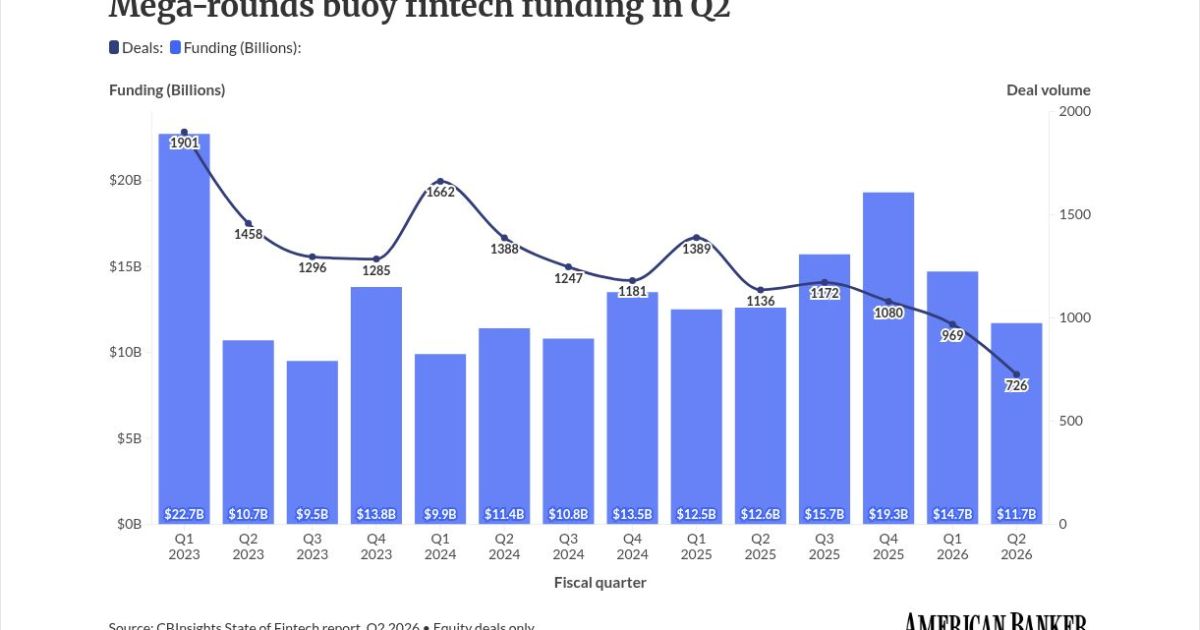
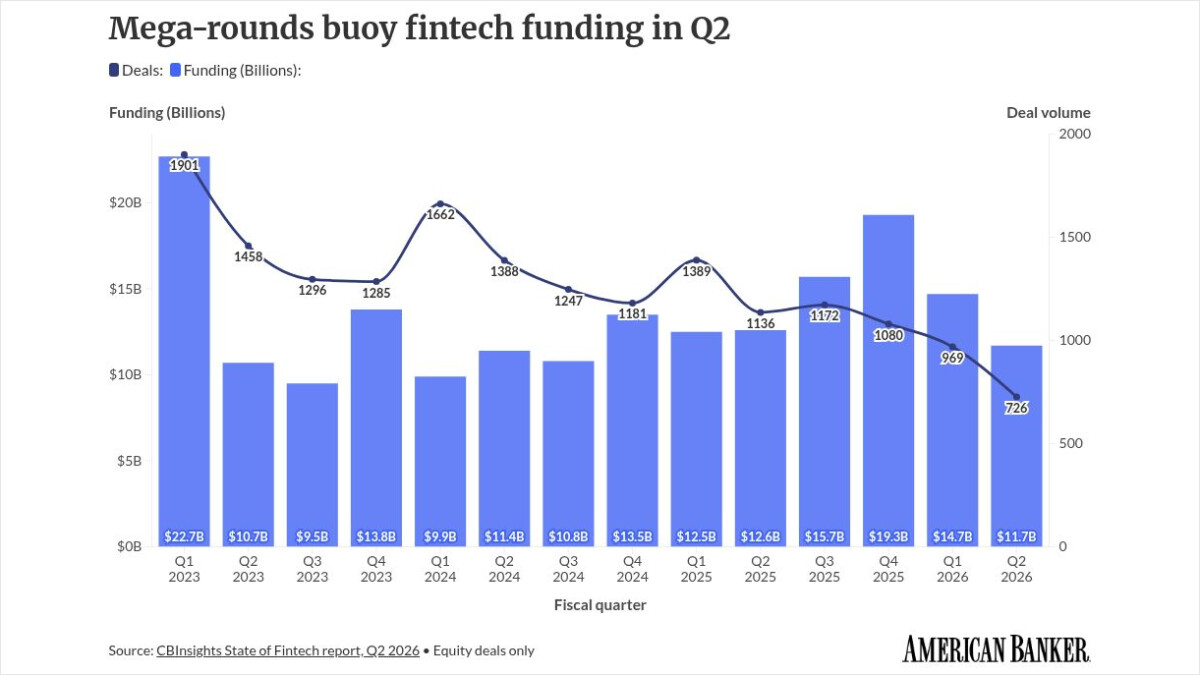
The total number of global fintech deals in the second quarter of 2026 fell 25% quarter over quarter and 36% year over year, according to research firm CB Insight’s most recent
The total amount fundraised across all deals for the second quarter of this year was $11.7 billion, a 20% decrease from the previous quarter and a 7% decrease from
Together, these two figures show a widening gap between the volume of funding rounds and the dollars going into them as fintech investors are
Digital banking, for example, saw an increase in deal volume even as deal count went down. Fintechs in this category saw a total of $2.6 billion in funding, doubled from last quarter’s total of $1.3 billion and slightly increased year over year from $2.5 billion – even as this quarter saw nearly half of the total deal volume, from 96 deals in Q2 2025 to only 54 in Q2 2026.
Four mega-rounds from
“While capital deployment has been more cautious, we continue to see deal values holding up due to larger checks,” Pitchbook fintech analyst Rudy Yang told American Banker. “Venture growth deals are naturally larger, so they will capture a higher percentage of the deal value.
While the fintech IPO market was
Since then, there have been no fintech IPOs of note this year. KeyBanc Capital Markets, or KBCM, analysts said in a note that “the fintech IPO pipeline remains pending as private equity firms are extending their holding period amid less favorable public market valuations and growing investor preference for larger and more liquid IPOs.”
Read more:
The KBCM analysts also said that recent drops in cryptocurrency and public market valuations has likely pushed the IPO timing of several digital asset companies from 2026 to 2027, and more activity is expected in general for 2027-2028.
Many of the largest fintech companies have also continued to remain private, with some collecting increased valuations while doing so. That includes fintech giants such as Stripe, Plaid, Revolut and Monzo, which have opted for secondary share sales, sought additional private financing or are simply waiting out the public markets.
“Private markets underwriting deals are placing a higher premium on organic growth with [the] ability to deploy AI across the organization to expand the product base,” the KBCM note continued. “Furthermore, companies who are category leaders in areas that are highly strategic are commanding a premium multiple.”