A Quarter of Companies Have No Analyst Coverage
One of the benefits of public markets is their transparency, demonstrated through consistent accounting statements and disclosures. That, in turn, allows for better valuations and more efficient price discovery and asset allocations.
A key component in this process is professional equity analysts.
Their reports regularly move stock prices and include expert analysis on everything from the company’s industry and competitive landscape to corporate financials and valuations to company-specific risks. They also usually include a price target and a buy, hold, or sell rating.
Their reports can be invaluable for institutional and retail investors deciding how to deploy capital. That also helps determine a company’s cost of capital, which can affect whether they raise new capital for growth and employ more workers.
But not all companies have analyst coverage.
A rising share of companies has no coverage and that’s bad for stock prices
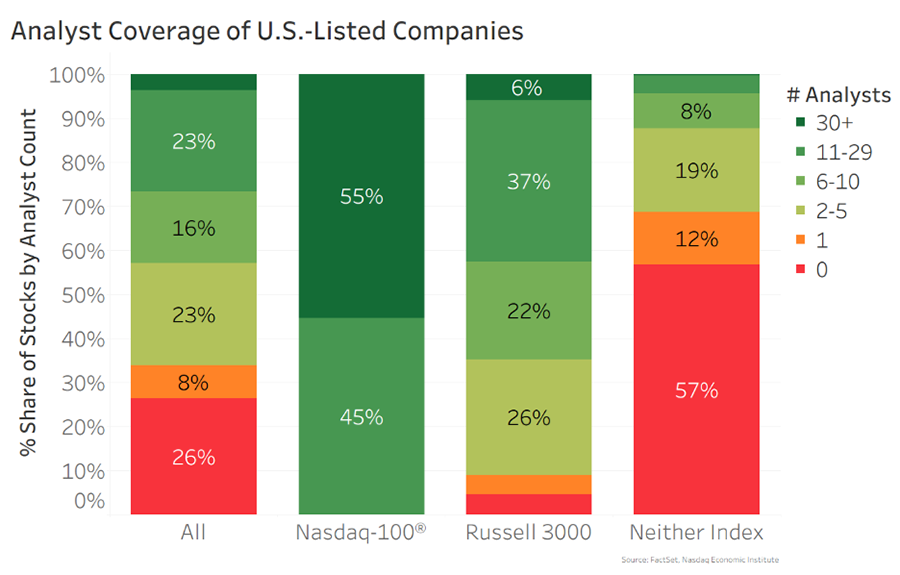
A full quarter of U.S.-listed companies have zero analysts covering them – and recent research from Bloomberg indicates that the share of stocks with zero analysts has been rising over the last decade.
This lack of coverage matters for companies because research shows that losing analyst coverage (due to unrelated events like brokerages closing) results in information asymmetry, which causes spreads to widen, and prices and investor demand to fall.
Chart 1: A third of U.S.-listed companies have one or zero analysts covering them
Image
An unbundled world makes it hard to support smaller companies
The data suggests that being small is the main factor that is hurting coverage (Chart 2). In fact, the average market cap for companies without analyst coverage is around $230 million (and the median is under $50 million).
Meanwhile, every company in the Nasdaq-100® Index (blue dots) has analyst coverage. Notably, the average company has about 35 analysts, with some mega caps being covered by more than 60!
But the lack of coverage for smaller companies is likely due to multiple factors, such as shrinking commissions, the rise of passive investing, industry consolidation, regulatory changes, and more.
These changes have upended the economics of analyst coverage, which require the cost of coverage (analyst salary, research tools, etc.) to be less than the potential revenue from coverage (trading commissions, investment banking fees, etc.).
Unbundling doesn’t help. In Europe, unbundling of commissions resulted in lower analyst coverage for smaller companies. Even in the U.S., competition focused on trading removes the economics that allow platforms to support smaller, new companies.
This is something Nasdaq has tried to address twice in the past. The first time was with the Independent Research Network, which operatedfrom 2005 to 2007 and was designed to generate coverage for small- and mid-caps after 2002 reforms led to reduced coverage of those companies. Then, Nasdaq partnered with Morningstar in 2010 on a similar effort but, again, wasn’t able to make the economics work.
Being included in major indexes does help – the average company in the Russell 3000 has 11 analysts covering it. But that’s not always the case. According to FactSet data, more than 125 companies in the Russell 3000 index (green circles) have zero analysts covering them.
Chart 2: Analyst coverage and market cap are correlated
Image

Analyst coverage is important for investors. Their reports help keep the market informed, which keeps prices efficient and, in turn, ensures investments are better allocated within the economy.
We know the U.S. Securities and Exchange Commission (SEC) has a new focus on bringing initial public offerings to market, but they may want to add this to the list of things to consider addressing at the same time. It’s important that markets work well for all companies, as well as to help U.S. households save for their retirement and ensure their own financial security.