
The Market Just Hit a Risky Milestone. History Says Investors Should Make This 1 Move.
Jamie Dimon, CEO of JPMorgan Chase (JPM -0.48%), eloquently described the risks the market faces today as “tectonic plates” that are “shifting below the surface.” He highlighted risks such as geopolitical conflict, high debt levels, and inflation. But he also included elevated asset prices on his list. As if on cue, the S&P 500 Shiller CAPE Ratio is flashing a warning sign about the extreme valuation of the market. Here’s what you need to know.
There’s no way to know what happens from here
First and foremost, it is important to state the obvious: Nobody knows what the future holds. Which is why Jamie Dimon prefaced his market warnings by saying, “We cannot predict how these forces will ultimately play out. They may remain manageable.” However, he added that his list of tectonic plates “could also cause meaningful disruptions when they shift or collide.” The takeaway is that investors are always balancing risk against reward. Right now, risk appears to be elevated.

Image source: Getty Images.
That is highlighted by the S&P 500 Shiller CAPE Ratio rising above 40x. It hasn’t been that high since just before the dot-com crash, which seems a bit ominous given that a new technology revolution, artificial intelligence (AI), is currently captivating investors and driving a massive arms race in the tech sector. By the time the dot-com bubble had fully deflated, the S&P 500 CAPE ratio had been cut in half, falling from nearly 45x to a little over 20x.
To put the current 40x S&P 500 Shiller CAPE Ratio into perspective, the long-term average is 22x. That’s a big difference, with the current ratio more than a standard deviation above the average. A reversion to the mean would lead to a dramatic market decline.
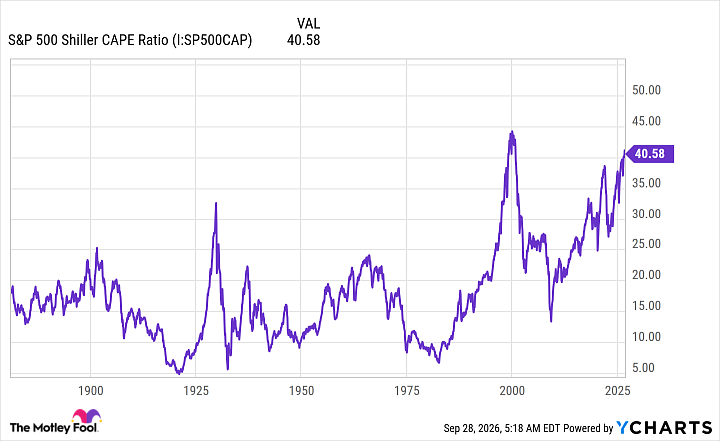
S&P 500 Shiller CAPE Ratio data by YCharts
What is the S&P 500 Shiller CAPE ratio?
The market tends to swing between extremes, and right now the S&P 500 index (^GSPC -0.17%) looks expensive. The S&P 500 Shiller CAPE Ratio is interesting on this front because it is the current price of the S&P 500 divided by the 10-year moving average of inflation-adjusted earnings. Developed by economist Robert Shiller, the ratio basically smooths earnings to provide a clearer valuation picture, since earnings can be volatile over short periods.
In other words, the warning that a historically high S&P 500 Shiller CAPE Ratio is giving today shouldn’t be ignored. That’s not to suggest that investors should abandon their long-term investment plans and run for the hills. However, it is probably a good time to assess your tolerance for risk. If you lived through the dot-com bubble or the Great Recession, how did you handle those downturns? If you didn’t live through those bear markets, what would you do if you lost half of your wealth over the next 12 to 18 months?
Today’s Change
(-0.17%) -12.85
Index Level
7,670.84
Key Data Points
Day’s Range
7,653.55 – 7,699.60
52wk Range
6,316.91 – 7,816.70
That’s basically what happened the last time the S&P 500 Shiller CAPE Ratio was this high. If you are like most investors, a deep bear market would be an emotionally difficult period. Now, before a decline like that starts, is the time to honestly consider your tolerance for risk.
You may decide to start letting cash accumulate. Or perhaps you might consider pulling back on some of your higher-risk investments, including taking some profits on AI winners. You could even do some strategic shifting, pulling cash from riskier sectors and moving it into areas that have historically been considered safer, like consumer staples and utilities.
Don’t wait until fear is driving your decisions
A historically high S&P 500 Shiller CAPE Ratio is a warning sign. It doesn’t mean that a bear market is imminent, but it does mean you should consider the possibility that one is on the way. And your number one move today should probably be to assess your risk tolerance before a bear market arrives, because when you are in one, fear will likely drive your decisions. Letting your emotions drive your decisions can lead to short-term choices that may harm your long-term finances.