Festive loan this year? 60% of borrowers’ EMIs nearly match their family income – what to check
As the festive season approaches, many households may consider taking a personal loan, using a credit card, or opting for other forms of credit to fund travel, shopping, or family expenses.
But before adding another EMI, borrowers may need to look at how much of their income is already going towards debt repayment.
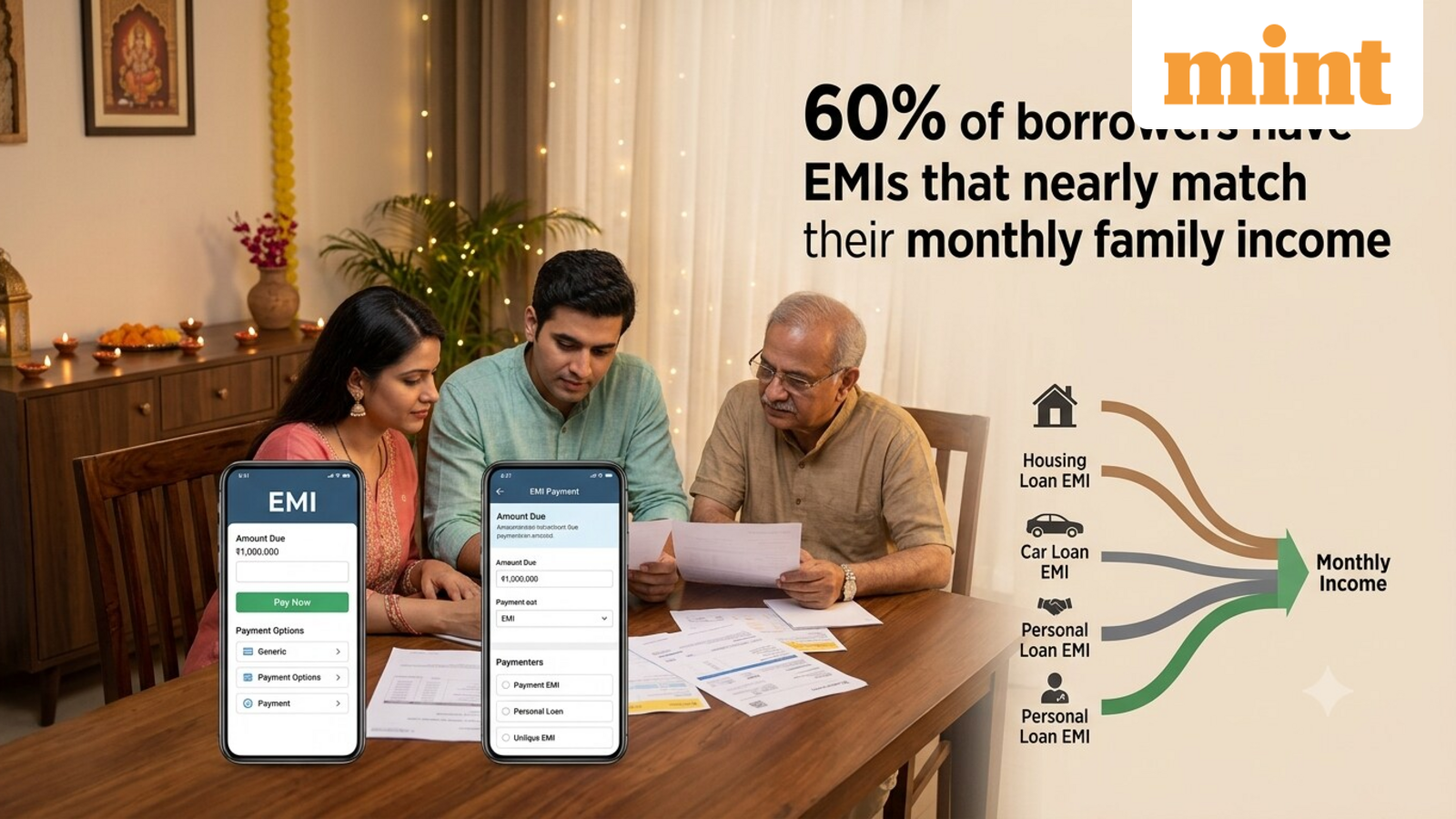
According to a survey conducted by debt and loan resolution platform Expert Panel, 60% of borrowers have EMIs that either exceed or nearly equal their total monthly family income.
The platform also found that 40% of borrowers were managing existing EMIs by taking new loans or using credit cards.
This means the bigger risk for consumers may not be the festive loan itself, but adding fresh borrowing to an already stretched household budget.
Why are borrowers taking loans in the first place?
According to the survey, borrowing is often linked to essential or unavoidable expenses, rather than just discretionary spending. Medical emergencies or health issues accounted for 26% of loan-taking cases, the most frequently cited reason.
Another 22% borrowed for family or personal expenses, including weddings and education, while 18% cited business or job-loss-related requirements. Household and daily needs accounted for another 15%.
“This means that for many households, borrowing is already serving multiple purposes. A festive-season loan may therefore not be an isolated financial decision; it can become an additional EMI layered on top of existing obligations,” the release noted.
What happens when borrowers struggle to repay?
The data also highlights how quickly repayment stress can escalate. Job loss or salary reduction was cited in 31% of cases where borrowers could not repay, while a high EMI burden relative to income accounted for 28%. Multiple loans or overborrowing accounted for another 19% of cases.
According to the release, repayment stress can quickly turn into recovery pressure. 39% of borrowers reported recovery calls or abusive language, while 28% faced frequent calls from multiple lenders. A further 11% reported home or workplace visits, and 8% reported threats of legal or police action.
The broader data also shows that 35% of borrowers were facing some form of harassment, while 17% reported severe harassment involving threats, abusive calls, or home visits. Additionally, 20% had received legal notices from lenders.
Should you take a festive-season loan?
The question is not whether you should take a loan. But the festive season should not become the starting point of a debt cycle.
Anurag Mehra, Director, Expert Panel, said, “Festive spending is often driven by emotion, social expectations and the desire to make the occasion special, but a loan converts that one-time expense into a recurring financial commitment.”
He added that consumers should assess their total borrowing cost, existing EMI commitments, and repayment capacity before taking a festive-season loan.
“A loan should solve a genuine financial requirement, not create another obligation that becomes difficult to manage after the celebrations are over,” Mehra added.
What should you check before another loan?
The release highlighted four things borrowers should check before taking additional credit:
- Calculate total existing EMIs
- Consider your credit-card dues, existing personal loans, Buy Now-Pay Later (BNPL) obligations, and other EMIs
- Understand the complete repayment cost
- Check whether your income can absorb the additional EMI if an unexpected expense arises
With 60% of borrowers having EMIs that exceed or nearly equal their family income, the survey noted that the festive season may be a good time for consumers to celebrate, but also to pause before adding another EMI to the household budget.
Disclaimer: This is for informational and educational purposes only. Please consult a qualified expert before making any financial decisions.