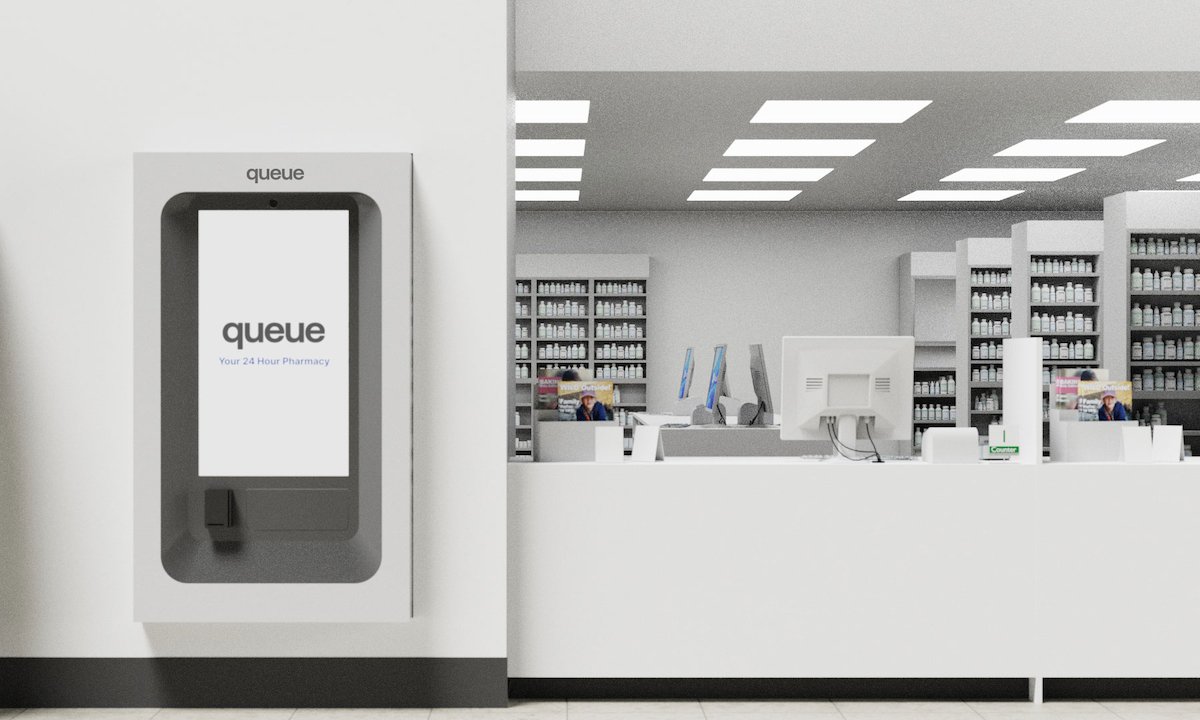
Fully Robotic Pharmacy Fills Prescriptions in Under 60 Seconds
One in three U.S. pharmacies has closed between 2010 and 2021, according to UC Berkeley Public Health and USC. Pharmacy schools are graduating between 3,000 and 4,000 fewer pharmacists annually than the industry needs, Drugstore News reported.
The closures have concentrated in lower-density markets where foot traffic does not support the cost of a staffed operation, producing pharmacy deserts where the nearest dispensing location can sit miles away. That staffing shortage deepens the cost pressure driving the closures.
California-based robotics startup Queue, which is backed by $18.6 million in total funding, emerged from stealth on June 30 with a system it describes as the world’s first fully autonomous pharmacy, according to a company press release. The unit accepts sealed wholesale medication bottles and produces filled verified prescription vials without human involvement in the dispensing step. It covers 250 commonly prescribed medications. Queue said it can reduce fulfillment costs by up to 96% compared with traditional pharmacy operations, though the company has not independently verified that figure. An undisclosed major national pharmacy chain has taken on a working prototype for early commercial testing.
Computer Vision and Robotics Replace the Physical Work
Hospitals have run automated pill-dispensing systems for decades, and retail chains have tested kiosk pharmacy formats, The Next Web noted. Queue’s distinction is removing human involvement from the dispensing step entirely and compressing a full pharmacy operation into one machine. The system uses computer vision and robotics to identify, count, dispense and verify medications, while a predictive AI layer monitors inventory levels and alerts pharmacy technicians when medications need to be replenished, according to the company.
The pharmacist’s role in the Queue model shifts to drug interaction review, patient counseling and prescriptions that require clinical judgment rather than mechanical execution. The 250 medications the platform covers are high-volume routine refills for chronic conditions including hypertension, diabetes and high cholesterol, the refills that consume the most pharmacist time per shift.
If high-volume routine prescriptions migrate to autonomous machines, the remaining traffic at full-service pharmacies may not sustain their economics for patients who need medications outside Queue’s 250. Queue’s system does not replicate pharmacist counseling or drug interaction review, functions that regulation requires for controlled substances and other prescription categories. Whether autonomous dispensing expands access in underserved communities or accelerates closures in the full-service pharmacies those communities also depend on is a question the current pilot cannot answer.
Regulatory Approval and Pharmacy Benefit Manager Integration Remain Unresolved
Queue has not disclosed the regulatory framework under which its prototype is operating. Deployment at scale requires state pharmacy board clearance in each market, integration with pharmacy benefit managers that process insurance claims and agreements with health systems or retailers willing to place machines outside traditional pharmacy settings. Automated dispensing in non-traditional locations touches both state pharmacy board jurisdiction and federal oversight of controlled substance handling.
PYMNTS reported that the hardest part of deploying AI in healthcare is not proving the model works in a controlled setting but fitting the technology into a system built around licensed professionals, established standards of care and legal accountability structures not designed for autonomous systems.
For all PYMNTS digital transformation coverage, subscribe to the daily Digital Transformation Newsletter.