UPI transaction charges: Who will pay, who will earn and will small transactions stay free – explained
The Unified Payments Interface (UPI) ecosystem could be heading for a major change as regulators consider introducing charges on some higher-value merchant transactions, while keeping small payments and person-to-person transfers outside the fee framework.
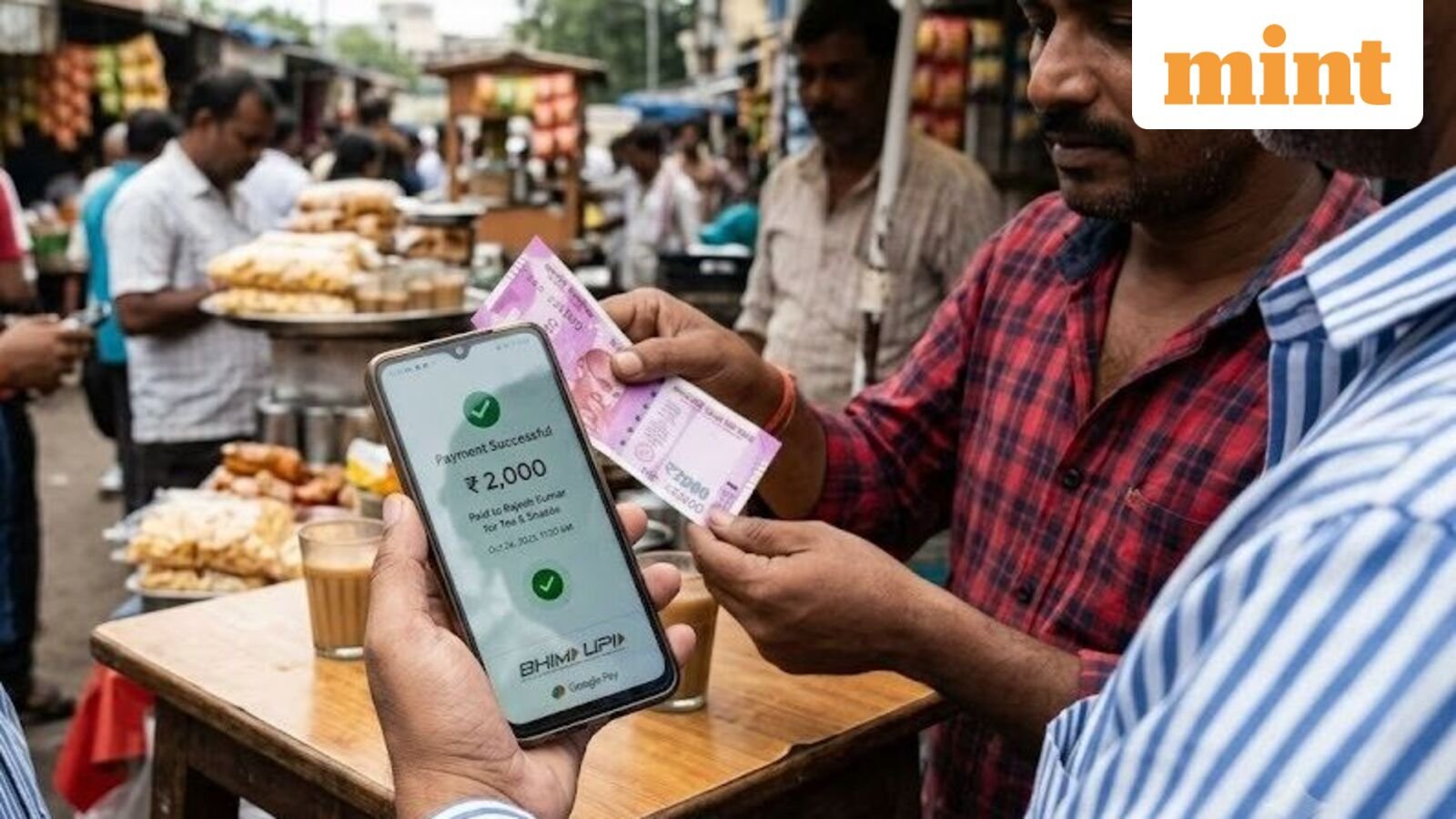
The Finance Ministry has notified that UPI transactions of up to ₹2,000 cannot be subjected to any direct or indirect charge by banks or system providers. The move effectively protects the vast majority of UPI transactions from charges, as around 96% of transactions by volume fall within the ₹0- ₹2,000 band.
In a Gazette notification issued on September 14, the Department of Financial Services under the Ministry of Finance listed two electronic payment modes — “Debit Card powered by RuPay” and “Unified Payments Interface (UPI) transactions up to Rs. 2,000.”
The notification specifically bars banks and system providers from imposing direct or indirect charges on UPI transactions up to ₹2,000. It also covers payments made through RuPay-powered debit cards.
The ₹2,000 threshold is significant because most UPI payments are relatively small.
Industry data suggests that about 96% of all UPI transactions by volume fall within this band.
The same pattern is broadly visible in person-to-merchant payments. Industry estimates indicate that only around 4% of P2M transactions are valued above ₹2,000.
Does the notification introduce MDR on UPI?
The notification does not itself prescribe a Merchant Discount Rate (MDR) for UPI payments above ₹2,000.
This distinction is important. While the notification establishes zero-charge protection for transactions within the specified limit, it does not specify the actual fee or revenue-sharing mechanism for UPI payments exceeding ₹2,000.
What could happen to large UPI transactions?
The possibility of charging higher fees on higher-value merchant transactions is now being discussed in India’s payments industry.
The payments authority is holding consultations with banks and payment companies to discuss the possibility of levying charges on large transactions on the world’s largest retail fast-payment system, Reuters reported, citing people familiar with the matter.
Until now, UPI payments have been free, with merchants and customers not paying an MDR on transactions through the system.
The discussions primarily focus on person-to-merchant (P2M) transactions rather than transfers between individuals.
Under the emerging framework, larger customer payments to merchants could attract a fee. The exact rate, however, has not been finalised.
The agenda of the consultations includes determining the overall fee applicable to merchant transactions and deciding how the proceeds would be distributed among banks, payment applications and aggregators, Reuters reported.
Regulatory authorities, including the National Payments Corporation of India (NPCI) and the Reserve Bank of India (RBI), are reportedly considering a charge of around 0.4%.
However, the proposed rate is not final and the eventual structure could be different.
Who will earn from UPI charges?
If the proposed fee structure is implemented, several participants in the UPI ecosystem could receive a share of the revenue.
According to the Reuters report, banks could receive 40% of the fees. The remaining amount could be divided equally between the payment application and the merchant payment service provider.
Will person-to-person UPI payments remain free?
For consumers, one of the most important questions is whether sending money to another individual will remain free.
According to the Reuters report, peer-to-peer (P2P) UPI transactions are expected to remain free, even if charges are introduced for certain merchant payments.
This means a person transferring money to a family member, friend or another individual would not be expected to pay a transaction fee under the proposed model.
The focus of monetisation is instead expected to be on person-to-merchant payments, particularly larger-value transactions.
UPI’s enormous scale
The stakes are high because of the extraordinary scale of India’s UPI network.
According to data from the National Payments Corporation of India, UPI processed more than 24,500 million transactions worth nearly ₹29.82 lakh crore in August 2026.
India’s digital payments system has grown rapidly as consumers, merchants and businesses increasingly rely on UPI for everyday transactions.
Reuters reported that the system processed around 24 billion payments worth $311 billion in August, highlighting the enormous volume of transactions flowing through the network.
The notification specifically bars banks and system providers from imposing direct or indirect charges on UPI transactions up to ₹2,000. It also covers payments made through RuPay-powered debit cards.
The ₹2,000 threshold is significant because most UPI payments are relatively small. Industry data suggests that about 96 per cent of all UPI transactions by volume fall within this band.
The same pattern is broadly visible in person-to-merchant payments. Industry estimates indicate that only around 4 per cent of P2M transactions are valued above ₹2,000, meaning nearly 96 per cent remain below the threshold.