Mamdani Rollouts Diverge For Pied-à-terre Tax, Outdoor Dining

Mamdani took a victory lap Monday, signing a widely popular policy into law.
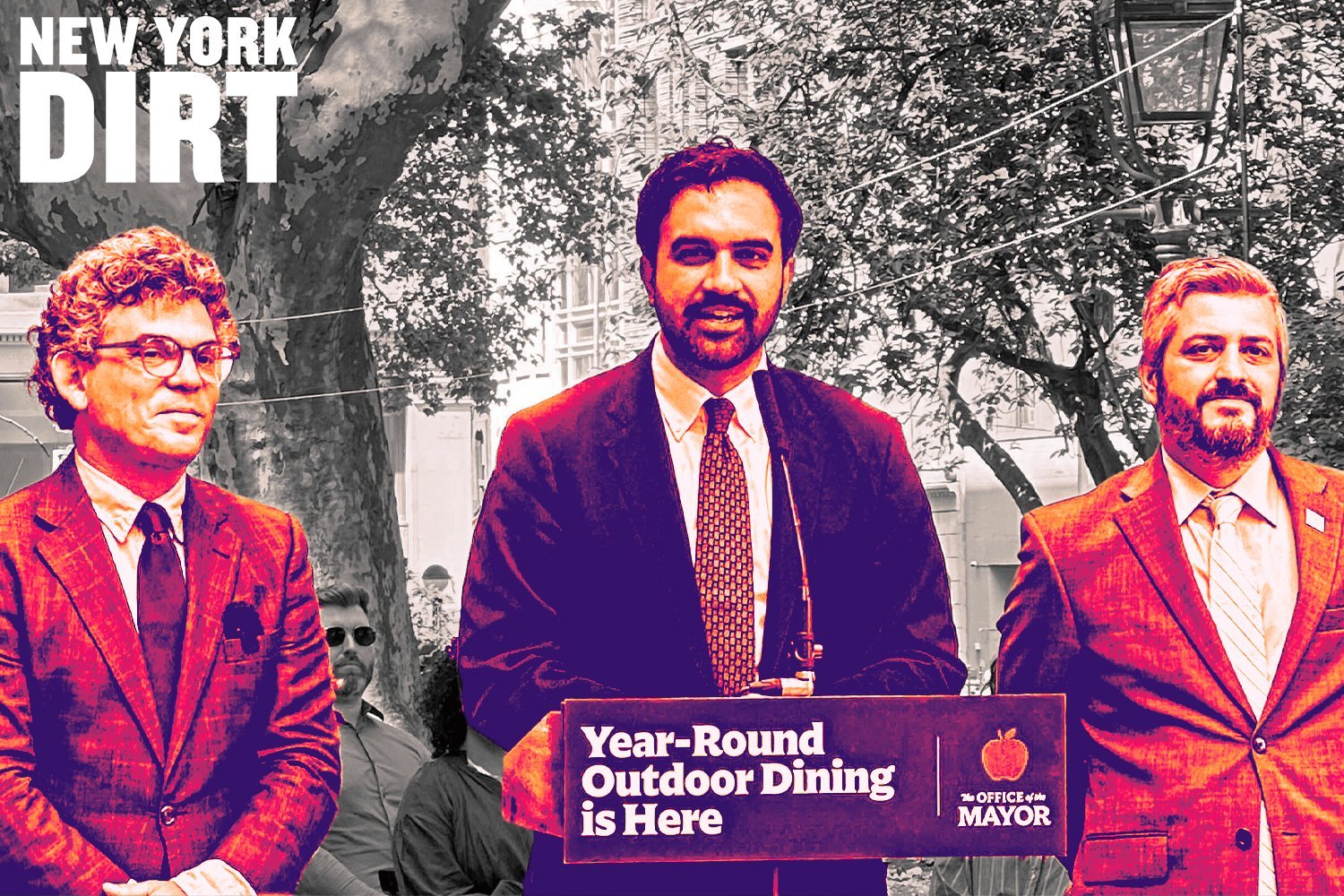
The mayor held not one, but two events to announce his signing of a City Council bill into law that allows year-round outdoor dining. He wanted to make sure everyone knew he supported an uncontroversial move to reinstate off-season sidewalk tables, lauded by restaurateurs and diners alike, so he set up a faux cafe behind City Hall while his administration’s lawyers geared up to defend his second home surcharge rollout in a Staten Island courthouse.
While both policies conjure a vaguely French set of associations, outdoor dining and the pied-à-terre tax couldn’t be more different when it comes to the administration’s approach to maneuvering public opinion.
One is a tested and broadly popular initiative, updated by the City Council to remove cumbersome requirements that small business owners dismantle their outdoor dining setups every year, which counts among its few opponents those who will miss the parking spaces and neighbors gearing up to file noise complaints.
Council member Lincoln Restler even had an answer for concerned residents who live adjacent to restaurants with outdoor dining, noting that they had adjusted the curfew for operating outside to 11 p.m.
Just a ferry ride away, former Deputy Mayor Randy Mastro went to bat in Staten Island court for thousands of disgruntled homeowners furious over “a botched rollout of unparalleled proportions,” telling a judge that the city may not “terrify first, clarify later,” when it comes to the pied-à-terre tax rollout. Despite the broad-based approval of the policy among lawmakers, even supporters have admitted that early implementation of the levy on nonprimary residences hasn’t gone very smoothly.
Another key difference is the rhetorical posture the mayor can take when rolling out the two policies. When it comes to outdoor dining, he can frame his new initiative as a step toward cleaning up convoluted regulations and cutting red tape left over from the previous administration. After his initial jab at Ken Griffin to introduce his second home surcharge rollout, Mamdani has largely been forced to own the new policy and answer for its imperfections.
Celebrating al fresco meals makes for a more entertaining press conference than lamenting the complexities of property value assessments, but the mayor will ultimately get credit or blame for the outcomes of both policies.
What we’re thinking about: Do you think that year-round outdoor dining will be a success? Will it change the types of spaces where prospective restaurant operators look to run their businesses? Let me know at ben.miller@therealdeal.com.
A thing we’ve learned:
Anthropic, which finalized its lease for 330 Hudson Street in Manhattan this summer, isn’t only focused on staffing up for its newly expanded office footprint in the city. The AI outfit has also hired London House and CMW Strategies, paying each firm $12,500 monthly to lobby across City Council and the New York State Legislature, according to Nick Garber of New York Focus.
Elsewhere…
- Mayor Mamdani on Monday also promised to address payment delays that are threatening to derail the rollout of another signature policy: free childcare for 2-year-olds. He pledged to invest $43 million to rebuild depleted staffing at the Education Department’s Division of Early Childhood Education and said the administration would process all loans requested by providers before Monday by the end of the week, Chalkbeat reported.
- Commuters were caught short-handed Monday morning when they were unable to refill their physical OMNY cards. The MTA wouldn’t disclose what caused the issue, but posted on social media that riders wouldn’t be able to use vending machines, customer service centers, or online means to refill the cards, leaving them to use alternate means like tap-to-pay on phones, credit or debit and preloaded OMNY cards, Gothamist reported.
- George Santos, a former lawmaker who represented New York in Congress, has earned the dubious distinction of the first-ever lifetime ban from Kalshi, New York Magazine reported. The prediction market platform booted him for betting on himself to not attend the State of the Union address, generating more than $17,000 in profit, with the Commodity Futures Trading Commission then ordering him to pay $35,000 for “manipulative trading” in July.
Closing time
Residential: The most expensive residential sale recorded Monday was $8.2 million for 212 5th Avenue, 16B. The NoMad condo unit is 3,100 square feet and last sold in 2017 for $9.4 million.
Commercial: The most expensive commercial transaction was $50 million for 158-162 West 25th Street. The Lam Group sold the 22-story, 158-key Chelsean New York Hotel to Manga Corporate, per reports.
New to the Market: The highest price for a residential property hitting the market is $18.8 million for 150 Barrow Street, Unit PH1. The West Village condo is new construction and 4,300 square feet. Howard Hanna’s Peter Oliveri and Clara Ceccaldi have the listing.
— Joseph Jungermann