ITAT Mumbai ruling: ₹16.64 lakh cash seized in tax raid, taxpayer wins ₹8.87 lakh unexplained cash dispute
The Income Tax Appellate Tribunal (ITAT), Mumbai, has deleted an ₹8.87 lakh addition made under Section 69A of the Income-tax Act after accepting a taxpayer’s explanation that cash found during a search belonged to different members of his family.
The case involved Pawan Onkardas Chandak, a Pune-based taxpayer. In an order dated 20 July 2026, the Mumbai bench of the ITAT held that tax authorities cannot assess household cash without considering surrounding circumstances, normal human behaviour and prevailing social practices. The case was Pawan Onkardas Chandak v. ACIT, Central Circle 6(1), Mumbai, ITA No. 4183/Mum/2026, for assessment year 2022-23.
Income-tax search found ₹19.14 lakh cash
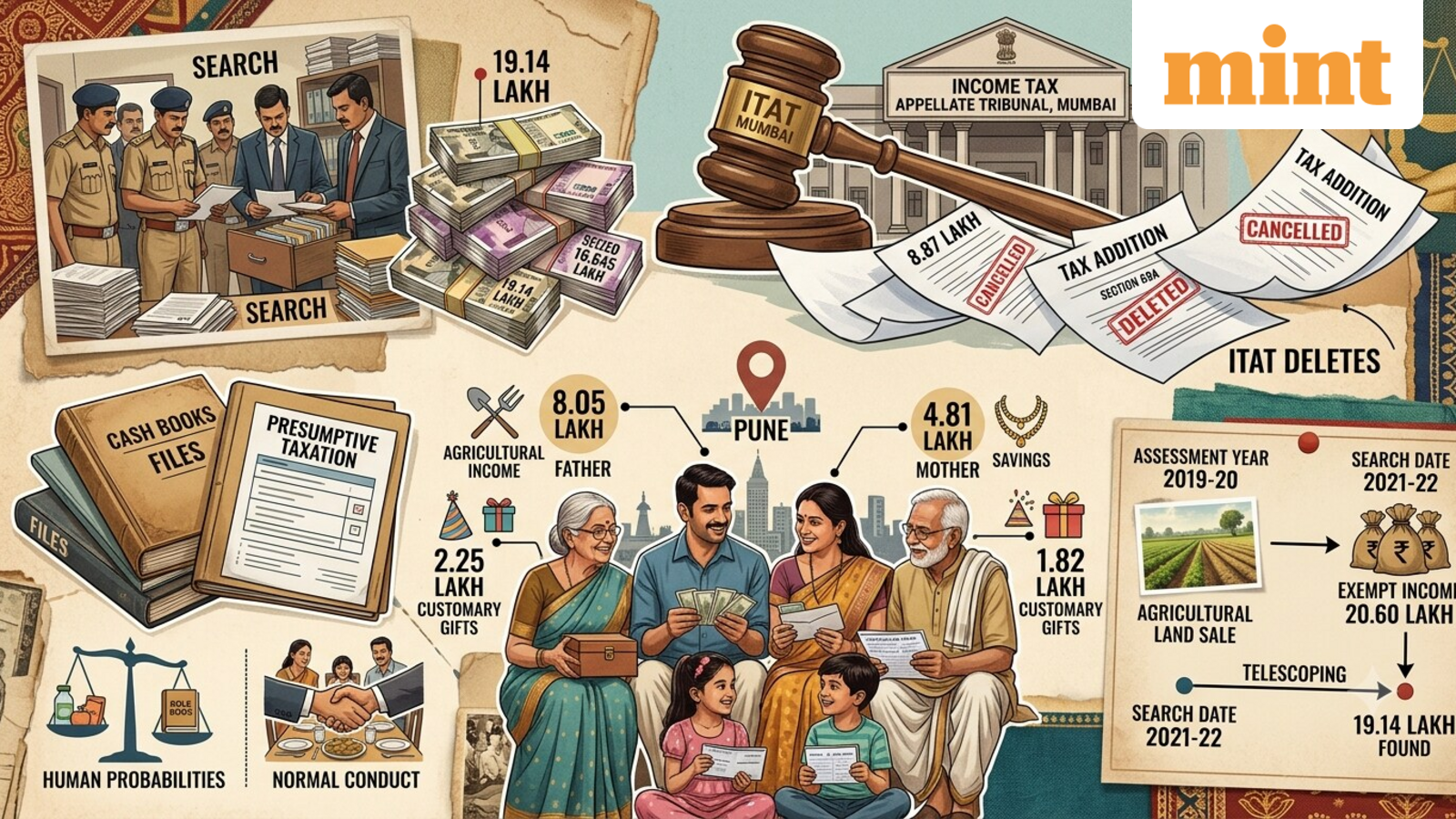
The Income Tax Department conducted a search under Section 132 of the Income-tax Act on 23 September 2021 at Chandak’s residential and business premises and those of connected entities. During the search, officials found ₹19.14 lakh in cash and seized ₹16.645 lakh.
Chandak subsequently explained that the cash did not belong entirely to him. He attributed it to six family members: ₹1.782 lakh to himself, ₹43,500 to his wife, ₹8.054 lakh to his father, ₹4.806 lakh to his mother, ₹2.253 lakh to his minor daughter and ₹1.815 lakh to his minor son.
For himself and his wife, Chandak produced cash books. His father’s cash was explained through an opening balance, agricultural income and bank withdrawals. The amount attributed to his mother was described as lifetime savings, while the cash attributed to his two children was said to have accumulated through customary gifts from relatives.
The Assessing Officer rejected the explanation and treated the entire ₹16.645 lakh seized as unexplained money under Section 69A. The officer questioned the cash books because Chandak had opted for presumptive taxation under Section 44ADA and had not maintained regular books. The officer also found insufficient evidence for the children’s gifts, the mother’s savings and the father’s agricultural income.
First appeal gave Chandak partial relief
Chandak challenged the assessment before the Commissioner of Income Tax (Appeals). The CIT(A) accepted the explanation for ₹1.782 lakh belonging to Chandak, ₹43,500 belonging to his wife and ₹8.054 lakh attributed to his father.
This resulted in deletion of ₹7.771 lakh of the addition. However, the CIT(A) sustained an ₹8.874 lakh addition relating to Chandak’s mother and two minor children.
The CIT(A) questioned the claim that the mother could have accumulated ₹4.806 lakh in cash as lifetime savings without an independent income source. It also rejected the explanation concerning the children’s customary cash gifts.
Chandak then approached the ITAT Mumbai.
Tribunal considered family savings and past cash availability
The ITAT disagreed with the approach of the lower authorities. It noted that the absence of income-tax returns by a non-earning senior citizen or minor children cannot, by itself, be treated as incriminating evidence.
The Tribunal said household savings accumulated by a housewife or senior citizen through household allowances, personal savings, family gifts and traditional stridhan can form part of Indian household practices. Similarly, cash gifts received by minor children from relatives during occasions such as birthdays and family celebrations cannot necessarily be expected to have formal accounting records.
The bench relied on the Supreme Court’s principles concerning human probabilities and surrounding circumstances, including those laid down in CIT v. Durga Prasad More and Sumati Dayal v. CIT.
The Tribunal also accepted Chandak’s alternative argument based on telescoping.
In an earlier assessment year, 2019-20, cash of ₹20,60,970 arising from the sale of agricultural land had been treated by the CIT(A) as part of exempt agricultural land sale proceeds. The Revenue had not established that this cash had subsequently been spent or invested elsewhere.
The ITAT held that this earlier accepted cash availability could explain the cash found during the later search. Since ₹20.60 lakh was more than the ₹19.145 lakh cash found during the search, the entire amount was covered on this alternative basis as well.
The Tribunal therefore directed the Assessing Officer to delete the remaining ₹8.874 lakh addition under Section 69A and allowed Chandak’s appeal.