Subhash Chandra’s Rs 22,006 Crore Debt Settlement: Will Banks Recover Just 3 Paise Per Rs 100 Owed?
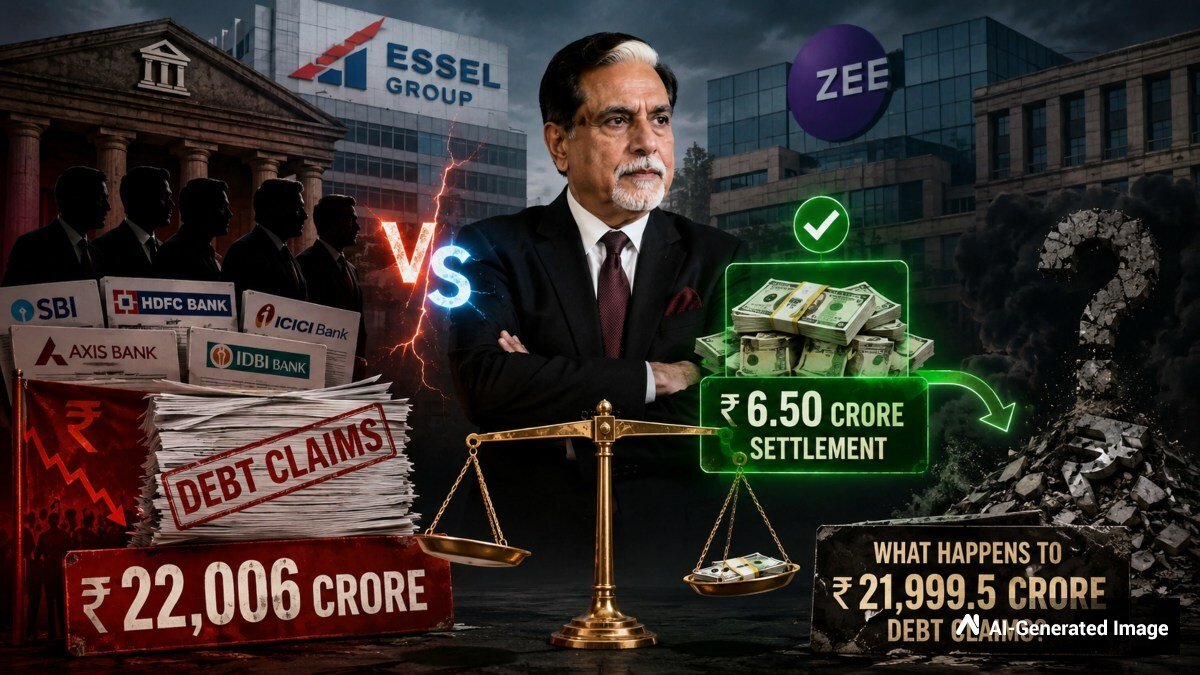
A new lifeline has been granted to Essel/Zee-linked companies’ founder, Subhash Chandra, who has been forgiven 99.97% of total debt claims against him. To give a clear picture, that’s a Rs 6.50 crore settlement against a Goliath debt of Rs 22,006 crore. What happens to the rest of the Rs 21,999.5 crore of debt is now being debated and in the limelight. The National Company Law Tribunal (NCLT) decision of relief to Chandra and his group, however, paints a harsher picture for lenders.
Subhash Chandra’s Debt Settlement: Pay Rs 6.5 Crore
/img/2026/08/subhashchandradebtcase1-41671787897855.jpg)
The NCLT okayed a Zee Group plan, which enables Subhash Chandra to settle his dues with just Rs 6.50 crore against admitted debt claims of Rs 22,006 crore by lenders. This is a 99.97% haircut in the total debt. For lenders, this means only three paise recovery for every Rs 100 owed.
The 99.97% haircut in total debt translates to Rs 21,999.5 crore. And what will happen to this amount?
Opinions Split On The Settlement
Firstly, what needs to be known is that the NCLT did not randomly cherry-pick and decide to give a lifeline to Chandra. In fact, the repayment plan received 80.814% of creditors’ votes by voting share. This means only 19.186% of the voters opposed.
Among the voters in favour seemed to be related parties, while NCLT said, “All the banks could vote against the repayment plan, though their vote share comprises 19.186%.”
NCLT stated that they cannot simply replace the commercial decision of the majority of creditors in the voting share with their own assessment on whether the recovery amount is passable.
This has raised concerns over the insolvency framework in India and the extent to which creditors will be pushed to accept minuscule recovery.
Who Opposed Subhash Chandra’s Debt Settlement Plan?
Under the latest NCLT tribunal statement, LIC Housing Finance, which is one of the creditors who opposed the repayment plan, called it “unviable and unlawful.”
The NBFC contended that the repayment plan proposed payment of only INR 6.25 crores to creditors and INR 25 lakhs towards process costs.
While opposing, LIC Housing revealed that in their case, their admitted claims stood at Rs 1,322.39 crore, and the proposed repayment was merely Rs 38,09,294, which is approximately a feeble 0.0028% of the admitted dues.
“We hereby confirm that LIC Housing Finance Limited (LICHFL) had sanctioned financial facilities across two loan accounts wherein Dr. Subhash Chandra is the personal guarantor. LICHFL continues to hold and enforce its security interest over the secured assets against which the financial facilities were granted, which have been duly charged/mortgaged in favour of LIC HFL. Accordingly, LICHFL continues to hold and retain all its rights, security interests, enforcement remedies, and recovery avenues over the said secured assets in accordance with applicable provisions of law,” said LIC Housing in its regulatory filing after the order.
Others who opposed the recovery of Rs 6.5 crore also included major banks are Axis Bank, Canara Bank, HDFC Bank and IDBI Trusteeship (Franklin Templeton), RBL Bank, and Union Bank of India. While IndusInd Bank did not vote at all.
Meanwhile, Vijay Mallya, the once-upon-a-time Kingfisher king and also a billionaire defaulter in India, has reacted to the Chandra’s debt settlement. He tweeted, saying. “If true, many congratulations to my friend Subhash. Banks and Government have admitted to having recovered Rs 14,100 crores from me against a Judgement debt of Rs 6203 crores. Many more borrowers have settled at a fraction. Indian Debt Resolution Justice, I presume. No media questions.”
If True many congratulations to my friend Subhash.Banks and Government have admitted having recovered Rs 14,100 crores from me against a Judgement debt of Rs 6203 crores. Many more borrowers have settled at a fraction. Indian Debt Resolution Justice I presume. No media questions. pic.twitter.com/5uwxYSAX8H
— Vijay Mallya (@TheVijayMallya) August 26, 2026 “>
What Happens To The Rest of the Rs 21,995.5 Crore Debt?
Sources told PTI that the Rs 22,006 crore figure represents claims admitted against Chandra in his capacity as a personal guarantor for loans taken by several Essel/Zee-linked companies, not debt personally borrowed by him.
They said the distinction is critical to understanding the NCLT order. The plan provides for the recovery of about Rs 6.25 crore from Chandra’s personal estate, but the principal corporate borrowers remain liable for their debts, and the repayment plan envisages about Rs 1,494 crore in payments by those borrowers, apart from Chandra’s personal contribution.
These sources revealed that only about Rs 2,574 crore of admitted debt claims are linked to Chandra’s personal guarantee during the time of borrowing. The other guarantees were furnished as additional security later. Hence, they said that the 99.97% haircut in the claims is related to the amount recoverable from Chandra as a personal guarantor instead of 99.97% loss on Rs 22,006 crore of bank loans.
“The approved Repayment Plan, in my opinion, will be binding upon all the creditors, whether assenting or dissenting to the Repayment Plan, in accordance with Section 115 of the Insolvency and Bankruptcy Code, 2016, and shall have all consequences contemplated under the Code,” NCLT’s order said.
However, the tribunal report of a 99.97% haircut could be misunderstood.
What is understood is that Subhash Chandra did not personally take the Rs 22,006 crore loans. This figure is a claim that represents his capacity as a personal guarantor, not Rs 22,006 crore he personally borrowed and received from lenders.
The borrowings are connected to the companies he owns. For instance, Essel Group, Zee companies and DishTV have pledged as security against these borrowings.
The creditors also contested Chandra’s historical citing of his net worth. They argued that his net worth was reported to be Rs 45,888 crore in 2017 and fell to Rs 40,562 crore in 2018. Now, his net worth is a meagre Rs 31.79 crore. Hence, the creditors seek a deeper investigation into his assets. Meanwhile, Chandra’s team has also claimed that they have repaid up to Rs 43,000 crore to creditors so far.
Hence, the sources clarified that the current Rs 6.5 crore settlement is in the case where he is a personal guarantor. And these should not be categorized as a settlement or write-off of the entire debt which are owed by Essel/Zee companies.
How Did Subhash Chandra’s Debt Mount To Rs 22,006 Crore?
It all began in December 2016 when Chandra took a loan of Rs 170 crore for Vivek Infracon, for which he provided a personal guarantee. But when the loan defaulted, Indiabulls Housing Finance approached the NCLT under the Insolvency and Bankruptcy Code in 2022. Later, in April 2024, a personal insolvency proceeding against Chandra was admitted before NCLT. Meanwhile, Indiabulls Housing Finance was renamed as Sammaan Capital in that same year.
As the insolvency proceeding continued, total claims of Rs 22,006 crore were filed against Chandra in the personal-guarantor insolvency proceedings.
Stocks Reaction To Chandra’s Debt Settlement
At the time of writing, Zee Entertainment stock traded under pressure by 0.53% to Rs 103.50 apiece on BSE with a market cap of Rs 9,941.38 crore. On the other hand, Zee Media stock surged 5% to trade at Rs 9.01 apiece, while Zee Learn surged 2% to trade at Rs 7.95 apiece.
Among the creditors who are listed and voted against Chandra’s recovery plan, LIC Housing stock traded higher by 1% to Rs 536.65 apiece, HDFC Bank was marginally up to trade around Rs 714 apiece, while Axis Bank shares soared 1% to trade around Rs 1259.80 crore. Further, Canara Bank gained 2% to trade around Rs 127.65 apiece and Union Bank of India rallied 3% to trade around Rs 185.45 apiece. However, RBL Bank stock is down by 0.5% to trade around Rs 382.15.
Majorly, stocks are unaffected by the latest NCLT order.