Builders Turning To Prefab Solutions As Speed To Delivery Becomes Critical Consideration
:no_upscale():quality(75))
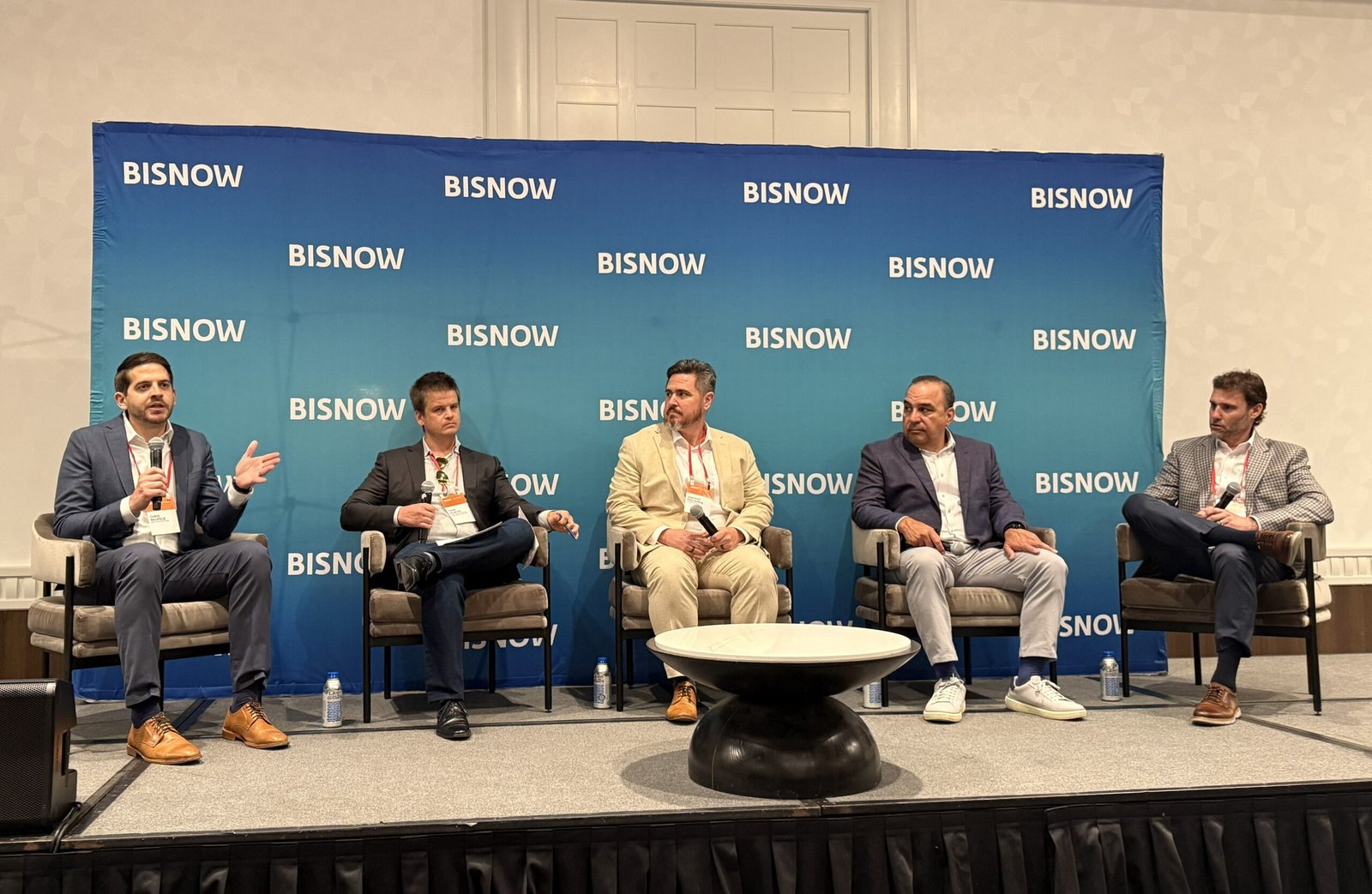
Photo credit: Bisnow/Bora Altunay
DPR Construction’s Chris Neufeld, Sares Regis Group’s Thor Hoskins, Clark Pacific’s Vincent Polhemus, The Michaels Organization’s Raoul Amescua and TimberQuest’s Aaron Rhodes
Prefabrication has long been pitched as a way to trim budgets and streamline construction, but developers say its real value has shifted. In today’s market, prefab is becoming the fastest path to delivering data centers, student housing and multifamily projects.
Builders are discarding traditional sequencing in favor of modular components and preengineered systems that can cut months off delivery timelines.
“We told the owner to throw out the traditional playbook and follow this approach and strategy, and we’ll be able to deliver at record speed,” Chris Neufeld of DPR Construction said of a data center project his company completed in Texas using prefabricated components.
:no_upscale():quality(75))
Photo credit: Bisnow/Bora Altunay
MassFrame Solutions’ James Woodbury, Harbinger Production’s Jamie Hiteshew, Villa’s Heather Miksch, Terner Lab’s Ruby Bolaria Shifrin and Kitchell’s Tony Mirenda
DPR was able to complete the project in just 13 months, he said at Bisnow’s Bay Area Prefab, Modular and Mass Timber Summit at the Hyatt Regency San Francisco Downtown on July 15.
“The investment we’ve made in upfront design time and leveraging computational design so we’re not starting from scratch every single time has really accelerated our ability to deliver projects,” Neufeld said.
Cost savings has historically been a primary driver when developers choose prefabricated building solutions versus traditional field-built methods, but in the rush to deliver additional compute power for hyperscale customers, the winning solution has become the one that gets a project built the fastest, said Vincent Polhemus, associate director of preconstruction for prefabricated building solutions provider Clark Pacific, of West Sacramento.
:no_upscale():quality(75))
Photo credit: Bisnow/Bora Altunay
OWow’s Danny Haber, GPLA’s Erik Kneer, UC Berkeley’s Paul Mayencourt, Perkins & Will’s Matt Covall and CAC’s Jamie Pincus
Clark Pacific shifted into providing precast solutions that allow the company to speed up the development of data centers, Polhemus said. That pivot was simplified by the company’s decade of experience in manufacturing precast structures for the life sciences industry.
“We were developing entire lab structures out of precast concrete,” he said. “That kit of parts was able to be quickly pivoted into the mission critical [for data centers]. When we have those kits, that’s what has allowed us to be successful.”
The prefab industry is at an inflection point, said Raoul Amescua, executive vice president of development for The Michaels Organization western region projects. The ongoing combination of high capital and construction costs, compressed rents in many primary and tertiary markets, and a dearth of investment capital have put the potential benefits of prefab systems into sharper focus, he said. Coupled with speed to delivery, prefab often becomes the most compelling construction option.
“The arbitrage is being able to compress time and budget to a total cost of development that’s lower than what you can get in the field, and there’s some leading firms out there that really understand that,” Amescua said.
Amescua said The Michaels Organization likely wouldn’t have stayed on schedule to deliver nearly 5,000 student beds for housing projects at the University of California, Davis if it had used traditional stick-built construction methods.
“The speed these things erect at is unbelievable, and the ability to make up schedule is unprecedented,” Amescua said of the modular framing approach.
:no_upscale():quality(75))
Photo credit: Bisnow/Bora Altunay
Decro’s Ted Handel, Impact Housing’s Eduardo Santana, Dignity Move’s Joanne Price, Avanath Capital’s Kieth Harris and Kalesnikoff Mass Timber’s Sophia Smith
Adopting prefab and modular build methods requires early coordination and consideration of site, building and zoning conditions, plus early inclusion in the design-build process to ensure projects meet stringent entitlement and planning requirements, said Thor Hoskins, assistant vice president for Sares Regis Group of Northern California. Sares Regis’ prefab projects include transitional housing, parking garages, building exteriors systems and mass timber framing.
“In California, we have onerous entitlement requirements, and you need to be looking at your prefab solution, because that has planning implications,” Hoskins said.
The nature of a project can significantly add to the complexity of using prefabricated building solutions, Amescua said. Parking structures and shells for data centers don’t have the same set of requirements as large multifamily projects.
“Multifamily is ecosystems within ecosystems,” Amescua said. “You have kitchens and bathrooms within every unit. To make it more complicated, you also have spaces that don’t repeat, like gyms, amenities, coworking and study spaces.”
As the prefab and modular industry continues to evolve and mature, it creates increased opportunity for developers to realize value on large- and small-scale projects, Neufeld said. Prefab can also solve logistical challenges that are common when building in site-constrained locations such as downtown San Francisco.
DPR Construction installed 12 modular clean rooms in a single day in a building at 16th and Mariposa streets using preengineered modules that contained HVAC, lighting and process piping systems. The speed of installation kept disruption on surface streets to a minimum.
“Scale is the low-hanging fruit for how prefab adds value, but there are other ways it can as well,” Neufeld said.