53% may stop using UPI for payments above ₹3,000 if MDR returns, survey claims. What are Merchant Discount Rates?
More than half of Unified Payments Interface (UPI) users are likely to switch to other modes of payment for transactions exceeding ₹3,000 if the central government approves the proposed amendments to the Payment and Settlement Systems Act, 2007, which could effectively bring back merchant discount rates (MDR) on UPI transactions.
The amendments would allow the government to introduce MDR on UPI by removing the zero-MDR provision under Section 10A, which currently prevents banks and payment service providers (PSPs) from charging fees on notified digital payments.
Notably, the Bill does not propose any fees for consumers using UPI, meaning the burden would fall on merchants. For customers, this means there should be no additional charges or transaction fees due to MDR.
53% of users may avoid UPI for transactions above ₹3,000 if MDR returns
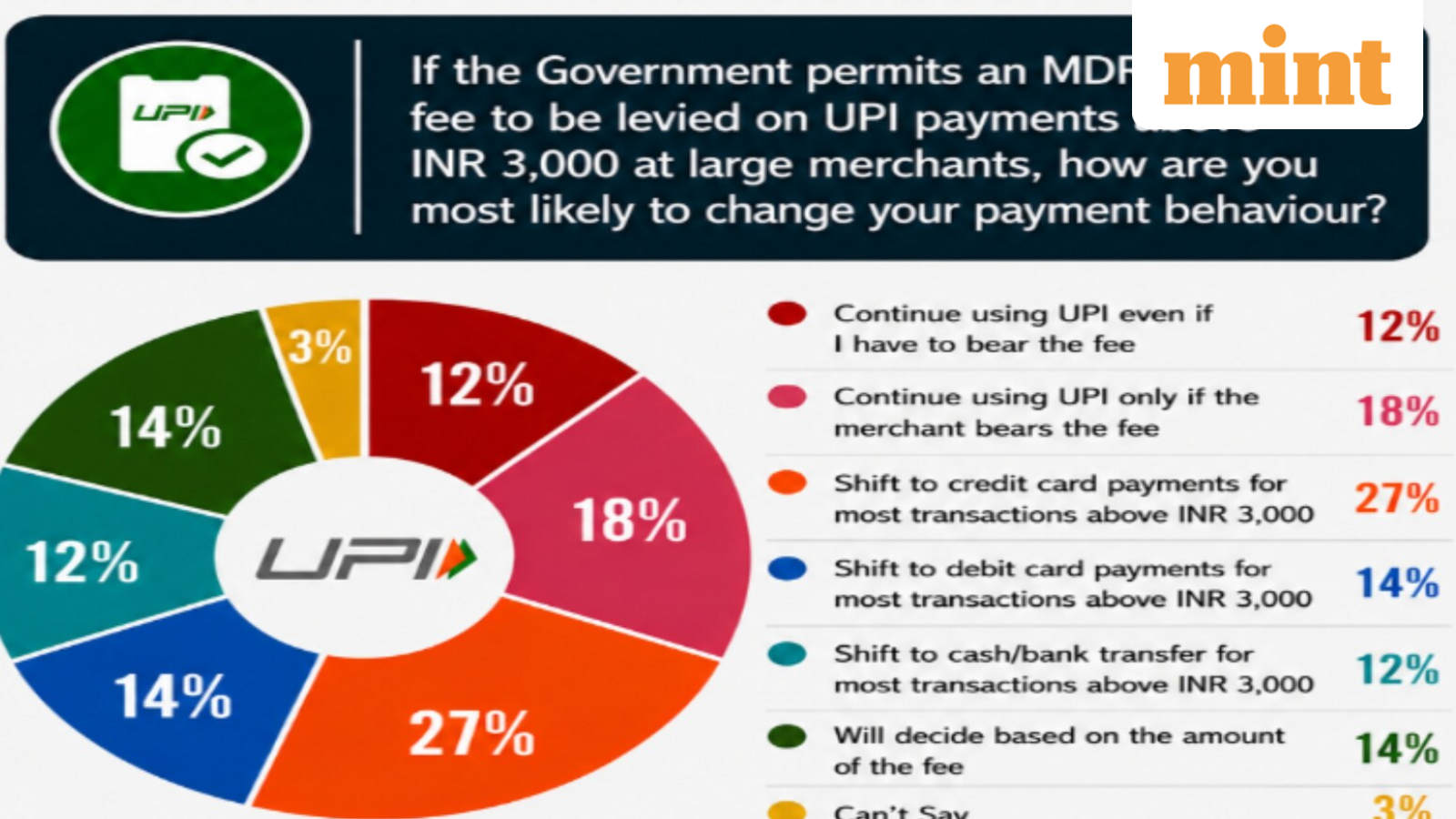
A LocalCircles survey released on Tuesday, which received more than 45,000 responses from across 322 districts in India, found that 53% of respondents would move away from UPI for transactions above ₹3,000 if an MDR is imposed on large merchants. Of these, 27% said they would switch to credit cards, 14% to debit cards, and 12% to bank transfers or cash.
Another 18% said they would continue using UPI only if the merchant bears the fee, while 12% said they would continue using UPI even if they had to pay the charge. A further 14% said their decision would depend on the amount of the fee, according to the survey.
The survey follows the government’s proposal to amend Section 10A of the Payment and Settlement Systems Act, which currently prevents banks and payment system providers from charging MDR on notified digital payment modes. Under the proposed amendment, the Centre would have the power to notify which payment modes remain exempt from such charges.
What are Merchant Discount Rates?
Regulated by the Reserve Bank of India (RBI), merchant discount rate or MDR is the fee businesses pay to banks and PSPs to process online transactions made by customers.
Since 2020, this has stood at 0% for UPI and RuPay debit card transactions as the Centre sought to promote digital payments and mandated no MDR for customers and merchants.
In practice, this works like this: A customer pays ₹1,000 for an item using credit or debit card; of this, a small percentage is deducted and split between the banks on the two ends, while the merchant receives the net amount. For UPI transactions at present, merchants receive the full transaction amount.
Weighing in on the proposed amendments to the Payment and Settlement Systems Act, Sonia Asher, Executive Chairperson and Whole-time Director of Paramotor Digital Technology Limited, said the changes could help create a more sustainable commercial framework for India’s digital payments ecosystem.
“A resilient digital payments infrastructure cannot exist without long-term economic sustainability,” Asher said, adding that while zero MDR played a key role in accelerating UPI adoption, maintaining world-class payment infrastructure at current transaction volumes requires continued investment in innovation, security, resilience and customer experience.
She said the proposed amendments “could help establish a more sustainable commercial framework for the ecosystem” by aligning incentives across banks, payment processors, prepaid payment instrument (PPI) issuers and merchants, while preserving affordable access for consumers and small businesses.
“A balanced and sustainable payments ecosystem will be instrumental in powering India’s next phase of digital growth and advancing the vision of Viksit Bharat through a secure, inclusive and innovation-led digital economy,” she added.