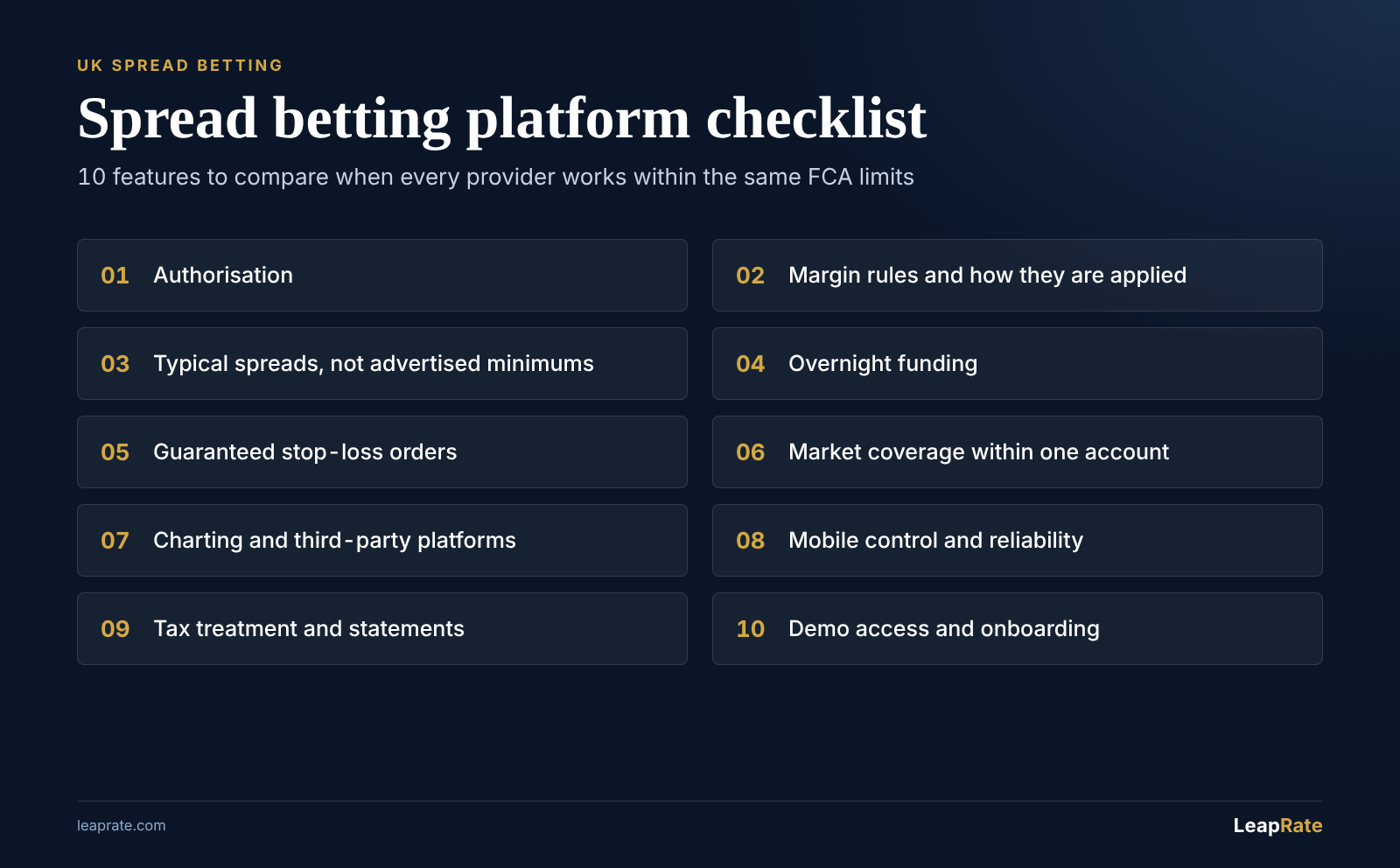
Spread Betting Platform Checklist: 10 Features to Compare
Since the FCA made its retail CFD restrictions permanent in 2019, UK spread betting providers have lost leverage as a selling point. Every authorised firm works within the same regulatory limits, so competition has shifted to pricing, execution, platform features and service quality, which are hard to judge from a homepage.
Whether you are comparing providers for the first time or reconsidering your current platform, these ten features can help you assess the quality of their offer.
1. Authorisation
Any firm offering spread betting to UK retail clients must be authorised by the Financial Conduct Authority (FCA), and the Financial Services Register is where that should be confirmed. The entry should match the legal entity named in the client agreement. This matters because the FCA regularly warns about clone firms that copy the details of genuine brokers.
Authorisation also affects what happens when something goes wrong. Clients of an unauthorised firm have no route to the Financial Ombudsman Service. If an authorised firm fails, the FSCS can cover eligible investment claims up to £85,000 per person, per firm, a limit left untouched when deposit protection rose to £120,000 in December 2025. Authorised firms must also follow the FCA’s rules on retail client protection, and how they are applied is the next point of comparison.
2. Margin Rules and How the Platform Applies Them
FCA rules cap leverage on retail spread bets at between 30:1 and 2:1, depending on the underlying market. Providers must close positions when account funds fall to 50% of the margin required to maintain them. Retail clients also receive negative balance protection, which prevents them from losing more than the funds in their trading account.
Because these rules apply uniformly, the way a platform presents information becomes a key differentiator. Look for clear margin figures and alerts that help you act before your account reaches a close-out level. Be cautious if a provider encourages you to apply for elective professional client status. Professional clients do not receive the same retail protections, including leverage limits and negative balance protection.

3. Typical Spreads, Not Just Advertised Minimums
Spreads are the most visible cost and the most selectively advertised, usually quoted “from” a minimum that applies during peak liquidity. A tight EUR/USD price in London hours reveals little about a minor index late in the evening, so checking typical spreads during the hours you normally trade is the most sensible approach here. If you focus on currency pairs, look at the costs of your preferred majors and crosses. For index trading, check how spreads behave outside the main market session.

4. Overnight Funding
Rolling daily bets carry a financing charge each night, generally a benchmark interest rate plus the provider’s markup. Quarterly or futures-style bets avoid that charge by building the cost into a wider spread. Check how each provider calculates its charges and whether weekend adjustments apply. Over longer holding periods, financing costs can exceed the initial spread, so comparing both gives you a realistic picture of the total cost.

5. Guaranteed Stop-Loss Orders
A standard stop-loss closes a position at the next available price once the market reaches your chosen level. However, if the market gaps, the execution price may be much worse than expected. Guaranteed stops remove that slippage in return for a premium. Terms differ between providers, and so does the list of markets where a guaranteed stop is available. Make sure to check which instruments support guaranteed stops and review the conditions attached to them.

6. Market Coverage Within One Account
A broad market range can make it easier to follow different opportunities without opening multiple accounts. Check whether the provider offers forex, indices, commodities and bonds through the same spread betting account and whether these positions share a single margin balance. Bonds deserve attention as well. The gilt sell-off after the September 2022 mini-budget showed how quickly UK government borrowing costs can change, yet some providers’ spread betting products exclude government debt.
7. Charting and Third-Party Platforms
Many traders use platforms such as TradingView or MetaTrader 4 to analyse markets and expect to manage their positions from the same interface. Before choosing a provider, confirm that the integration applies to the spread betting account, not just the CFD service. Platform versions matter as well: certain UK providers support spread betting on MT4 but not on MT5. If you rely on particular indicators, chart layouts or order tools, make sure they work with the account you intend to use.
8. Mobile Control and Platform Reliability
The mobile app is often where a position gets managed when it moves unexpectedly, so it should offer more than live prices and a basic buy or sell function. Reliability belongs in the comparison too. The FCA has highlighted operational resilience in its supervisory work with CFD firms, recognising how heavily these businesses depend on stable IT systems. Researching a provider’s service history and how it communicates during outages can help you assess its reliability.
9. Tax Treatment and Account Statements
Record-keeping comes next. For most UK individuals, spread betting profits are free of Capital Gains Tax, and because no shares change hands, no stamp duty is due either. HMRC’s Capital Gains Manual states that spread betting produces no chargeable gains or allowable losses, so you cannot use spread betting losses to offset taxable gains elsewhere.
Tax treatment depends on individual circumstances and may change. If you also trade shares or taxable CFDs, check whether the provider’s statements clearly distinguish between these activities. Well-organised records make it easier to review your transactions and understand your tax position.
10. Demo Access and Onboarding
A demo account on live prices allows execution and order handling to be tested without risk. Onboarding is revealing too. Spread bets are classed as complex products, so FCA rules require providers to assess whether they are appropriate for each applicant. How clearly a provider explains this assessment and the information it requires can show how seriously it takes its regulatory responsibilities.
Weighing Up the Checklist
No provider leads on every point, and the weighting depends on your trading style. A short-term index trader will prioritise spreads and guaranteed stops, whereas someone holding currency positions for weeks may pay closer attention to overnight funding.
Use these ten points to compare providers against the markets you follow and the way you manage positions. The aim is to understand the full service before opening an account.
Spread bets are complex instruments, you should consider whether you understand how spread bets work and whether you can afford to take the high risk of losing your money.