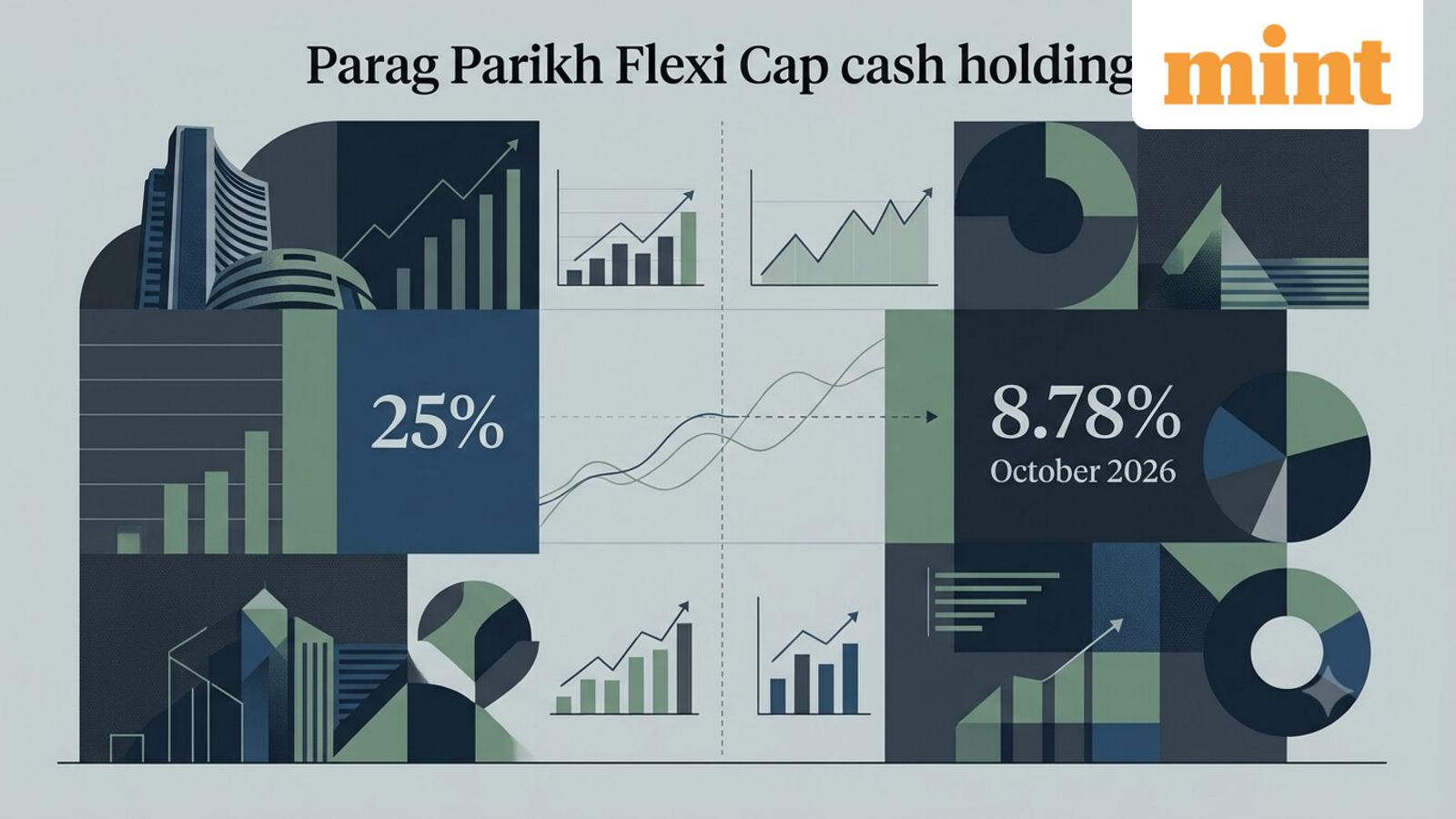
Parag Parikh Flexi Cap Fund cuts cash holding from 25% peak to 8.78% in Oct: Is it more attractive now? Experts weigh in
Parag Parikh Flexi Cap Fund, India’s largest actively managed equity mutual fund, had assets under management (AUM) of ₹1,46,785 crore as of October 2026. Over the past year, the fund has drawn attention for poor performance and maintaining relatively high cash holdings, which peaked at around 25%.
However, its latest monthly portfolio disclosure for October 2026 shows a sharp reduction in its cash allocation to 8.78% (including cash, debt & money market instruments and arbitrage positions).
The move follows comments made by Rajeev Thakkar, Chief Investment Officer – Equity and Director at PPFAS Mutual Fund, in his August 2026 investor letter. Addressing concerns about the fund’s performance and high cash allocation, Thakkar said cash holdings had declined from their peak of about 25% to 14–15% in the Flexi Cap Fund.
He added that the fund was increasingly finding investment opportunities and expected cash levels to move into single digits over time.
With its cash allocation down to 8.78%, the fund has deployed more of its available capital into equities, which accounted for 75.25% of its portfolio in October. But does this make the Parag Parikh Flexi Cap Fund more attractive to investors? Here’s what experts suggest.
What does the reduction in cash holding mean?
Vedant Gupte, Co-Founder and CEO of investment platform Trackk, said the reduction reflects greater deployment into equities rather than a directional call on cash. The reserve was not idle cash but was held in money-market instruments and arbitrage positions that generated returns. Over the past year, the fund has steadily moved this reserve into Indian equities.
“That largely answers the cash drag criticism, but it also removes the cushion that helped investors in past drawdowns. So the fund hasn’t become more or less attractive; it now carries closer to full equity risk,” he added.
“Everyone complained when Parag Parikh Flexi Cap sat on 25% cash. Now that it is down to 8.78%, the same people are asking if something has changed. Nothing has. The managers of this fund have never taken decisions based on the next quarter. They wait when prices don’t make sense and buy when they do. That is exactly what the last year shows,” CA Drupad Patel, Founder, Wealtheria, says.
Looking at October’s portfolio changes, the fund did not add any new Indian stocks. Instead, it increased its exposure to existing holdings, including DLF, Coal India, M&M, Indus Towers and Petronet LNG, while replacing Meta with Netflix in its overseas portfolio. This signals conviction in its existing stock picks rather than chasing new opportunities, he added.
How has the Parag Parikh Flexi Cap Fund performed?
According to Value Research data as of 12 November (Direct Plan):
- October return: 0.60%, after two consecutive months of negative returns (-1.38% and -2.14%).
- 1-year return: 0.74%, against over 16% delivered by the category’s top-performing fund.
- 3-year return: 13.47%, compared with 20.37% for the top-performing fund.
- 5-year return: 11.79%, versus 16.79% for the category leader.
Should you invest in the Parag Parikh Flexi Cap Fund?
Gupte said comparing a fund with the category’s top performer over one year is misleading, as the leader changes every year and cannot be identified in advance. He said the fund’s performance should instead be assessed against its benchmark, the Nifty 500 TRI, which it has beaten over one, three, five and ten years.
Its weaker absolute returns reflect a subdued market and a conservative, large-cap-heavy portfolio rather than a flawed investment process.
Patel advised existing investors to stay invested and continue their SIPs, as exiting now could mean missing a potential recovery. For fresh investments, he said the fund can remain a core flexi-cap holding through SIPs or staggered lump-sum investments, alongside a growth-oriented fund (such as a mid-cap or small-cap fund) for balance.
Disclaimer: This story is for educational purposes only. The views and recommendations made above are those of individual analysts or broking companies, and not of Mint. We advise investors to check with certified experts before making any investment decisions.
About the Author
Sheetal Goel is a Content Producer at Livemint, where she covers corporate developments, personal finance, business trends, markets, and SEBI-related updates. She focuses on simplifying complex financial concepts and presenting them in a clear, reader-friendly manner, thereby helping audiences better understand investment trends, personal finance, and market developments. Her writing focuses on making finance more accessible to everyday readers while maintaining clarity, accuracy, and relevance.
She holds a degree in Economics (Hons.) along with an MBA in Finance, which has helped her develop a strong foundation in financial analysis, market understanding, and business reporting. Before joining journalism, she worked with finance and broking firms, where she closely followed market developments, investment strategies, and evolving industry trends. This practical exposure strengthened her understanding of financial markets. She has also written content across multiple formats and platforms, including YouTube, LinkedIn, and Instagram.
Over time, she has developed expertise in covering market-linked stories, investor-focused topics, and regulatory updates in a simplified yet informative style. She also enjoys reading and listening to Hindi poetry, reflecting her appreciation for literature and creative expression beyond the world of markets and numbers.