Munis see losses, USTs sell off after hot CPI report
Processing Content
Municipals were weaker Tuesday, outperforming a U.S. Treasury selloff after a hotter-than-expected inflation print suggested the Federal Reserve will need to hike rates more aggressively. Equities ended down.
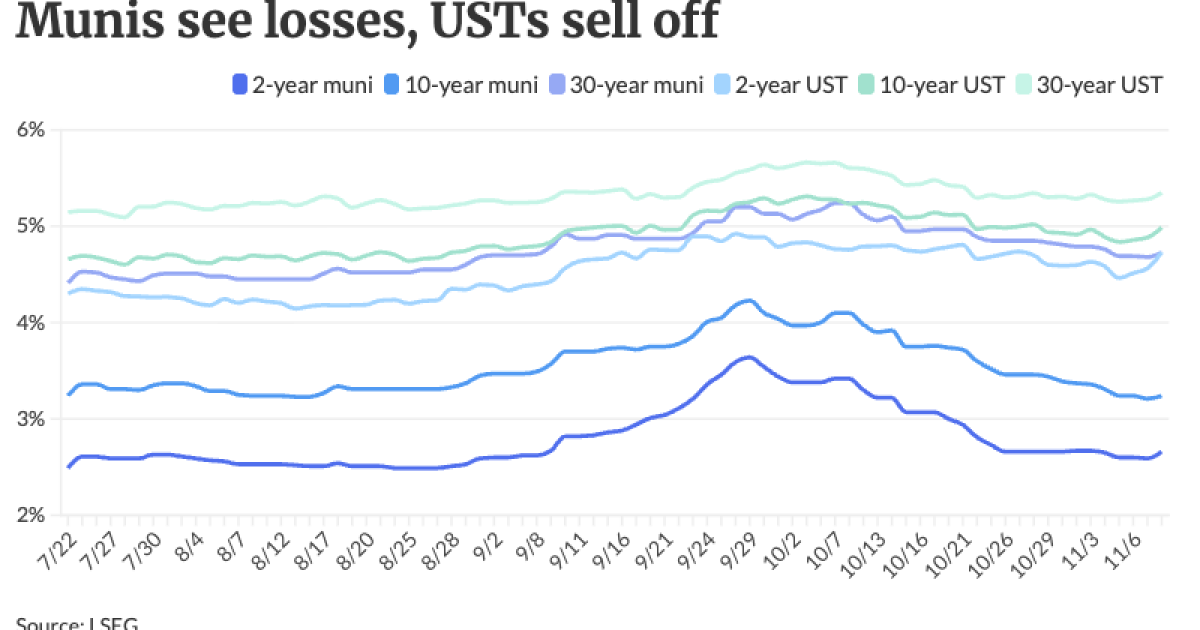
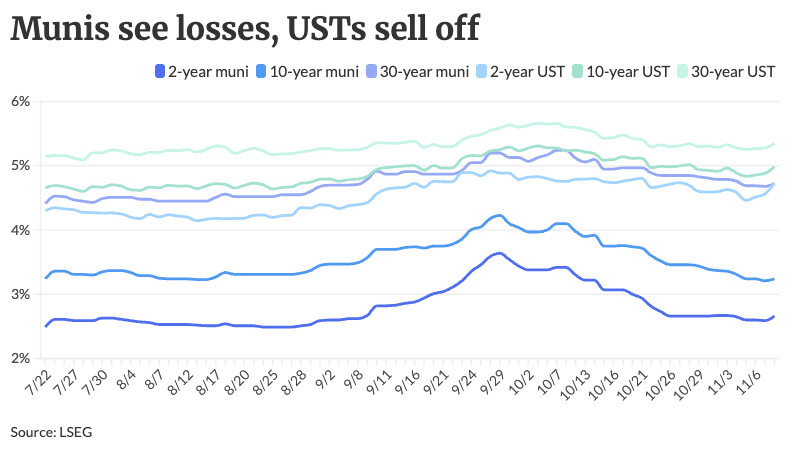
Muni yields were bumped one to seven basis points, depending on the scale. UST yields rose seven to 17 basis points, with the largest losses on the front end, at a 3:40 p.m. read.
The big news in the market Tuesday was the hot consumer producer index print and the shift to market thinking that now expects the Fed to hike more than previously expected. This led to a selloff in USTs, resulting in munis being up a little bit, said Cooper Howard, director of fixed income research and strategy at Charles Schwab.
The losses put a bit of a pause on the recent market strength, he said.
Over the past several weeks, munis have now fully recovered from the price losses during September’s sharp selloff, and 10-year AAA munis have fallen around 100 basis points from their late-September peak, Municipal Market Analytics said in a LinkedIn post.
Muni outperformance “has been supported by lighter primary issuance and the redeployment of proceeds generated by substantial tax-loss harvesting activity during September and October,” the firm said.
However, Tuesday’s hotter-than-expected CPI report “could challenge the recent streak of positive momentum, with front-end Treasury yields rising nearly 20 basis points and futures markets now fully pricing in a rate hike at the December [Federal Open Market Committee] meeting,” MMA said.
New-issue market
In the primary market Tuesday, BofA Securities priced for Massachusetts (Aa1/AA+/AA+/) $810.905 million of general obligation bonds. The first tranche, $700 million of GO consolidated loan of 2026 bonds, Series I, was priced with 5s of 12/2029 at 2.76%, 5s of 2031 at 2.93%, 5s of 2036 at 3.33%, 5s of 2041 at 3.83%, 5s of 2046 at 4.41% and 5s of 2051 at 4.70%, callable 12/2036.
The second tranche, $110.905 million of GO refunding bonds, 2026 Series D, priced with 5s of 12/2029 at 2.76%, 5s of 2031 at 2.93% and 5s of 2035 at 3.23%, noncall.
Morgan Stanley priced for Riviera Beach Utility Special District, Florida, $421.96 million of water and sewer revenue bonds. The first tranche, $346.515 million of Series 2026A-1 (/AA/A+/), saw 5s of 10/2029 at 2.95%, 5s of 2031 at 3.14%, 5s of 2036 at 3.54%, 5s of 2041 at 4.17%. 5.25s of 2046 at 4.68%, 5.5s of 2051 at 4.94% and 5.5s of 2056 at 5.08%, callable 10/2035.
The second tranche, $75.445 million of Series 2026A-2 (/A+/A+/), saw 3.625s of 10/2031 price at par, callable 10/2028.
In the competitive market, the Florida Department of Transportation (Aa2/AA/AA/) sold $310.405 million of turnpike revenue bonds, Series 2026C, to BofA Securities, with 5s of 7/2027 at 2.65%, 5s of 2031 at 2.91%, 5s of 2036 at 3.32%, 5s of 2041 at 3.96%. 5s of 2046 at 4.46%, 5s of 2051 at 4.77% and 5s of 2056 at 4.90%, callable 7/2036.
The Virginia Public School Authority (Aaa/AAA/AAA/) sold $220.175 million of special obligation school financing and refunding bonds to Barclays, with 5s of 10/2027 at 2.66%, 5s of 2031 at 2.91%, 5s of 2036 at 3.30%, 5s of 2041 at 3.81% and 5s of 2046 at 4.36%, callable 10/2034.
CPI
A hotter than expected consumer price index report and comments by Fed Gov. Christopher Waller have markets convinced of a 25-basis-point Fed rate hike in December, with the possibility of it being a half-point increase or an additional quarter-point move up in January.
“Bond yields are moving higher, with the 10-year Treasury yield approaching 5.0%, as investors reassess the outlook for Federal Reserve policy,” said Brian Therien, senior analyst at Edward Jones.
Waller said in a speech in London early Tuesday morning that he was open to a 50-basis-point move next month if the core CPI rose 0.3% or more in October.
The report “significantly boosted market rate-hike expectations,” said FHN Financial Chief Economist Chris Low. “Now, a hike in December is seen as 100% likely, with a 17% chance it will be 50 basis points. A second hike is fully priced in by March and a third hike by September is seen as a 66% probability.”
Gov. Lisa Cook and Cleveland Fed President Beth Hammack, who voted for a rate hike in October, “will likely back Waller” in pushing for a half-point hike, Low said. “The rest of the FOMC is expected to opt for a quarter-point, every-other-meeting pace. Hence, futures see the odds of a 50bp move as unlikely, but not entirely negligible.”
Seema Shah, chief global strategist at Principal Asset Management, called the release “a warning shot. A December hike now looks locked in, with the upside surprise extending well beyond energy and into both core goods and services. Coming just a week after the midterm elections exposed the depth of voters’ concerns about affordability, the message for the Fed is uncomfortable but clear: the inflation fight is not finished.”
But the size of the increase is not yet determined, she added. “An outsized move should require evidence that inflation is accelerating decisively, expectations are becoming unanchored or the economy is overheating. We are not there yet.”
Still, she concluded, “For now, however, the broader picture still favors a more cautious approach.”
Peter Graf, chief investment officer at Amova Asset Management Americas, said, “With less political pressure to toe the line on low rates after the midterm election, don’t be surprised to see FOMC members expressing regret about last month’s hold in rates and reminding the market that two more hikes may not be enough to complete the cycle.”
But the report might not be as bad as it seems, said Daniel Siluk, global head of short duration and liquidity and portfolio manager at Janus Henderson. “The details were perhaps a little less alarming than the headline surprise suggests,” he said. “Core services moderated slightly, with rent and owners’ equivalent rent inflation easing, while core goods inflation also slowed.”
Still the big picture “remains uncomfortable: there was no single outsized component responsible for the surprise, inflation pressures remain relatively broad, and the three-month annualized pace of core inflation has now accelerated to around 3.7%,” Siluk said.