ARMs hit record 17% of locks: Pitch beyond the 30-year
- What’s at Stake: Homebuyers seeking immediate affordability relief who risk facing severe sticker shock.
- Expert Quote: “October’s data show how much affordability is shaping the purchase market.” — Brennan O’Connell, Director of Data Solutions, Optimal Blue
Overview bullets generated by AI with editorial review.
A growing share of borrowers flocked to adjustable-rate mortgages in October, providing clues about where business may lie as well as the impact that the current economic environment is having on consumer behavior.
The share of adjustable-rate mortgage locks last month hit 17%, the highest since the data was first tracked in 2019, according to Optimal Blue’s Market Advantage Report. The ARM portion of locks rose from 14% one month earlier.
Processing Content
The new high mark came at the same time total rate-lock volume
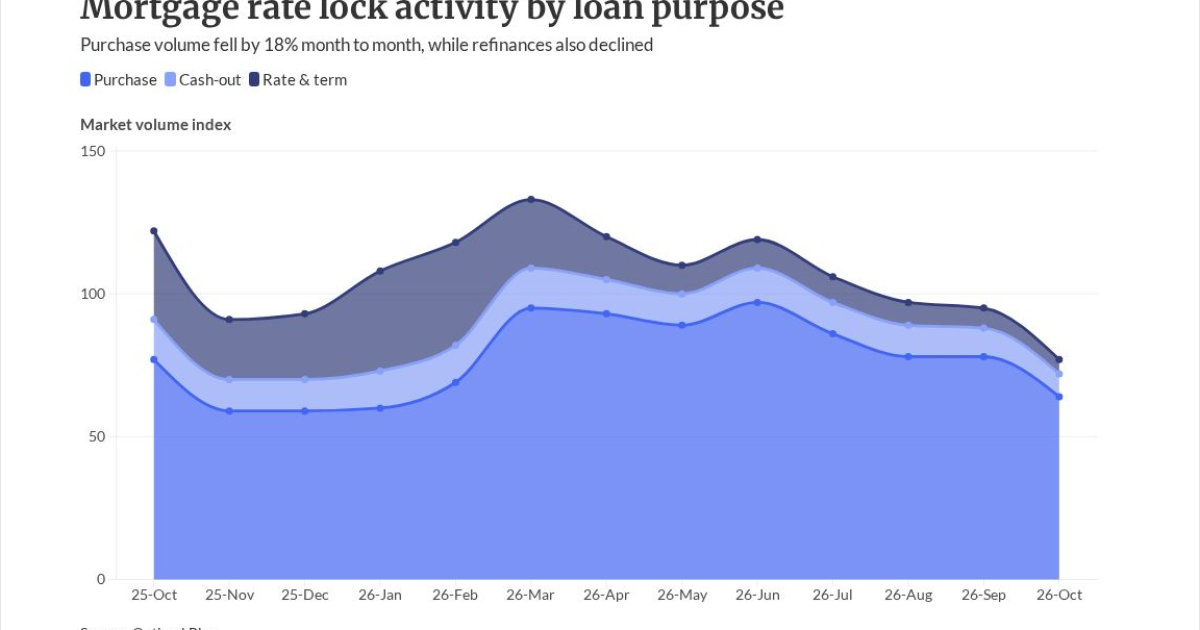
Purchase lock volume decreased to an 84% share, relative to total activity, with demand slipping 18% and 17% from the prior month and year. The downward pressure across loan types led Optimal Blue’s market volume index to plummet to a reading of 77 compared to 94 in September.
“October’s data show how much affordability is shaping the purchase market,” said Brennan O’Connell, director of data solutions at Optimal Blue, in a press release.
In other data showing the momentum currently boosting ARMs, the Mortgage Bankers Association reported lenders expanded availability of such financing for borrowers, especially those with lower loan-to-value ratios compared with recent history. The offerings helped push MBA’s Mortgage Credit Availability Index higher for the first time in three months.
The trends suggest that opportunities in today’s subdued housing market exist outside the standard fixed-rate loan as long as originators can work with borrowers to find solutions that fit individual needs. ARM
“For lenders, that means the opportunity is increasingly in helping borrowers find the product and payment structure that works for their circumstances,” O’Connell said.
Supporting its findings, Optimal Blue pointed out Federal Housing Administration-backed loans also accounted for an expanding percentage of mortgage locks, and first-time homebuyers grew in the agency market.
The FHA segment made up 20% of locks, while Department of Veterans Affairs-backed mortgages took an 11% share, both up from September. Meanwhile, conforming loans made up 46% of all October locks, while non-conforming transactions accounted for 22%, both declining from the prior month.
First-time buyers nabbed 45% of conforming purchase locks, climbing from both the previous month and year.
Non-qualified mortgages, which are also experiencing heightened demand this year, made up 12% of October loan production, edging down from September but up by 195 basis points over the past three months and 420 basis points year over year. Non-QM lock volume split in close-to-equivalent shares between debt service coverage ratio, bank-statement and expanded guideline programs.
Mortgage lenders see expanded credit availability
The MBA’s credit index increased 0.4% between September and October to a reading of 107.5, in part due to elevated ARM interest, with higher marks indicative of a greater number of products. In September, the MCAI settled at a score of 107.1, with a benchmark of 100 representing credit availability in March 2012, following the Great Recession.
Unlike Optimal Blue’s findings, though, government-product availability flattened, while conventional offerings grew, MBA reported.
The uptick in ARM loans with lower LTV ratios included cash-out refinancing products, according to the trade association.
“This also boosted the jumbo index, which was up to its highest level in three months,” said Joel Kan, MBA vice president and deputy chief economist.
The conventional MCAI increased 0.6%, while the government index grew by just 0.1%. Subindices within the conventional component showed jumbo offerings up 0.8% month to month and conforming credit unchanged.
Look out for ARM regret
Although lenders will appreciate the activity boosting their bottom line, recent history suggests consumers may want to approach them with caution. Research conducted in 2024 found approximately 70% of ARM borrowers