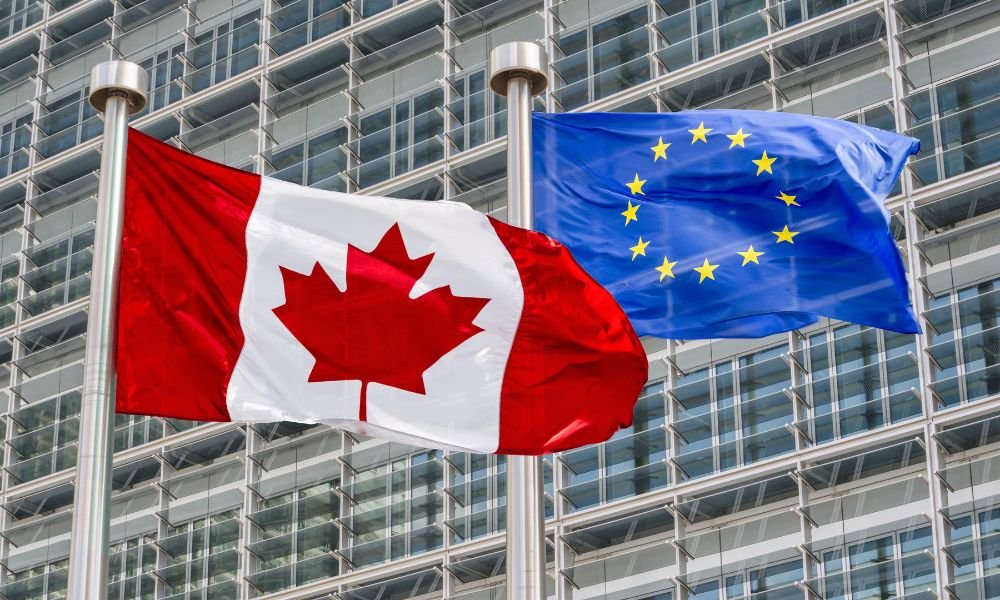
Canada-EU alliance signals a shift in portfolio diversification strategy
TD economists Vikram Rai and Rishi Sondhi identified the largest long-term opportunity sectors. These include defence, energy, critical minerals, digital markets, and financial services.
Canada currently accounts for roughly one percent of EU goods and services imports, per the TD report. The EU takes around five to six percent of Canada’s international merchandise exports — a share similar to the United Kingdom and China combined.
A closer EU relationship would expand the investment protection framework under the Canada-EU Comprehensive Economic and Trade Agreement (CETA). That could improve access and certainty for clients with European equity, fixed income, and infrastructure exposure.
CETA has been in provisional application since 2017 but remains unratified by ten of 27 EU member states. Mark Manger, a professor at the Munk School of Global Affairs and Public Policy at the University of Toronto, cautioned that realising the potential would take time. “Canada and the EU both are now in this position where the most important ally they relied upon is suddenly not behaving like an ally anymore,” he told Reuters on October 29, 2026.
The longer road ahead
Advisors should treat Montréal as a directional signal rather than an immediate market event. The EU’s Carbon Border Adjustment Mechanism (CBAM) — an import tariff on carbon-intensive goods — remains unresolved. It poses a risk to Canadian steel and aluminium exporters already under US tariff pressure.