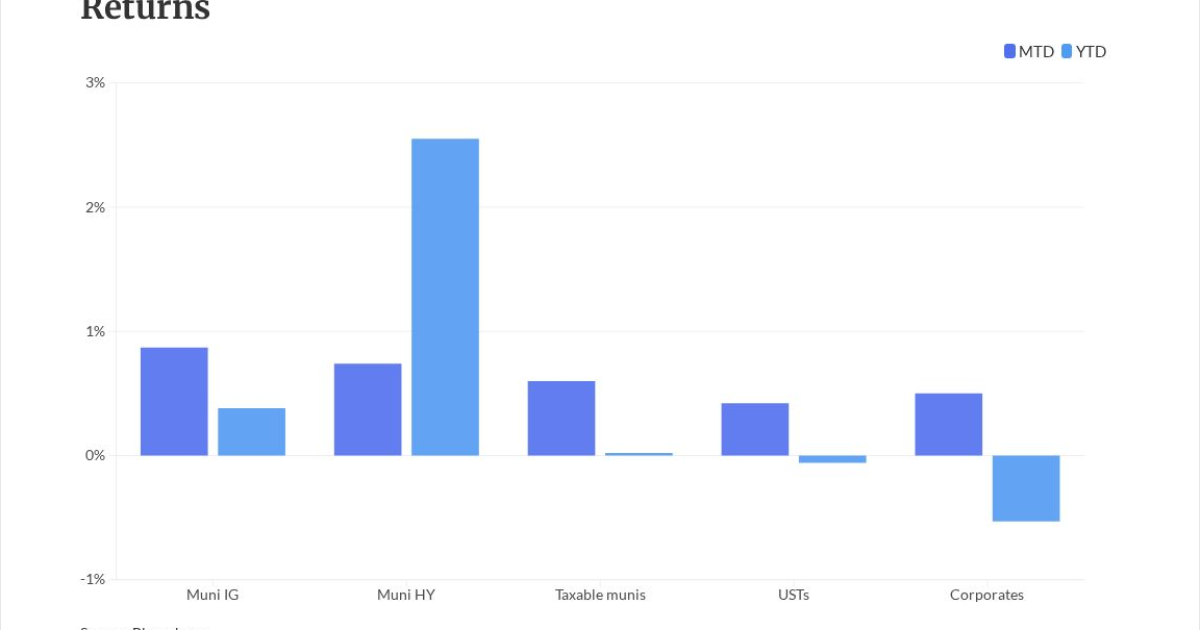
Munis extend strength, new-issue calendar falls below $5B
Municipals firmed as short-term U.S. Treasuries saw losses and equities were mixed.
Processing Content
Muni yields were bumped up to six basis points, depending on the scale, as U.S. Treasury yields rose up to five basis points, with the largest losses on the front end, at a 3:30 read.
With the election overhang finally removed and the gridlock outcome supportive for munis, Barclays strategists expect munis to continue performing well through yearend.
“Supply is running at a somewhat higher pace than last year, but we think it should remain quite manageable over the next two months; as a result, most deals coming to market continue to be heavily oversubscribed,” Barclays strategists said.
Tax swapping — though it still may remain popular — may slow slightly, leading to a modest decline in trading volume, they said.
Primary to come
Issuance is an estimated $4.807 billion for the week of Nov. 9, with $3.673 billion of negotiated deals on tap and $1.133 billion of competitives, according to LSEG.
Massachusetts leads the negotiated calendar with $762.825 million of general obligation bonds.
The competitive calendar is led by the Virginia Public School Authority with $220.175 million of special obligation school financing and refunding bonds.
Jobs report
The U.S. economy added 165,000 jobs in October, exceeding expectations.
“Under normal circumstances, an unexpectedly strong jobs report would crush Treasuries and lift rate hike expectations,” said Brad Conger, chief investment officer at Hirtle & Co. “Given the rout in the AI capex sectors over the past couple weeks, however, all data points will be considered extremely ‘backward looking’. All eyes are, rightly, on the SOX and Anthropic IPO.”
“The resilience evident in [Friday’s] jobs report is particularly reassuring after [Thursday’s] sharp tech-led sell-off,” said Seema Shah, chief global strategist at Principal Asset Management. “It reinforces the distinction between a market correction and an economic downturn: an AI-led market correction does not have to translate into a broader deterioration in economic fundamentals. Strong fundamentals may not prevent further bouts of volatility, but they should ultimately provide an anchor for markets and help steady sentiment even as investors continue to grapple with concerns around AI and tech.”
Jeff Schulze, head investment strategist at Franklin Templeton Institute, said, “October’s jobs report was hot and puts renewed pressure on the Fed to hike in December after post-midterm fears that a slower AI buildout cooled hike expectations.”
“This is an interesting situation for fixed-income investors, as the reality is that the direction of rates is clearly higher both at the front end and likely further out the yield curve as well. That will create significant volatility for longer duration assets,” said Larry Holzenthaler, senior portfolio manager of the Catalyst Insider Income Fund (IIXAX) at Catalyst Funds.
But not everyone is on board with a rate hike.
“The Fed will be reassured by the October jobs report. But if the AI sell-off deepens, they could still refrain from a rate hike at their last decision of the year,” said